Identify the electrophile and the nucleophile in each of the following reaction steps and then draw curved arrows to illustrate the bond-making and bondbreaking processes. c.
Verified step by step guidance
1
Step 1: Identify the electrophile and nucleophile in the reaction. The electrophile is BH₃ (borane) because it has an empty p-orbital and can accept electrons. The nucleophile is CH₃CH=CH₂ (propene) because the π-electrons in the double bond can donate electrons.
Step 2: Analyze the bond-making and bond-breaking process. The π-electrons from the double bond in propene attack the boron atom in BH₃, forming a new bond between the boron and one of the carbon atoms in the double bond.
Step 3: Draw curved arrows to represent the electron movement. One curved arrow should originate from the π-electrons of the double bond and point toward the boron atom in BH₃, indicating the formation of the new bond.
Step 4: Note the regioselectivity of the reaction. In hydroboration, the boron atom typically attaches to the less substituted carbon of the double bond due to steric and electronic factors.
Step 5: The product of the reaction is CH₃CH₂CH₂BH₂, where the double bond is broken, and a single bond is formed between boron and the less substituted carbon atom. Ensure the curved arrows accurately depict the electron flow leading to this product.
Verified video answer for a similar problem:
This video solution was recommended by our tutors as helpful for the problem above
Video duration:
5m
Play a video:
0 Comments
Key Concepts
Here are the essential concepts you must grasp in order to answer the question correctly.
Electrophiles
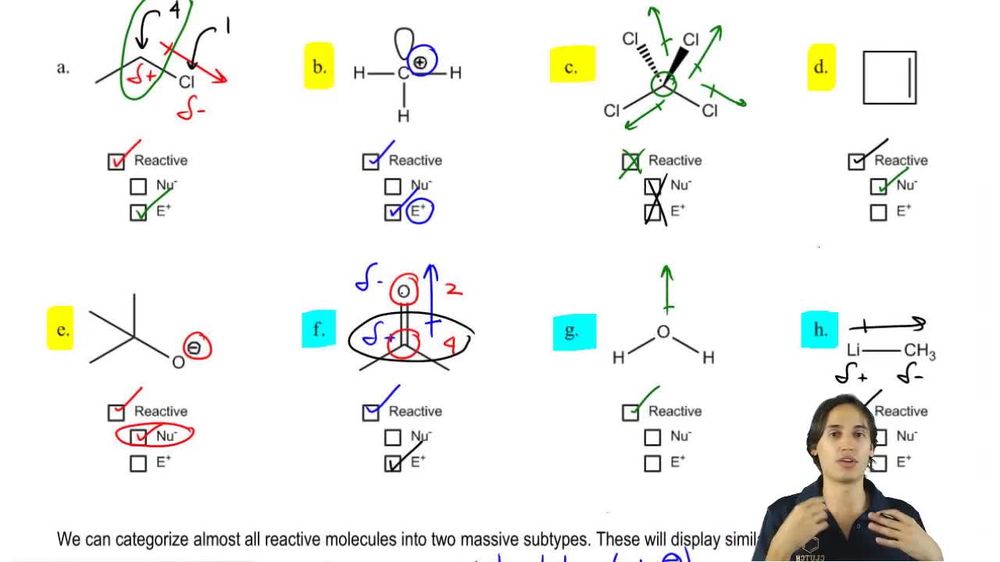
Electrophiles are species that accept electrons during a chemical reaction. They are typically positively charged or neutral molecules with an electron-deficient atom, making them attractive to nucleophiles. In the given reaction, borane (BH3) acts as the electrophile, as it can accept a pair of electrons from the alkene.
Nucleophiles are electron-rich species that donate a pair of electrons to form a chemical bond. They are usually negatively charged or neutral molecules with a lone pair of electrons. In this reaction, the alkene (CH3CH=CH2) serves as the nucleophile, providing electrons to bond with the electrophile, borane.
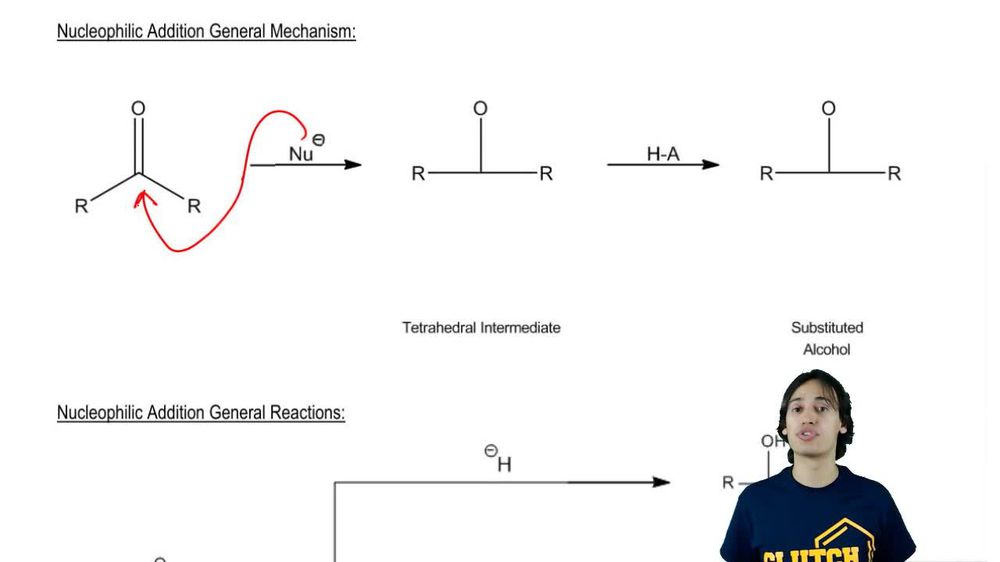
Curved arrows are used in organic chemistry to illustrate the movement of electrons during chemical reactions. The tail of the arrow indicates the electron source (where the electrons are coming from), while the head points to the electron destination (where the electrons are going). In this reaction, curved arrows would show the electron donation from the alkene to borane, indicating bond formation and breaking.