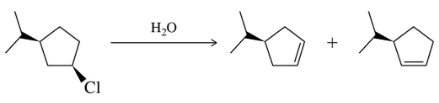
Show a mechanism for the following elimination reactions. Label the mechanism as E1 or E2. (c)
Verified step by step guidance
1
Step 1: Analyze the reaction conditions. The presence of H₂O (a polar protic solvent) suggests that the reaction likely proceeds via an E1 mechanism, as polar protic solvents stabilize carbocations formed during the reaction.
Step 2: Identify the leaving group. In the given structure, the chlorine atom (Cl) is the leaving group. It will depart first, forming a carbocation intermediate.
Step 3: Formation of the carbocation. The chlorine atom leaves, generating a tertiary carbocation at the carbon where Cl was attached. Tertiary carbocations are highly stable due to hyperconjugation and inductive effects.
Step 4: Proton elimination to form the double bond. A base (likely H₂O or another molecule in the solution) abstracts a proton (H⁺) from a β-carbon adjacent to the carbocation. This leads to the formation of a double bond, resulting in the alkene product. Depending on which β-hydrogen is removed, two different alkenes can form (major and minor products).
Step 5: Consider regioselectivity. The major product is determined by Zaitsev's rule, which states that the more substituted alkene is favored. In this case, the double bond forms preferentially in the more substituted position, leading to the major product. The less substituted alkene is the minor product.
Verified video answer for a similar problem:
This video solution was recommended by our tutors as helpful for the problem above
Video duration:
5m
Play a video:
0 Comments
Key Concepts
Here are the essential concepts you must grasp in order to answer the question correctly.
Elimination Reactions
Elimination reactions involve the removal of a small molecule from a larger one, resulting in the formation of a double bond. In organic chemistry, these reactions are typically classified as E1 or E2, depending on the mechanism. E1 reactions are unimolecular and proceed through a carbocation intermediate, while E2 reactions are bimolecular and involve a concerted mechanism where the bond-breaking and bond-forming occur simultaneously.
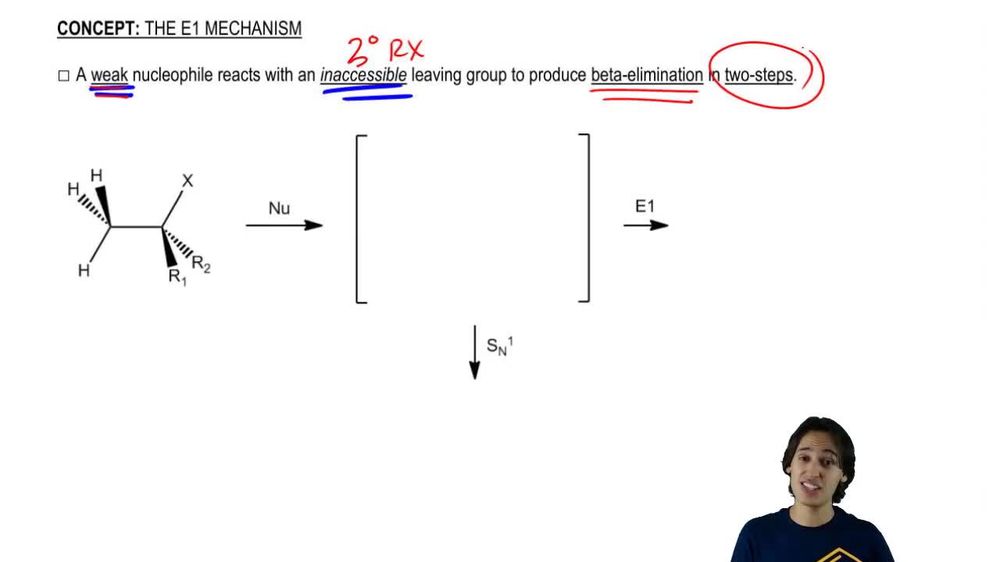
The E1 mechanism is characterized by a two-step process where the leaving group departs first, forming a carbocation intermediate. This step is rate-determining and can lead to rearrangements if a more stable carbocation can form. The second step involves the deprotonation of a neighboring carbon to form a double bond, resulting in the final alkene product. E1 reactions are favored in polar protic solvents and with tertiary substrates.
The E2 mechanism is a one-step process where the base abstracts a proton while the leaving group departs simultaneously, resulting in the formation of a double bond. This concerted mechanism requires a strong base and is stereospecific, often leading to the formation of the more stable alkene product. E2 reactions are favored with strong bases and typically occur with secondary or tertiary substrates, especially in polar aprotic solvents.