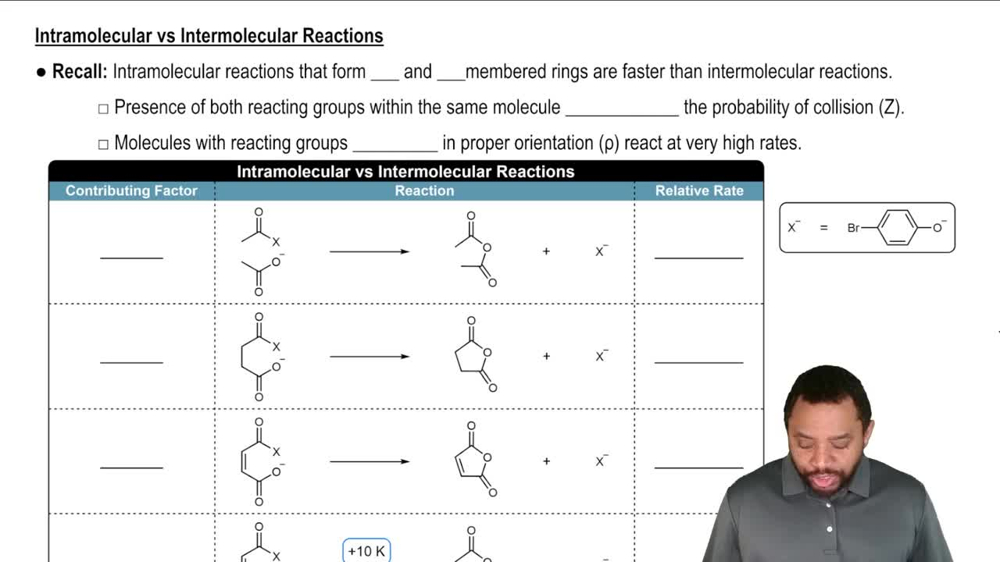
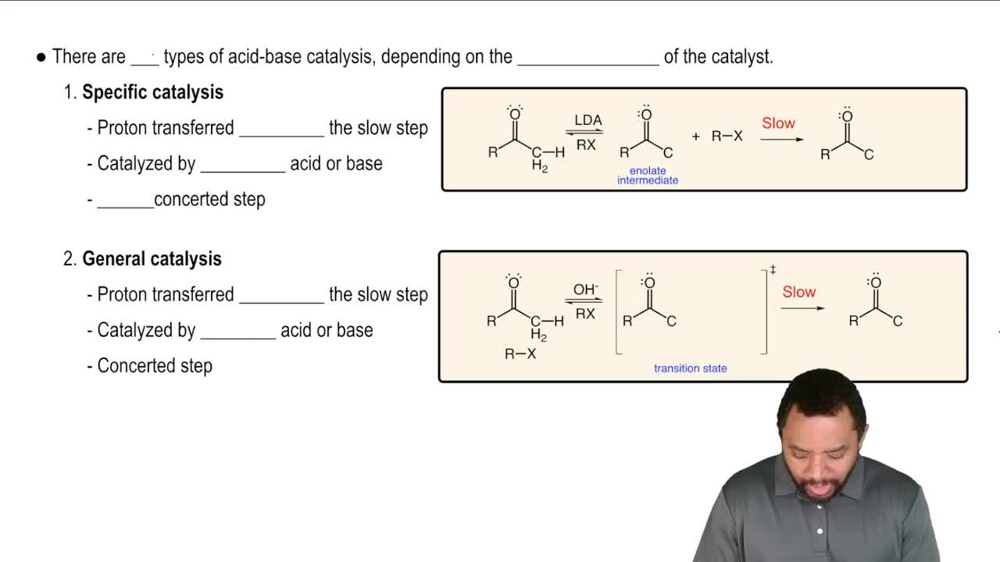
Indicate the type of catalysis that is occurring in the slow step in each of the following reaction sequences: b.
Verified step by step guidance
1
Step 1: Analyze the reaction sequence provided in the image. The slow step involves the cleavage of the ester bond in the molecule, resulting in the formation of two products: a carboxylic acid and a phenol.
Step 2: Identify the type of catalysis occurring in the slow step. The presence of hydroxyl groups (OH) and the protonated intermediate suggests that acid catalysis is involved. Acid catalysis typically facilitates bond cleavage by protonating the ester oxygen, making it more electrophilic and susceptible to nucleophilic attack.
Step 3: Recognize the role of the catalyst in the reaction. In acid catalysis, the acid donates a proton to stabilize the transition state and lower the activation energy of the reaction, thereby accelerating the bond cleavage process.
Step 4: Observe the intermediate formed during the slow step. The protonated carboxylic acid intermediate indicates that the reaction mechanism involves proton transfer, which is characteristic of acid catalysis.
Step 5: Conclude that the slow step in this reaction sequence is an example of acid catalysis, as the reaction mechanism relies on protonation to facilitate the cleavage of the ester bond.
Verified video answer for a similar problem:
This video solution was recommended by our tutors as helpful for the problem above
Video duration:
6m
Play a video:
0 Comments
Key Concepts
Here are the essential concepts you must grasp in order to answer the question correctly.
Catalysis
Catalysis refers to the process of increasing the rate of a chemical reaction by adding a substance known as a catalyst. Catalysts work by providing an alternative reaction pathway with a lower activation energy, allowing the reaction to proceed more quickly. In organic chemistry, catalysts can be either homogeneous (in the same phase as the reactants) or heterogeneous (in a different phase). Understanding the type of catalysis involved is crucial for analyzing reaction mechanisms.
The rate-determining step (RDS) is the slowest step in a reaction mechanism that determines the overall rate of the reaction. It is crucial to identify the RDS because it often involves the highest energy transition state and dictates the kinetics of the entire reaction sequence. In the context of the provided reaction, recognizing which step is slow helps in understanding the type of catalysis and the factors influencing the reaction rate.
Acid-base catalysis involves the acceleration of a reaction through the transfer of protons (H+) or the acceptance of protons by a base. In organic reactions, this can involve the protonation of a reactant to make it more reactive or the deprotonation of a product to stabilize it. The presence of hydroxyl groups in the reaction sequence suggests that acid-base catalysis may be occurring, particularly in the slow step, where proton transfers can significantly influence the reaction pathway.

 6:56 minutes
 Verified step by step guidance
 2:31
2:31