Triethyloxonium tetrafluoroborate, (CH3CH2)3O+ BF4–, is a solid with melting point 91–92°C. Show how this reagent can transfer an ethyl group to a nucleophile (Nuc:−) in an SN2 reaction. What is the leaving group? Why might this reagent be preferred to using an ethyl halide? (Consult Table 6-2)
Verified step by step guidance
1
Step 1: Understand the role of triethyloxonium tetrafluoroborate ((CH3CH2)3O+ BF4-) in the reaction. This compound acts as an ethylating agent, capable of transferring an ethyl group to a nucleophile (Nuc:−) via an SN2 mechanism. The positively charged oxonium ion ((CH3CH2)3O+) is highly electrophilic, making it susceptible to nucleophilic attack.
Step 2: Analyze the SN2 reaction mechanism. In an SN2 reaction, the nucleophile (Nuc:−) attacks the electrophilic carbon in the ethyl group of the oxonium ion. This attack occurs in a single step, where the bond between the ethyl group and the oxygen is broken simultaneously as the nucleophile forms a new bond with the ethyl group.
Step 3: Identify the leaving group. In this reaction, the leaving group is diethyl ether ((CH3CH2)2O), which is formed when the nucleophile displaces one ethyl group from the oxonium ion. Diethyl ether is a neutral and stable molecule, making it an excellent leaving group.
Step 4: Compare triethyloxonium tetrafluoroborate to ethyl halides. Ethyl halides, such as ethyl bromide (CH3CH2Br), are commonly used for ethylation reactions. However, triethyloxonium tetrafluoroborate is preferred because it avoids the use of halides, which can be toxic or environmentally harmful. Additionally, the oxonium ion is more reactive, allowing for faster and cleaner ethylation reactions.
Step 5: Consider the physical properties of triethyloxonium tetrafluoroborate. Unlike ethyl halides, which are often volatile liquids, triethyloxonium tetrafluoroborate is a solid with a melting point of 91–92 °C. This makes it easier to handle and store, reducing risks associated with volatility and flammability.
Verified video answer for a similar problem:
This video solution was recommended by our tutors as helpful for the problem above
Video duration:
6m
Play a video:
0 Comments
Key Concepts
Here are the essential concepts you must grasp in order to answer the question correctly.
S<sub>N</sub>2 Reaction Mechanism
The S<sub>N</sub>2 (substitution nucleophilic bimolecular) reaction is a fundamental mechanism in organic chemistry where a nucleophile attacks an electrophile, resulting in the substitution of a leaving group. This reaction occurs in a single concerted step, meaning that bond formation and bond breaking happen simultaneously. The reaction rate depends on the concentration of both the nucleophile and the substrate, making it a bimolecular process.
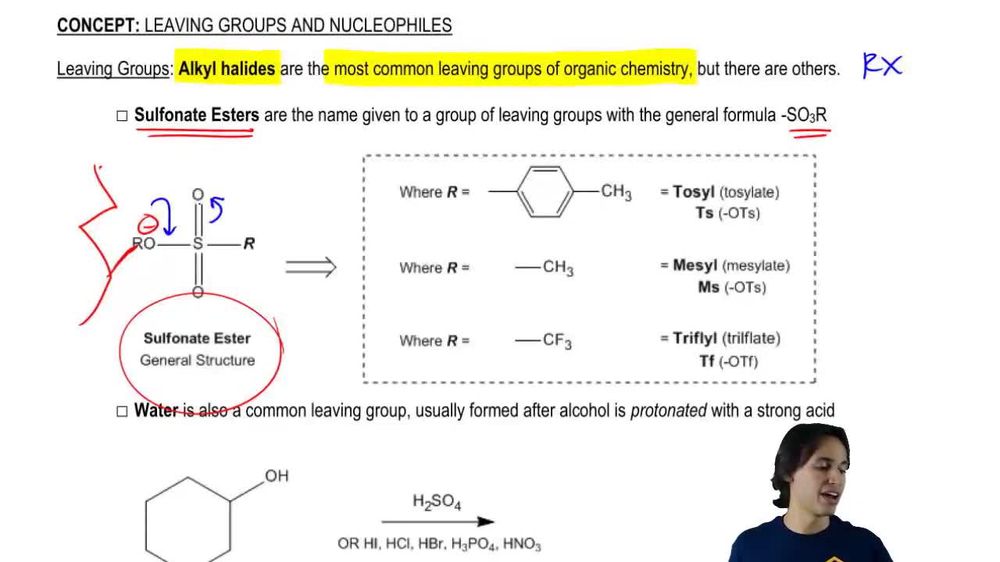
In nucleophilic substitution reactions, the leaving group is the atom or group that departs with a pair of electrons, allowing the nucleophile to bond with the substrate. A good leaving group is typically stable after departure, such as halides (e.g., Cl<sup>-</sup>, Br<sup>-</sup>, I<sup>-</sup>) or other groups like water. In the case of triethyloxonium tetrafluoroborate, the leaving group is the tetrafluoroborate ion (BF<sub>4</sub><sup>-</sup>), which is stable and facilitates the transfer of the ethyl group.
Using triethyloxonium tetrafluoroborate as a reagent for ethyl group transfer offers several advantages over traditional ethyl halides. It provides a more stable and less reactive source of the ethyl group, reducing side reactions and improving selectivity. Additionally, the tetrafluoroborate ion is a non-nucleophilic leaving group, which minimizes unwanted reactions that can occur with more reactive leaving groups found in alkyl halides.

 6:16 minutes
 Verified step by step guidance
 02:16
02:16