Consider the reaction of 1-bromobutane with a large excess of ammonia (NH3). Draw the reactants, the transition state, and the products. Note that the initial product is the salt of an amine (RNH3+Br−), which is deprotonated by the excess ammonia to give the amine.
Verified step by step guidance
1
Step 1: Identify the type of reaction. This is a nucleophilic substitution reaction (SN2 mechanism) where ammonia (NH3) acts as the nucleophile and 1-bromobutane (CH3CH2CH2CH2Br) is the substrate. The bromine atom is the leaving group.
Step 2: Draw the reactants. Represent 1-bromobutane as CH3CH2CH2CH2Br and ammonia as NH3. Show the lone pair of electrons on the nitrogen atom in NH3, which will attack the carbon atom bonded to the bromine.
Step 3: Illustrate the transition state. In the SN2 mechanism, the nucleophile (NH3) attacks the electrophilic carbon atom from the opposite side of the leaving group (Br−). Draw a pentavalent carbon in the transition state with partial bonds to both the nucleophile (NH3) and the leaving group (Br−). Use dashed lines to represent these partial bonds.
Step 4: Draw the initial product. After the bromine leaves, the nitrogen from NH3 is bonded to the carbon chain, forming CH3CH2CH2CH2NH3+. This is the ammonium salt (RNH3+ Br−), where R = CH3CH2CH2CH2.
Step 5: Show the deprotonation step. The excess ammonia (NH3) acts as a base and removes a proton (H+) from CH3CH2CH2CH2NH3+, resulting in the formation of the neutral amine (CH3CH2CH2CH2NH2) and ammonium bromide (NH4+ Br−).
Verified video answer for a similar problem:
This video solution was recommended by our tutors as helpful for the problem above
Video duration:
10m
Play a video:
0 Comments
Key Concepts
Here are the essential concepts you must grasp in order to answer the question correctly.
Nucleophilic Substitution
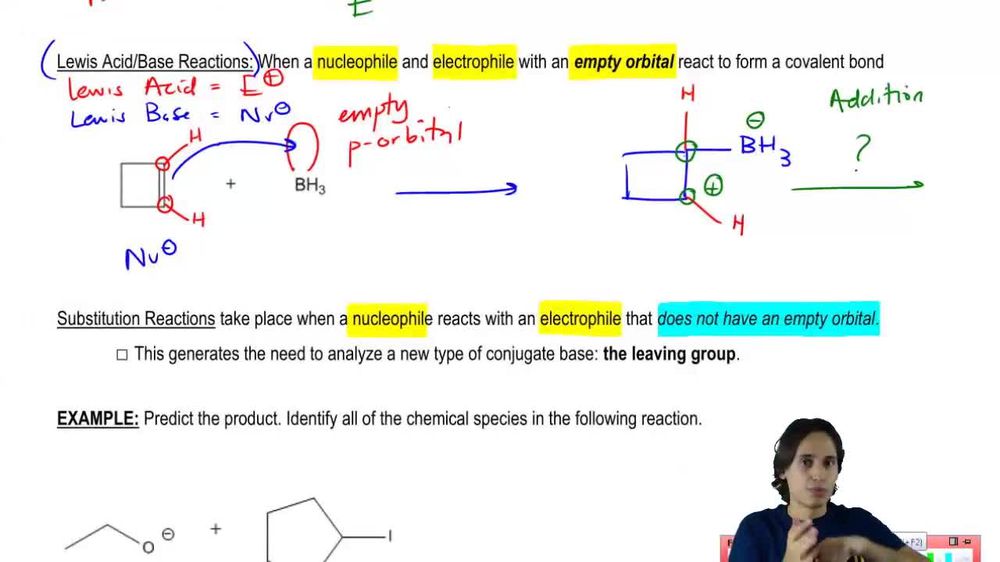
Nucleophilic substitution is a fundamental reaction in organic chemistry where a nucleophile attacks an electrophile, resulting in the replacement of a leaving group. In the case of 1-bromobutane reacting with ammonia, the ammonia acts as a nucleophile, attacking the carbon atom bonded to the bromine, leading to the formation of an amine.
Nucleophiles and Electrophiles can react in Substitution Reactions.
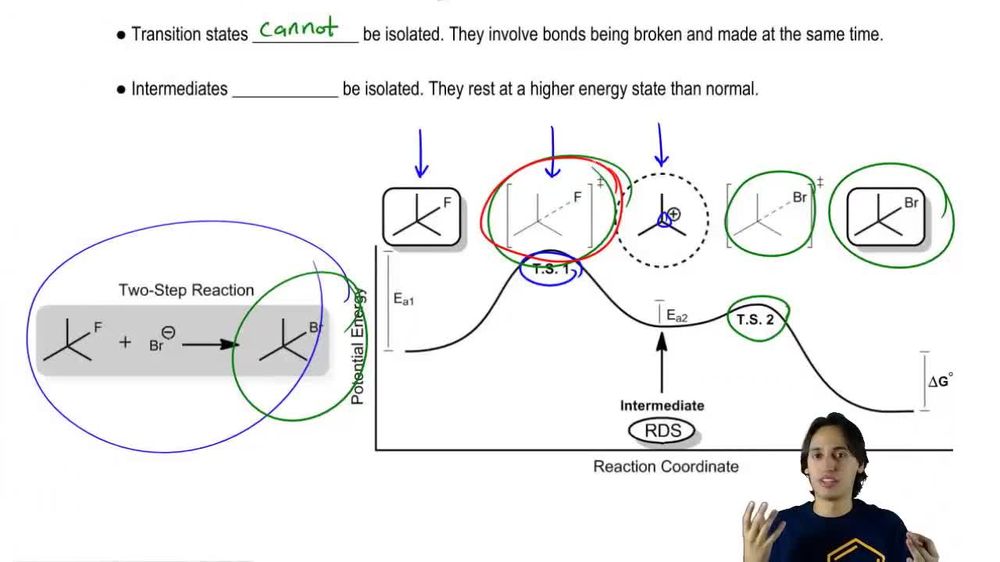
Transition State
The transition state is a high-energy, unstable arrangement of atoms that occurs during a chemical reaction. It represents the point at which reactants are transformed into products. In this reaction, the transition state would involve the partial bond formation between the nitrogen of ammonia and the carbon of 1-bromobutane, as well as the partial bond breaking of the C-Br bond.
Deprotonation is the removal of a proton (H+) from a molecule, resulting in the formation of a base. In this reaction, after the initial product (RNH3+ Br−) is formed, the excess ammonia deprotonates the ammonium salt to yield the neutral amine. This step is crucial for obtaining the final product and illustrates the role of ammonia as both a nucleophile and a base.

 10:08 minutes
 Verified step by step guidance
 01:47
01:47