Show how you might synthesize the following compounds starting with bromobenzene, and alkyl or alkenyl halides of four carbon atoms or fewer. c. dec-5-ene
Verified step by step guidance
1
Step 1: Begin with bromobenzene as the starting material. Perform a Grignard reaction by reacting bromobenzene with magnesium (Mg) in dry ether to form phenylmagnesium bromide (a Grignard reagent). This will allow the phenyl group to act as a nucleophile in subsequent steps.
Step 2: To introduce the alkyl chain, react phenylmagnesium bromide with 1-bromobutane (an alkyl halide with four carbon atoms). This reaction will result in the formation of butylbenzene through a nucleophilic substitution mechanism.
Step 3: Perform a Friedel-Crafts alkylation on butylbenzene to extend the carbon chain. Use an alkyl halide such as 1-bromo-2-butene (a four-carbon alkenyl halide) in the presence of a Lewis acid catalyst like AlCl₃. This will introduce a double bond and form a longer alkyl chain attached to the benzene ring.
Step 4: Hydrogenate the benzene ring selectively to remove aromaticity and form a cyclohexane derivative. Use a catalyst such as Pd/C under hydrogen gas (H₂) to achieve this transformation.
Step 5: Perform a dehydrohalogenation reaction to form dec-5-ene. Use a strong base such as KOH or NaOH in an alcohol solvent to eliminate a halogen atom and form the desired alkene structure.
Verified video answer for a similar problem:
This video solution was recommended by our tutors as helpful for the problem above
Video duration:
5m
Play a video:
0 Comments
Key Concepts
Here are the essential concepts you must grasp in order to answer the question correctly.
Electrophilic Aromatic Substitution
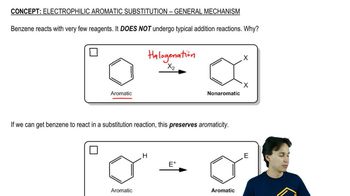
Electrophilic aromatic substitution (EAS) is a fundamental reaction in organic chemistry where an electrophile replaces a hydrogen atom on an aromatic ring. In the context of synthesizing compounds from bromobenzene, understanding EAS is crucial as it allows for the introduction of various substituents onto the benzene ring, which can then be further manipulated to create desired products like dec-5-ene.
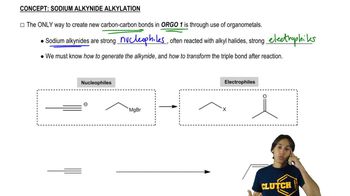
Alkylation reactions involve the introduction of an alkyl group into a molecule, often through nucleophilic substitution or EAS. When synthesizing dec-5-ene, alkyl halides can be used to add carbon chains to the aromatic system or to create alkenes. Recognizing how to effectively use alkyl halides in these reactions is essential for constructing the target compound.
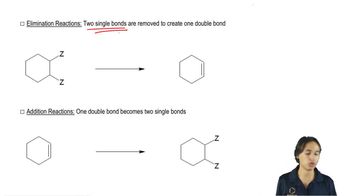
Elimination reactions are processes where two atoms or groups are removed from a molecule, resulting in the formation of a double bond. In the synthesis of dec-5-ene, elimination reactions can be employed after alkylation to generate the alkene from a saturated precursor. Understanding the conditions and mechanisms of elimination is vital for achieving the desired unsaturation in the final product.