

A student was studying terpene synthesis, and she wanted to make the compound shown here. First she converted 3-bromo-6-methylcyclohexene to alcohol A. She heated alcohol A with sulfuric acid and purified one of the components (compound B) from the resulting mixture. Compound B has the correct molecular formula for the desired product. a. Suggest how 3-bromo-6-methylcyclohexene might be converted to alcohol A.
Verified step by step guidance
1
Step 1: Analyze the structure of 3-bromo-6-methylcyclohexene. The bromine atom is attached to the cyclohexene ring, and the methyl group is at position 6. To convert this compound to alcohol A, the bromine atom must be replaced with a hydroxyl group (-OH). This suggests a nucleophilic substitution reaction.
Step 2: Choose an appropriate reagent for nucleophilic substitution. A common method to replace a bromine atom with a hydroxyl group is to use aqueous sodium hydroxide (NaOH) or potassium hydroxide (KOH) under heating conditions. This reaction proceeds via an SN2 or SN1 mechanism depending on the reaction conditions and the structure of the substrate.
Step 3: Consider the reaction mechanism. In this case, the cyclohexene ring is allylic, which stabilizes a carbocation intermediate. Therefore, the reaction is likely to proceed via an SN1 mechanism. The bromine atom leaves, forming a carbocation intermediate, which is then attacked by the hydroxide ion to form alcohol A.
Step 4: Verify the structure of alcohol A. The product should have the hydroxyl group (-OH) attached to the same carbon where the bromine atom was originally located. The structure of alcohol A matches this description, with the hydroxyl group replacing the bromine atom.
Step 5: Ensure reaction conditions are suitable. The reaction should be carried out in a polar protic solvent (e.g., water or ethanol) to stabilize the carbocation intermediate and facilitate the nucleophilic attack by hydroxide ions.
Verified video answer for a similar problem:
This video solution was recommended by our tutors as helpful for the problem above
Video duration:
3m
Play a video:
0 Comments
Key Concepts
Here are the essential concepts you must grasp in order to answer the question correctly.
Nucleophilic Substitution
Nucleophilic substitution is a fundamental reaction in organic chemistry where a nucleophile attacks an electrophilic carbon atom, replacing a leaving group. In the case of converting 3-bromo-6-methylcyclohexene to alcohol A, a nucleophile, such as hydroxide ion (OH-), can displace the bromine atom, resulting in the formation of an alcohol. This reaction is crucial for understanding how to manipulate functional groups in organic synthesis.
Nucleophiles and Electrophiles can react in Substitution Reactions.
Alcohol Formation
Alcohols are organic compounds characterized by the presence of one or more hydroxyl (-OH) groups. The conversion of alkenes or alkyl halides to alcohols is a common transformation in organic synthesis. In this scenario, the formation of alcohol A from 3-bromo-6-methylcyclohexene involves the addition of water or a hydroxide ion, which is essential for creating the desired functional group for further reactions.
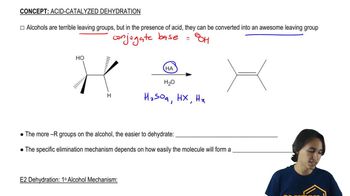
Acid-catalyzed dehydration is a reaction where an alcohol is converted into an alkene through the removal of a water molecule, typically facilitated by an acid like sulfuric acid. In the context of the question, heating alcohol A with sulfuric acid leads to the formation of compound B, which is an important step in synthesizing the desired terpene. Understanding this mechanism is vital for predicting the products of reactions involving alcohols.