Why are NH3 and CH3NH2 no longer nucleophiles when they are protonated?
Verified step by step guidance
1
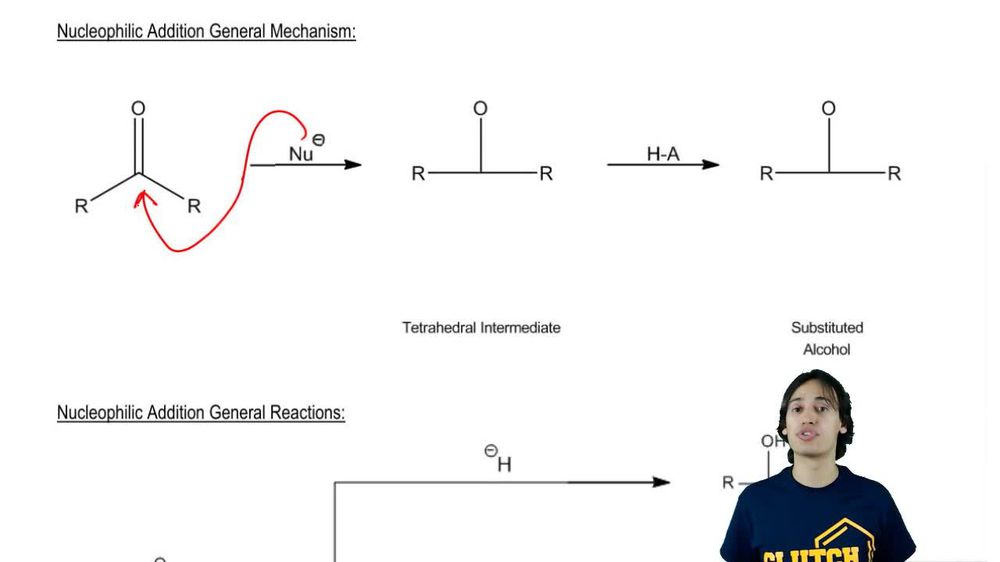
Understand the concept of nucleophiles: Nucleophiles are species that donate a pair of electrons to form a new covalent bond. They are typically rich in electrons and have a lone pair that can be donated.
Consider the structure of NH3 (ammonia) and CH3NH2 (methylamine): Both have a nitrogen atom with a lone pair of electrons, making them good nucleophiles in their neutral form.
Analyze what happens when NH3 and CH3NH2 are protonated: Protonation involves the addition of a proton (H⁺) to the molecule, which results in NH4⁺ (ammonium ion) and CH3NH3⁺ (methylammonium ion), respectively.
Examine the effect of protonation on electron availability: When NH3 and CH3NH2 are protonated, the lone pair of electrons on the nitrogen is used to form a bond with the added proton. This means the lone pair is no longer available for donation, reducing their nucleophilicity.
Conclude why protonated forms are not nucleophiles: Since the lone pair is occupied in bonding with the proton, NH4⁺ and CH3NH3⁺ lack the electron pair needed to act as nucleophiles, thus they are no longer nucleophiles.
Verified video answer for a similar problem:
This video solution was recommended by our tutors as helpful for the problem above
Video duration:
3m
Play a video:
0 Comments
Key Concepts
Here are the essential concepts you must grasp in order to answer the question correctly.
Nucleophilicity
Nucleophilicity refers to the ability of a species to donate an electron pair to an electrophile, forming a chemical bond. Nucleophiles are typically electron-rich species, such as amines like NH3 and CH3NH2, which have lone pairs of electrons that can be used for bonding. When these nucleophiles are protonated, they become positively charged, which significantly reduces their electron density and ability to donate electrons.
Protonation is the addition of a proton (H+) to a molecule, resulting in the formation of a positively charged species. In the case of NH3 and CH3NH2, protonation leads to the formation of NH4+ and CH3NH3+, respectively. This process alters the electronic structure of the molecules, making them less capable of acting as nucleophiles due to the increased positive charge that repels electron donation.
The charge of a molecule significantly influences its reactivity and ability to participate in chemical reactions. Neutral nucleophiles, like NH3 and CH3NH2, can readily attack electrophiles due to their electron-rich nature. However, once protonated, the resulting cations (NH4+ and CH3NH3+) are stabilized by their positive charge, which makes them less reactive towards electrophiles, effectively rendering them non-nucleophilic.

 3:17 minutes
 Verified step by step guidance
 08:27
08:27