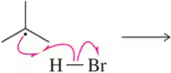
Predict the product that results from the following 'pushed electrons.' (f)
Verified step by step guidance
1
Analyze the given reaction mechanism and identify the starting material, intermediates, and the type of reaction (e.g., nucleophilic substitution, elimination, addition, etc.). Look for any curved arrows indicating electron movement.
Examine the 'pushed electrons' (curved arrows) to determine which bonds are being broken and formed. Curved arrows typically show the movement of electron pairs, such as from a nucleophile to an electrophile or from a bond to an atom.
Apply the principles of electron flow to predict the intermediate structure. For example, if a bond is breaking, identify the resulting species (e.g., carbocation, carbanion, or radical). If a bond is forming, determine the new connectivity of atoms.
Consider any resonance stabilization, rearrangements, or stereochemical implications that might occur as a result of the electron movement. For example, carbocation rearrangements may occur to form a more stable intermediate.
Using the information from the previous steps, predict the final product of the reaction. Ensure that all atoms have appropriate valences and that the product is consistent with the electron-pushing mechanism provided.
Verified video answer for a similar problem:
This video solution was recommended by our tutors as helpful for the problem above
Video duration:
4m
Play a video:
0 Comments
Key Concepts
Here are the essential concepts you must grasp in order to answer the question correctly.
Electron Pushing Mechanism
The electron pushing mechanism, often depicted using curved arrows, illustrates the movement of electrons during chemical reactions. This technique helps visualize how nucleophiles donate electrons to electrophiles, facilitating bond formation or breaking. Understanding this mechanism is crucial for predicting reaction products and determining the reaction pathway.
Nucleophiles are species that donate an electron pair to form a chemical bond, while electrophiles are electron-deficient species that accept electron pairs. Recognizing the roles of these species in a reaction is essential for predicting the outcome of electron-pushing scenarios. The interaction between nucleophiles and electrophiles drives many organic reactions.
A reaction mechanism details the step-by-step process by which reactants transform into products, including the formation and breaking of bonds. Understanding mechanisms allows chemists to predict products and understand the conditions under which reactions occur. Familiarity with common mechanisms, such as substitution and elimination, is vital for analyzing organic reactions.