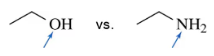
Which of the following indicated atoms would you expect to be most basic? (b)
Verified step by step guidance
1
Step 1: Understand the concept of basicity. Basicity refers to the ability of a molecule or atom to donate a pair of electrons to accept a proton (H⁺). The more readily an atom can donate its lone pair of electrons, the more basic it is.
Step 2: Analyze the functional groups in the given molecules. The first molecule contains an -OH group (hydroxyl group), and the second molecule contains an -NH₂ group (amine group). Both groups have lone pairs of electrons on the oxygen and nitrogen atoms, respectively.
Step 3: Compare the electronegativity of the atoms involved. Oxygen is more electronegative than nitrogen, meaning it holds onto its electrons more tightly. This makes the lone pair on oxygen less available for donation compared to the lone pair on nitrogen.
Step 4: Consider the stability of the conjugate acid formed. When the -OH group donates its lone pair, it forms H₂O⁺, which is highly stable due to hydrogen bonding and resonance. In contrast, the conjugate acid formed by -NH₂ (NH₃⁺) is less stable, making -NH₂ more likely to donate its lone pair and thus more basic.
Step 5: Conclude that the nitrogen atom in the -NH₂ group is expected to be more basic than the oxygen atom in the -OH group due to its lower electronegativity and greater ability to donate its lone pair of electrons.
Verified video answer for a similar problem:
This video solution was recommended by our tutors as helpful for the problem above
Play a video:
0 Comments
Key Concepts
Here are the essential concepts you must grasp in order to answer the question correctly.
Basicity
Basicity refers to the ability of a substance to accept protons (H+) or donate electron pairs. In organic chemistry, basicity is influenced by the structure of the molecule, including the presence of electronegative atoms, resonance effects, and steric hindrance. A more basic atom typically has a lone pair of electrons that can readily bond with protons.
Understanding the difference between basicity and nucleophilicity.
Electronegativity
Electronegativity is a measure of an atom's ability to attract and hold onto electrons. Atoms with high electronegativity, such as fluorine or oxygen, tend to be less basic because they hold onto their electrons tightly, making it harder for them to donate electron pairs. Understanding the electronegativity of the atoms in question is crucial for predicting their basicity.
Resonance stabilization occurs when a molecule can be represented by multiple valid Lewis structures, allowing for the delocalization of electrons. This delocalization can affect basicity; for instance, if a lone pair is involved in resonance, it may be less available to bond with protons, thus decreasing the basicity of that atom. Recognizing resonance structures is essential for evaluating the basicity of different atoms.

 Verified step by step guidance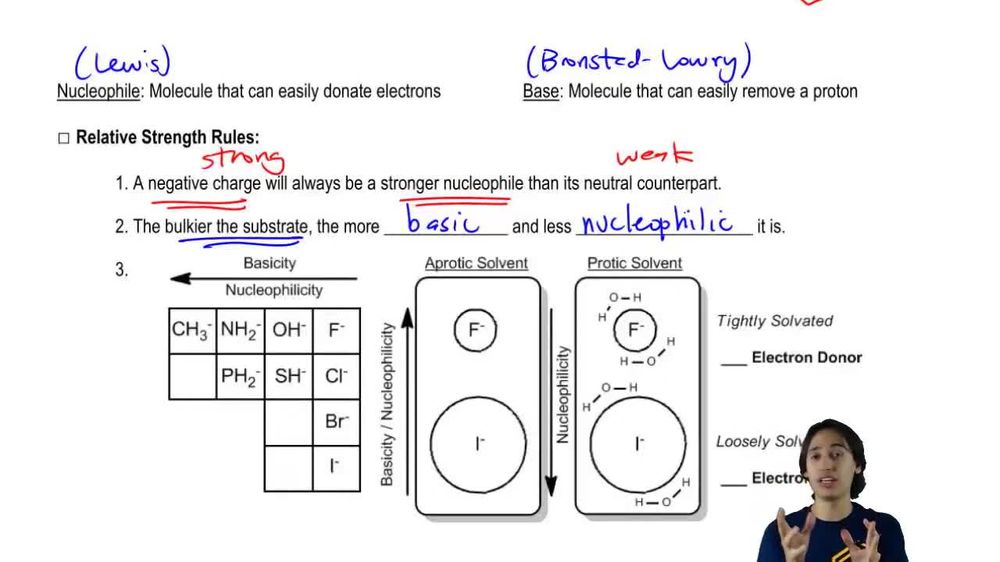
 06:21
06:21