Using qualitative reasoning for the acid–base reactions shown, (i) which is stronger, the base or the conjugate base? (ii) Which side of the reaction is favored? (iii) Would you expect a Keq greater than or less than 1? (c)
Verified step by step guidance
1
Step 1: Analyze the acid-base reaction provided. The reaction involves Cl⁻ (base) reacting with H₃O⁺ (acid) to form H₂O and HCl. Identify the base (Cl⁻) and the conjugate base (H₂O).
Step 2: Compare the strengths of the base (Cl⁻) and the conjugate base (H₂O). H₂O is a neutral molecule and is generally weaker as a base compared to Cl⁻, which is an anion and has a stronger tendency to accept protons.
Step 3: Determine which side of the reaction is favored. Since HCl is a strong acid, it dissociates almost completely in water, favoring the formation of H₃O⁺ and Cl⁻. This indicates that the equilibrium lies to the left side of the reaction.
Step 4: Use the equilibrium constant (Keq) to predict whether it is greater than or less than 1. Since the reaction favors the left side (reactants), the equilibrium constant (Keq) would be less than 1.
Step 5: Summarize the reasoning: The base (Cl⁻) is stronger than the conjugate base (H₂O). The reaction favors the left side (reactants), and the equilibrium constant (Keq) is expected to be less than 1.
Verified video answer for a similar problem:
This video solution was recommended by our tutors as helpful for the problem above
Video duration:
4m
Play a video:
0 Comments
Key Concepts
Here are the essential concepts you must grasp in order to answer the question correctly.
Acid-Base Theory
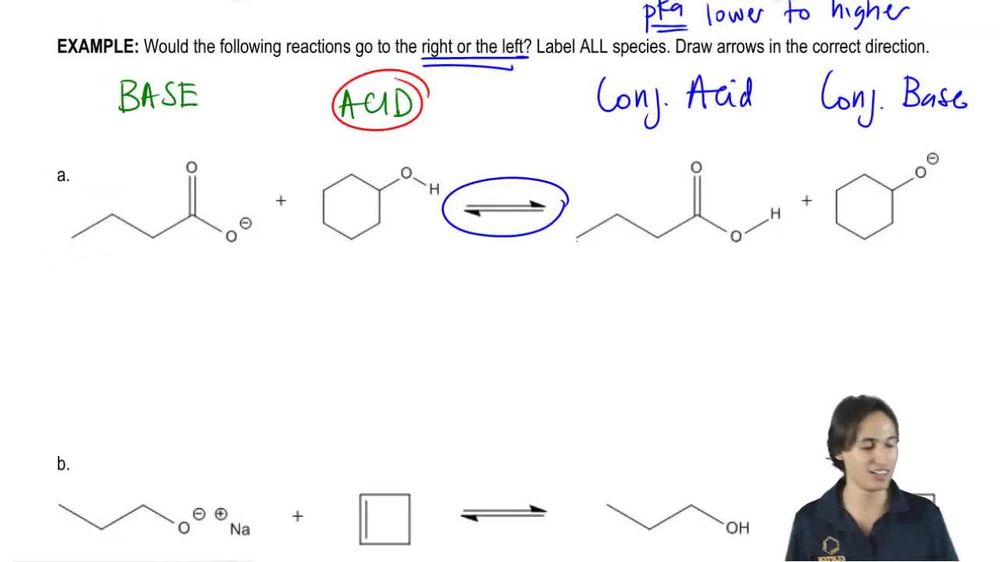
Acid-base theory explains the behavior of acids and bases in chemical reactions. According to the Brønsted-Lowry theory, acids are proton donors while bases are proton acceptors. In the given reaction, H3O+ acts as an acid by donating a proton, while Cl- acts as a base by accepting it. Understanding this theory is crucial for analyzing the strength of acids and bases in reactions.
Conjugate acid-base pairs consist of two species that differ by the presence of a proton (H+). When an acid donates a proton, it forms its conjugate base, while the base that accepts the proton becomes its conjugate acid. In the reaction shown, HCl is the conjugate acid of Cl-, and H2O is the conjugate base of H3O+. Recognizing these pairs helps in determining the relative strengths of acids and bases.
In acid-base reactions, the position of equilibrium indicates which side is favored. The stronger acid and stronger base will favor the formation of the weaker acid and weaker base. The equilibrium constant (K) can be used to quantify this favorability; if K is greater than 1, the products are favored, while if less than 1, the reactants are favored. This concept is essential for predicting the outcome of acid-base reactions.

 4:45 minutes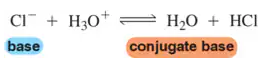
 Verified step by step guidance
 02:49
02:49