Convert the following structural formulas to line-angle drawings (c) CH3CH2NHCH2CH2OH
Verified step by step guidance
1
Step 1: Understand the structural formula provided. The molecule CH₃CH₂NHCH₂CH₂OH consists of an ethyl group (CH₃CH₂-) attached to an amine group (-NH-), which is further connected to a two-carbon chain (-CH₂CH₂-) ending in a hydroxyl group (-OH).
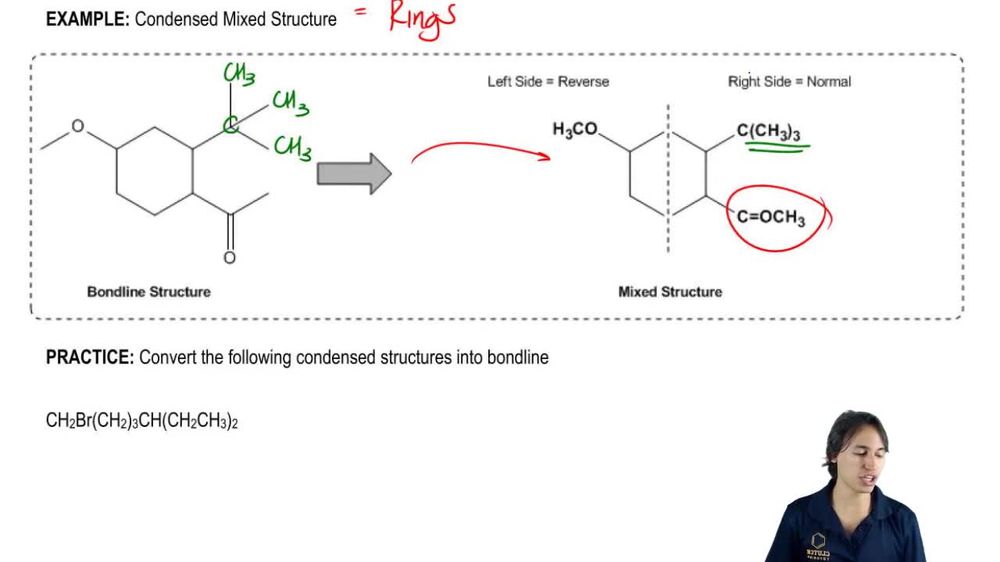
Step 2: Recall the conventions of line-angle drawings. In these representations, carbon atoms are implied at the vertices and ends of lines, hydrogen atoms bonded to carbon are omitted, and heteroatoms like nitrogen (N) and oxygen (O) are explicitly shown.
Step 3: Begin by drawing the ethyl group as a two-line segment, where the first vertex represents the CH₃ group and the second vertex represents the CH₂ group. Connect this to the nitrogen atom (N), which should be explicitly labeled.
Step 4: From the nitrogen atom, draw a single line to represent the CH₂ group, followed by another line to represent the second CH₂ group. Ensure the nitrogen atom has a single bond to the ethyl group and another single bond to the first CH₂ group.
Step 5: At the end of the second CH₂ group, add the hydroxyl group (-OH) explicitly. The oxygen atom (O) should be labeled, and a single bond should connect it to the terminal CH₂ group. Verify that the drawing adheres to the correct connectivity and bonding pattern.
Verified video answer for a similar problem:
This video solution was recommended by our tutors as helpful for the problem above
Video duration:
3m
Play a video:
0 Comments
Key Concepts
Here are the essential concepts you must grasp in order to answer the question correctly.
Line-Angle Drawings
Line-angle drawings, also known as skeletal structures, are a simplified way of representing organic molecules. In these drawings, carbon atoms are represented by the ends and intersections of lines, while hydrogen atoms are typically omitted for clarity. Functional groups, such as -NH and -OH, are explicitly shown to convey important chemical information. This method allows chemists to visualize complex structures quickly and efficiently.
Functional groups are specific groups of atoms within molecules that are responsible for the characteristic chemical reactions of those molecules. In the given formula, -NH (amine) and -OH (alcohol) are functional groups that influence the molecule's reactivity and properties. Understanding functional groups is essential for predicting how a compound will behave in chemical reactions and for identifying its potential uses in various applications.
Structural formulas provide a detailed representation of a molecule, showing how atoms are connected and the arrangement of bonds. They can depict all atoms, including hydrogen, and indicate the types of bonds (single, double, etc.) between them. Converting structural formulas to line-angle drawings requires an understanding of how to simplify these representations while retaining essential information about the molecule's structure and functional groups.