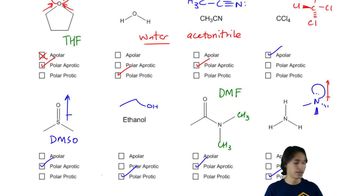
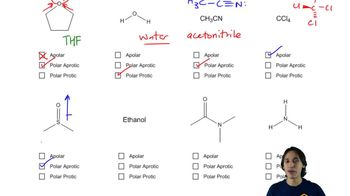
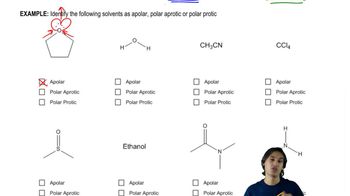
Identify the following solvents as polar protic, polar aprotic, or nonpolar. (a)
Verified step by step guidance
1
Step 1: Understand the definitions of polar protic, polar aprotic, and nonpolar solvents. Polar protic solvents have a hydrogen atom attached to an electronegative atom (e.g., O-H or N-H bonds), allowing them to participate in hydrogen bonding. Polar aprotic solvents lack such hydrogen atoms but are still polar due to their dipole moment. Nonpolar solvents have little to no dipole moment and do not interact strongly with polar molecules.
Step 2: Examine the molecular structure of the given solvent. Look for functional groups or bonds that indicate polarity (e.g., electronegative atoms like oxygen or nitrogen) and the presence of hydrogen atoms directly bonded to these electronegative atoms.
Step 3: Determine if the solvent can participate in hydrogen bonding. If it has O-H or N-H bonds, it is polar protic. If it lacks these bonds but has a dipole moment, it is polar aprotic. If it lacks both hydrogen bonding capability and a significant dipole moment, it is nonpolar.
Step 4: Consider the solvent's dielectric constant and dipole moment. Polar solvents generally have high dielectric constants, while nonpolar solvents have low dielectric constants. This can help confirm your classification.
Step 5: Assign the solvent to the correct category (polar protic, polar aprotic, or nonpolar) based on the analysis of its structure and properties. Repeat this process for each solvent provided in the problem.
Verified video answer for a similar problem:
This video solution was recommended by our tutors as helpful for the problem above
Video duration:
3m
Play a video:
0 Comments
Key Concepts
Here are the essential concepts you must grasp in order to answer the question correctly.
Polar Protic Solvents
Polar protic solvents are characterized by the presence of hydrogen atoms bonded to electronegative atoms, such as oxygen or nitrogen. These solvents can form hydrogen bonds and have high dielectric constants, which enhance their ability to dissolve ionic compounds. Common examples include water, alcohols, and carboxylic acids.
Polar aprotic solvents do not have hydrogen atoms that can participate in hydrogen bonding, yet they possess a significant dipole moment. These solvents can solvate cations effectively but do not stabilize anions as well as protic solvents. Examples include acetone, dimethyl sulfoxide (DMSO), and acetonitrile.
Nonpolar solvents are characterized by a lack of significant dipole moments and do not have polar bonds that can engage in hydrogen bonding. They are typically used to dissolve nonpolar compounds and are less effective for ionic or polar substances. Common examples include hexane, benzene, and toluene.