For each of the following alkynes, draw the products obtained from (1) the acid-catalyzed addition of water (mercuric ion is added for part a) and from (2) hydroboration–oxidation: a. 1-butyne
Verified step by step guidance
1
Step 1: Understand the reaction types. Acid-catalyzed hydration of alkynes involves the addition of water in the presence of an acid (H₂SO₄) and mercuric ion (Hg²⁺) as a catalyst. This reaction follows Markovnikov's rule and forms an enol intermediate, which tautomerizes to a ketone. Hydroboration-oxidation, on the other hand, involves the addition of BH₃ (or a borane derivative) followed by oxidation with H₂O₂/NaOH, leading to an anti-Markovnikov product, typically an aldehyde or ketone.
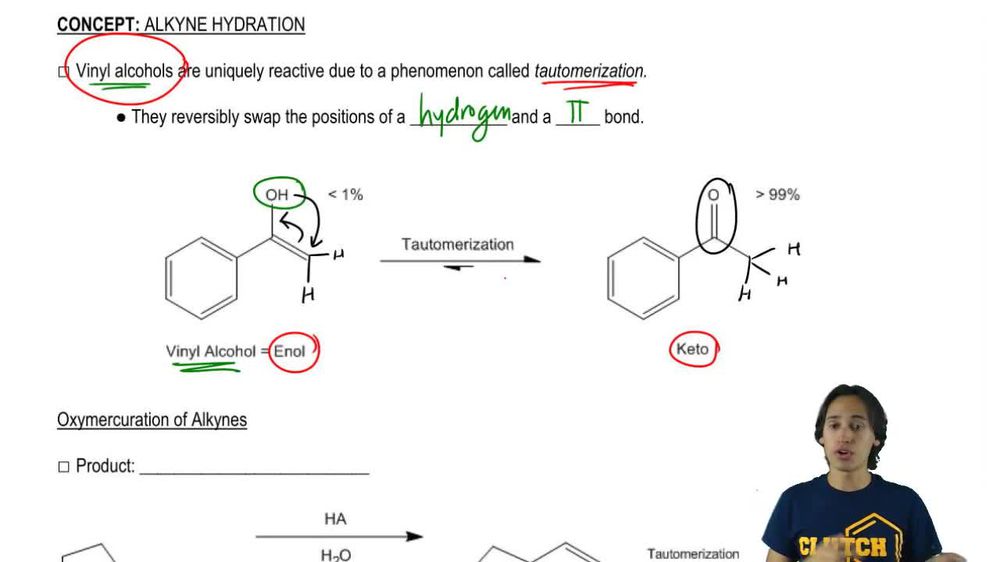
Step 2: For acid-catalyzed hydration of 1-butyne, identify the Markovnikov product. The water molecule adds across the triple bond such that the hydroxyl group (-OH) attaches to the more substituted carbon (C-2). This forms an enol intermediate, which undergoes keto-enol tautomerization to yield 2-butanone (a ketone).
Step 3: For hydroboration-oxidation of 1-butyne, identify the anti-Markovnikov product. The boron atom from BH₃ adds to the less substituted carbon (C-1) of the triple bond. After oxidation with H₂O₂/NaOH, the resulting product is an aldehyde, specifically butanal.
Step 4: Draw the structures of the intermediates and final products. For acid-catalyzed hydration, show the enol intermediate (CH₃-CH(OH)-CH=CH₂) and the final ketone product (CH₃-CO-CH₂-CH₃). For hydroboration-oxidation, show the intermediate organoborane and the final aldehyde product (CH₃-CH₂-CH₂-CHO).
Step 5: Verify the regioselectivity and stereochemistry of the products. Ensure that the acid-catalyzed hydration follows Markovnikov's rule and that the hydroboration-oxidation follows anti-Markovnikov's rule. Confirm that the products are consistent with the reaction mechanisms.
Verified video answer for a similar problem:
This video solution was recommended by our tutors as helpful for the problem above
Video duration:
4m
Play a video:
0 Comments
Key Concepts
Here are the essential concepts you must grasp in order to answer the question correctly.
Acid-Catalyzed Hydration of Alkynes
In acid-catalyzed hydration, alkynes react with water in the presence of an acid catalyst, typically forming an enol that quickly tautomerizes to a ketone. For terminal alkynes like 1-butyne, the addition of water leads to the formation of a carbonyl compound, with the mercuric ion facilitating the reaction by stabilizing the carbocation intermediate.
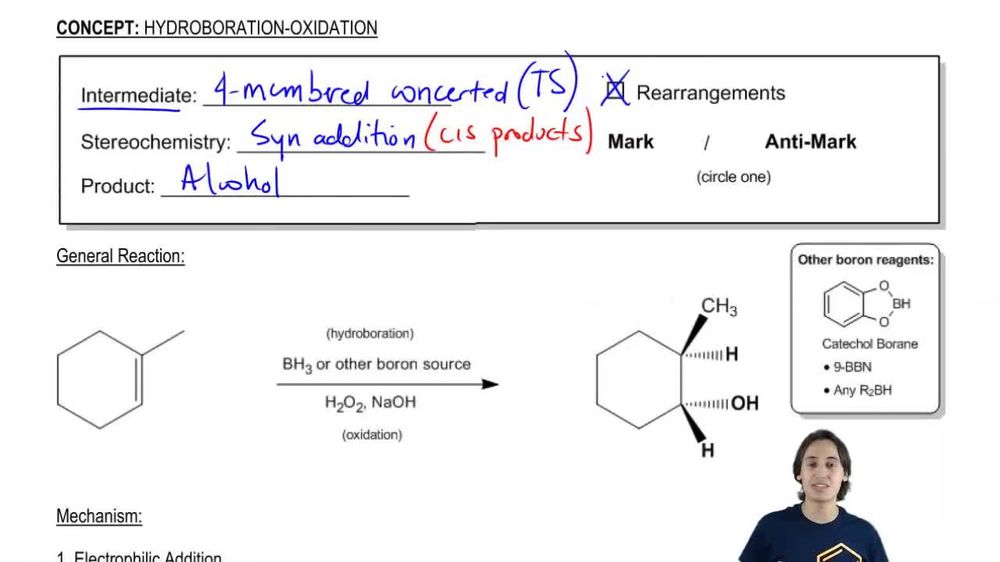
Hydroboration-oxidation is a two-step reaction where an alkene or alkyne first reacts with diborane (B2H6) to form an organoborane intermediate, followed by oxidation with hydrogen peroxide (H2O2) in a basic solution. This method results in the anti-Markovnikov addition of water, leading to the formation of alcohols, which can be further converted to carbonyl compounds.
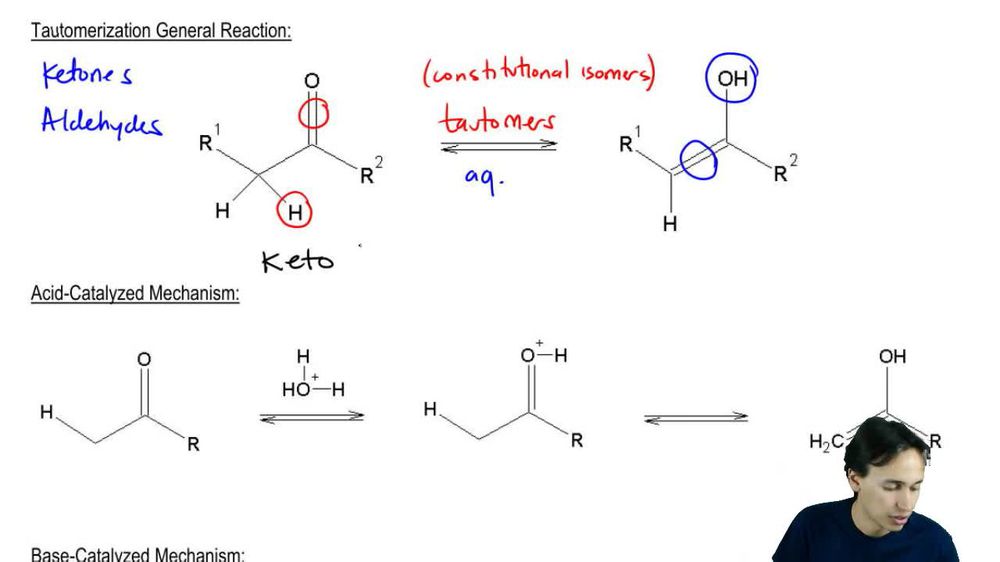
Tautomerization is a chemical reaction that involves the rearrangement of bonds within a compound, typically resulting in the interconversion between an enol and a carbonyl compound (keto form). In the context of alkynes, after acid-catalyzed hydration, the enol form is often unstable and quickly converts to the more stable ketone, which is crucial for understanding the final products of the reaction.

 4:18 minutes
 Verified step by step guidance
 09:11
09:11