Explain why the acid-catalyzed dehydration of an alcohol is a reversible reaction, whereas the base-promoted dehydrohalogenation of an alkyl halide is an irreversible reaction.
Verified step by step guidance
1
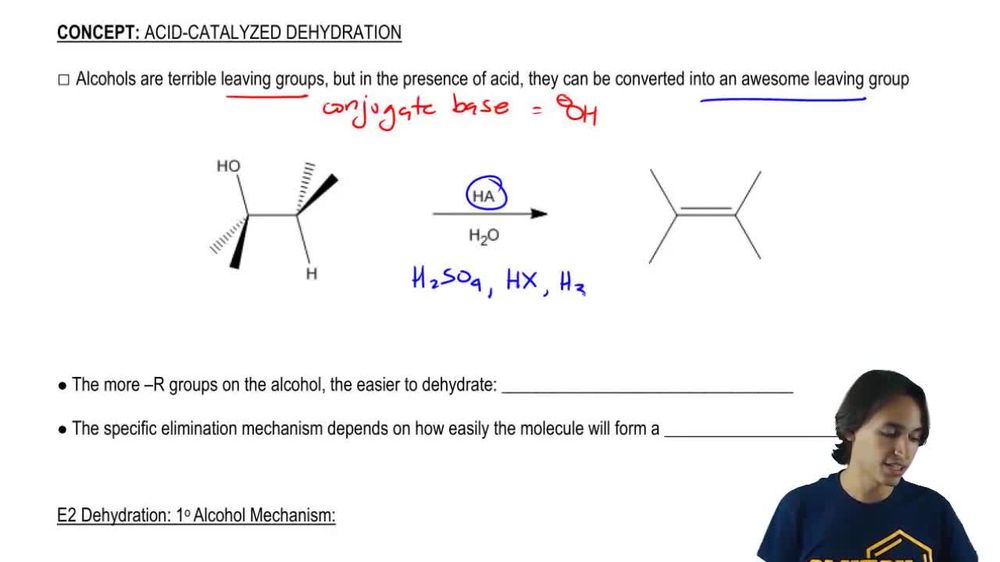
The acid-catalyzed dehydration of an alcohol involves the removal of a water molecule to form an alkene. This reaction is reversible because water, the byproduct, is a good nucleophile and can add back to the alkene in the presence of an acid catalyst, regenerating the alcohol. The equilibrium between the alcohol and the alkene depends on the reaction conditions, such as temperature and the concentration of water.
In the acid-catalyzed dehydration mechanism, the alcohol is first protonated by the acid catalyst, forming a better leaving group (water). The protonated alcohol then undergoes elimination to form a carbocation intermediate, which subsequently loses a proton to form the alkene. The reversibility arises because the alkene can react with water in the presence of the acid to regenerate the alcohol.
In contrast, the base-promoted dehydrohalogenation of an alkyl halide involves the removal of a hydrogen atom and a halide ion (HX) to form an alkene. This reaction is typically irreversible because the halide ion (e.g., Cl⁻, Br⁻) is a poor nucleophile under basic conditions and does not readily add back to the alkene. Additionally, the strong base used in the reaction (e.g., NaOH, KOH) drives the reaction forward by deprotonating the β-hydrogen.
The base-promoted dehydrohalogenation mechanism involves the abstraction of a β-hydrogen by the base, forming a double bond (alkene) and expelling the halide ion as the leaving group. The irreversibility is further reinforced by the fact that the reaction conditions (basic medium) do not favor the reverse reaction, as the halide ion is not reactive enough to attack the alkene.
In summary, the acid-catalyzed dehydration of an alcohol is reversible due to the nucleophilic nature of water and the equilibrium established under acidic conditions, while the base-promoted dehydrohalogenation of an alkyl halide is irreversible due to the poor nucleophilicity of the halide ion and the reaction-driving role of the strong base.
Verified video answer for a similar problem:
This video solution was recommended by our tutors as helpful for the problem above
Video duration:
5m
Play a video:
0 Comments
Key Concepts
Here are the essential concepts you must grasp in order to answer the question correctly.
Acid-Catalyzed Dehydration
Acid-catalyzed dehydration of alcohols involves the removal of a water molecule to form an alkene. This reaction is reversible because the products (alkene and water) can react under certain conditions to regenerate the starting alcohol. The equilibrium established between the reactants and products allows for both forward and reverse reactions, influenced by factors like temperature and concentration.
Base-promoted dehydrohalogenation is a reaction where a base removes a hydrogen halide (HX) from an alkyl halide, resulting in the formation of an alkene. This reaction is typically irreversible due to the strong bond formation in the alkene product and the stability of the leaving group (halide ion). The reaction proceeds to completion, as the formation of the alkene is favored energetically, making the reverse reaction less likely.
Reaction equilibrium refers to the state in which the rates of the forward and reverse reactions are equal, resulting in constant concentrations of reactants and products. In reversible reactions, such as acid-catalyzed dehydration, changes in conditions can shift the equilibrium position. In contrast, irreversible reactions, like base-promoted dehydrohalogenation, favor the formation of products to such an extent that the reverse reaction is negligible, leading to a one-way process.