What stereoisomers are formed in the following reactions? Which stereoisomer is the major product? a. the acid-catalyzed dehydration of 1-pentanol to 2-pentene
Verified step by step guidance
1
Step 1: Understand the reaction mechanism. The acid-catalyzed dehydration of 1-pentanol involves the removal of a water molecule to form an alkene. This reaction proceeds via an E1 mechanism, which includes the formation of a carbocation intermediate.
Step 2: Identify the carbocation intermediate. Protonation of the hydroxyl group (-OH) in 1-pentanol converts it into a better leaving group (water). The departure of water generates a carbocation at the 1-position. This carbocation can undergo a hydride shift to form a more stable secondary carbocation at the 2-position.
Step 3: Determine the possible alkenes. The secondary carbocation at the 2-position can lose a proton from either the adjacent carbon atoms (C-1 or C-3) to form two possible stereoisomers of 2-pentene: (E)-2-pentene and (Z)-2-pentene.
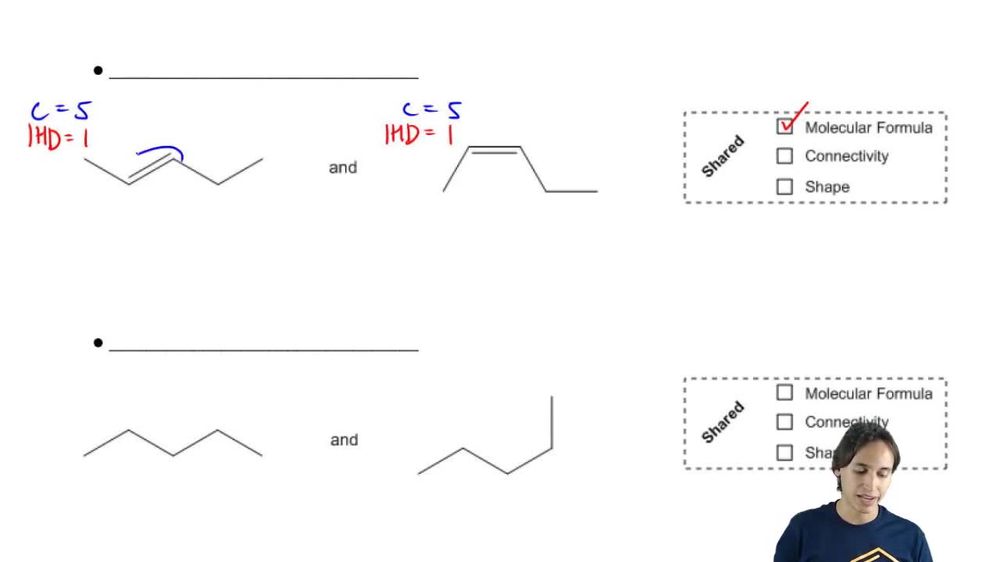
Step 4: Analyze the stereoisomers. The (E)-2-pentene has the two largest substituents on opposite sides of the double bond, while the (Z)-2-pentene has the two largest substituents on the same side of the double bond. These are geometric isomers (stereoisomers) of 2-pentene.
Step 5: Predict the major product. According to Zaitsev's rule, the more substituted alkene is favored. Additionally, the (E)-isomer is typically more stable than the (Z)-isomer due to reduced steric hindrance. Therefore, (E)-2-pentene is expected to be the major product.
Verified video answer for a similar problem:
This video solution was recommended by our tutors as helpful for the problem above
Video duration:
7m
Play a video:
0 Comments
Key Concepts
Here are the essential concepts you must grasp in order to answer the question correctly.
Stereoisomerism
Stereoisomerism refers to the phenomenon where compounds have the same molecular formula and connectivity of atoms but differ in the spatial arrangement of their atoms. This can lead to different physical and chemical properties. The two main types of stereoisomers are enantiomers, which are non-superimposable mirror images, and diastereomers, which are not mirror images of each other.
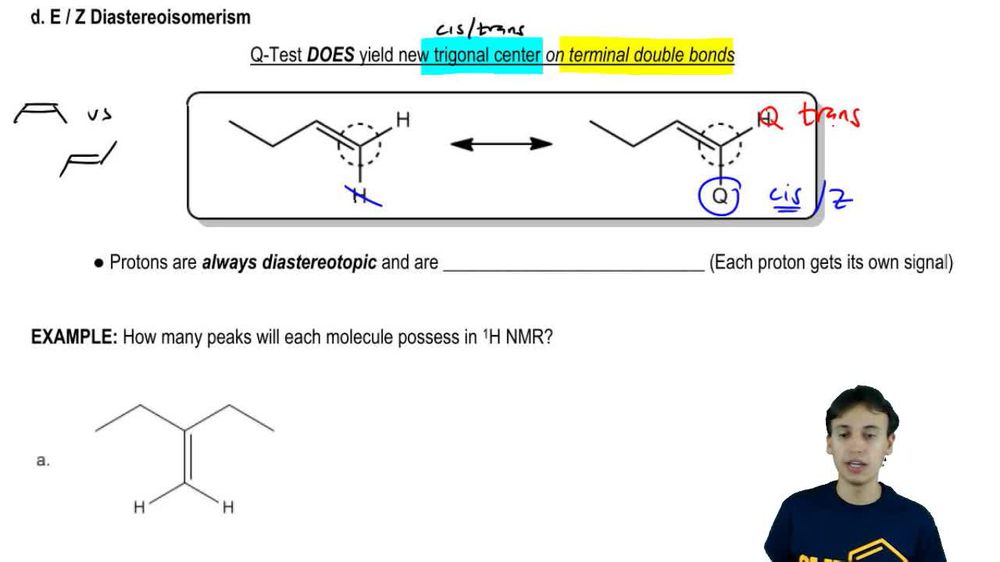
E/Z nomenclature is a system used to describe the stereochemistry of alkenes based on the priority of substituents attached to the double bond. The 'E' (entgegen) configuration indicates that the highest priority groups are on opposite sides, while the 'Z' (zusammen) configuration indicates they are on the same side. This nomenclature is crucial for identifying and distinguishing between different stereoisomers formed during reactions.
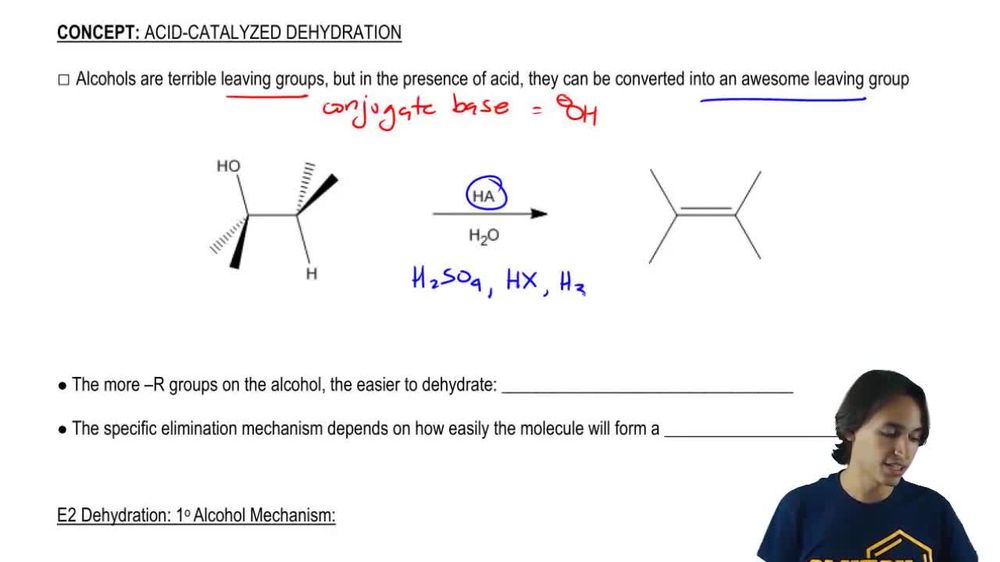
Acid-catalyzed dehydration is a reaction where an alcohol is converted into an alkene through the removal of a water molecule, facilitated by an acid catalyst. In the case of 1-pentanol, the reaction involves protonation of the alcohol, followed by the loss of water and formation of a carbocation, which can lead to the formation of different stereoisomers depending on the stability of the carbocation and the pathway taken during elimination.