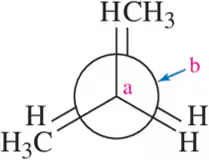
Using the Newman projections shown, draw each molecule in its line-angle drawing with all hydrogens and substituents shown. [Carbon b is behind carbon a in these structures.] Wedges and dashes should be used to indicate whether a substituent is coming out of, or going into, the plane of the page. (d)
Verified step by step guidance
1
Step 1: Understand the Newman projection. A Newman projection is a way to visualize the spatial arrangement of atoms around a bond. In this case, carbon 'a' is in the front, and carbon 'b' is behind it. Identify the substituents attached to each carbon and their relative positions (e.g., staggered or eclipsed).
Step 2: Translate the Newman projection into a 3D perspective. For carbon 'a' (the front carbon), draw the substituents radiating outward from the center. Use wedges to indicate substituents coming out of the plane of the page and dashes for substituents going into the plane of the page.
Step 3: For carbon 'b' (the rear carbon), position its substituents behind carbon 'a'. Ensure the substituents are correctly aligned based on the Newman projection. Use straight lines for substituents in the plane of the page.
Step 4: Combine the front and rear carbons into a single line-angle drawing. Connect the two carbons with a bond and ensure the substituents are accurately represented with wedges, dashes, and straight lines.
Step 5: Double-check your drawing to ensure it matches the spatial arrangement shown in the Newman projection. Verify that all hydrogens and substituents are included and correctly positioned.
Verified video answer for a similar problem:
This video solution was recommended by our tutors as helpful for the problem above
Video duration:
3m
Play a video:
0 Comments
Key Concepts
Here are the essential concepts you must grasp in order to answer the question correctly.
Newman Projections
Newman projections are a way to visualize the conformation of a molecule by looking straight down the bond connecting two carbon atoms. This representation helps in understanding the spatial arrangement of substituents around the bond, which is crucial for analyzing steric interactions and torsional strain in organic molecules.
Line-angle drawings, also known as skeletal structures, are a shorthand way of representing organic molecules. In this format, carbon atoms are represented by the ends and intersections of lines, while hydrogen atoms are often omitted for clarity. This method simplifies the visualization of complex structures and is widely used in organic chemistry.
Wedges and dashes are used in molecular drawings to indicate the three-dimensional orientation of substituents. A solid wedge represents a substituent that is coming out of the plane of the page, while a dashed line indicates a substituent that is going into the plane. This notation is essential for accurately conveying the stereochemistry of a molecule.