c. Draw Newman projections of the two conformers of the trans isomer. d. Which of the conformers predominates at equilibrium?
Verified step by step guidance
1
Step 1: Understand the problem. Newman projections are a way to visualize the conformations of a molecule by looking down a specific bond axis. For the trans isomer, identify the bond axis you will be analyzing (typically a carbon-carbon single bond).
Step 2: Draw the first conformer. To do this, look down the bond axis and arrange the substituents on the front and back carbon atoms. For the trans isomer, ensure that the substituents on opposite sides of the molecule are correctly positioned. Use MathML to represent the substituents and their spatial arrangement.
Step 3: Draw the second conformer. Rotate the front carbon atom (or the back carbon atom) by 60 degrees to create a new arrangement of substituents. Ensure that the trans relationship between substituents is maintained in this conformer.
Step 4: Compare the two conformers. Evaluate the steric hindrance and torsional strain in each conformer. The conformer with the least steric hindrance and torsional strain will be more stable and predominate at equilibrium.
Step 5: Conclude which conformer predominates at equilibrium. Use your analysis from Step 4 to determine the conformer that is energetically favored. This conformer will be the one that predominates at equilibrium.
Verified video answer for a similar problem:

This video solution was recommended by our tutors as helpful for the problem above
Video duration:
9m
Play a video:
0 Comments
Key Concepts
Here are the essential concepts you must grasp in order to answer the question correctly.
Newman Projections
Newman projections are a way to visualize the conformation of a molecule by looking straight down the bond connecting two carbon atoms. This representation helps in analyzing steric interactions and torsional strain between substituents attached to the carbons. By drawing these projections, one can easily compare different conformers and assess their stability.
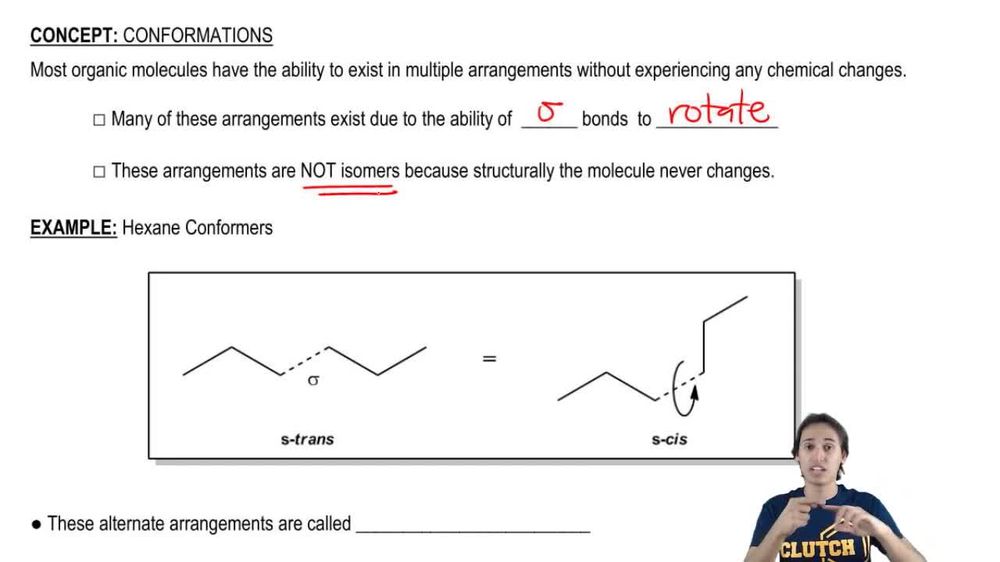
Conformers, or conformational isomers, are different spatial arrangements of a molecule that can be interconverted by rotation around single bonds. In the case of the trans isomer, the two main conformers can be staggered or eclipsed, affecting their energy levels and stability. Understanding which conformer is more stable is crucial for predicting the behavior of the molecule in a chemical context.
At equilibrium, the distribution of conformers is determined by their relative stabilities, which are influenced by factors such as steric hindrance and torsional strain. The conformer with lower energy is favored and predominates in the equilibrium mixture. Analyzing the energy differences between conformers allows chemists to predict which form will be more prevalent under standard conditions.