What substitution products are obtained when each of the following compounds is added to a solution of sodium acetate in acetic acid? a. 2-chloro-2-methyl-3-hexene b. 3-bromo-1-methylcyclohexene
Verified step by step guidance
1
Identify the type of substitution reaction: Since sodium acetate in acetic acid is a weak nucleophile and weak base, the reaction is likely to proceed via an SN1 mechanism, especially for substrates that can form stable carbocations.
Analyze the structure of the substrate (a. 2-chloro-2-methyl-3-hexene): The chlorine atom is attached to a tertiary carbon, which can form a stable tertiary carbocation upon ionization. The double bond in the molecule does not interfere with the carbocation formation at this position.
Predict the intermediate for (a): When the chlorine leaves, a tertiary carbocation forms at the 2-position. Sodium acetate acts as the nucleophile, attacking the carbocation to form the substitution product. The acetate group will replace the chlorine atom.
Analyze the structure of the substrate (b. 3-bromo-1-methylcyclohexene): The bromine atom is attached to a secondary carbon in a cyclohexene ring. Ionization of bromine will form a secondary carbocation. However, due to the presence of the double bond, the carbocation can undergo resonance stabilization, forming an allylic carbocation.
Predict the intermediate and product for (b): The allylic carbocation formed after bromine leaves is resonance-stabilized. Sodium acetate will attack the most stable carbocation position, leading to the substitution product where the acetate group replaces the bromine atom. Multiple regioisomers may form due to the resonance stabilization of the allylic carbocation.
Verified video answer for a similar problem:
This video solution was recommended by our tutors as helpful for the problem above
Video duration:
10m
Play a video:
0 Comments
Key Concepts
Here are the essential concepts you must grasp in order to answer the question correctly.
Nucleophilic Substitution
Nucleophilic substitution is a fundamental reaction in organic chemistry where a nucleophile attacks an electrophile, replacing a leaving group. In this context, sodium acetate acts as a nucleophile, attacking the electrophilic carbon in the alkene compounds. Understanding the mechanism of this reaction is crucial for predicting the substitution products formed.
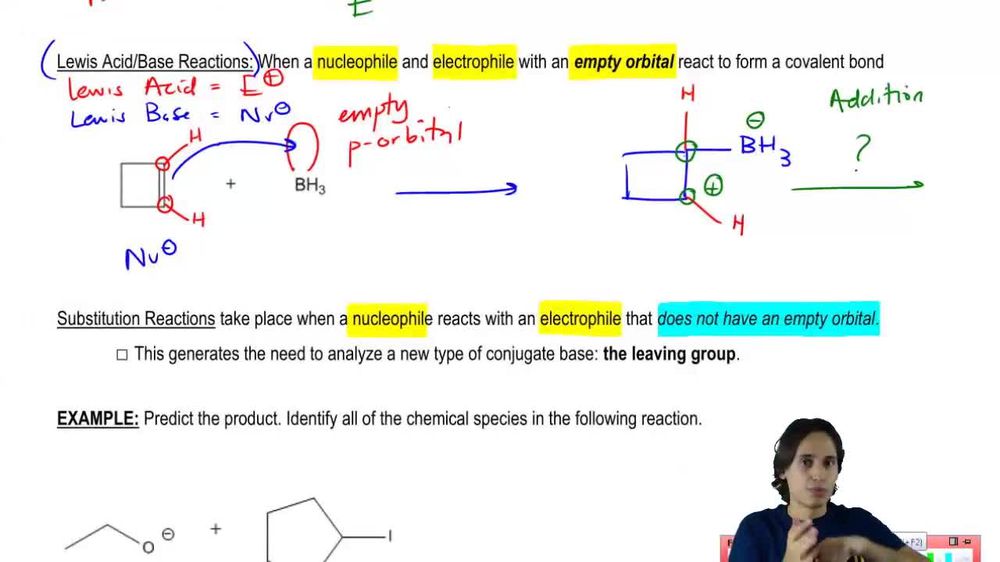
Nucleophiles and Electrophiles can react in Substitution Reactions.
Electrophilic Reactivity of Alkenes
Alkenes are characterized by their double bonds, which can act as sites for electrophilic attack. The reactivity of alkenes depends on the substituents attached to the double bond and their steric and electronic effects. Recognizing how the structure of 2-chloro-2-methyl-3-hexene and 3-bromo-1-methylcyclohexene influences their reactivity is essential for determining the substitution products.
The solvent system, in this case, acetic acid, plays a significant role in the reaction environment. Acetic acid can act as a weak acid, influencing the nucleophilicity of acetate ions and the stability of intermediates. Understanding how solvent properties affect reaction pathways and product formation is vital for predicting the outcomes of the substitution reactions.