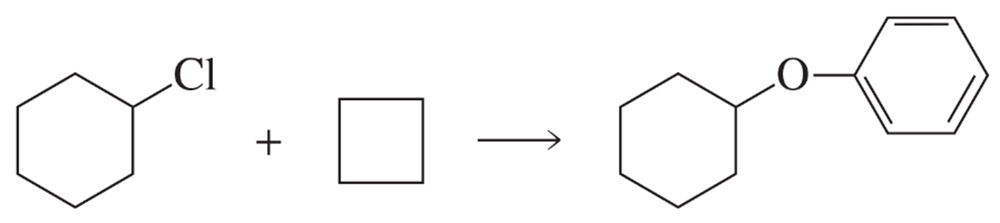
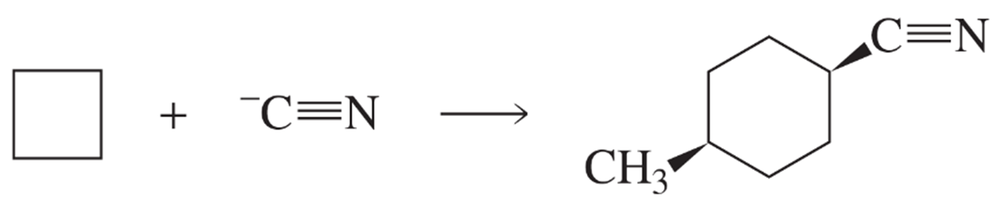
Fill in the squares in the following chemical equations: c. d.
Verified step by step guidance
1
Step 1: Analyze the first reaction. The starting material is cyclohexyl chloride (C6H11Cl), and the product is cyclohexyl phenyl ether (C6H11-O-C6H5). This suggests that the missing reactant in the square is phenol (C6H5OH), which reacts with cyclohexyl chloride in the presence of a base to form the ether.
Step 2: For the first reaction, the mechanism likely involves a nucleophilic substitution (SN2 or SN1) where phenol acts as the nucleophile, attacking the electrophilic carbon attached to the chlorine atom in cyclohexyl chloride.
Step 3: Analyze the second reaction. The product is a substituted cyclohexane with a methyl group and a cyano group (-C≡N) attached. This suggests that the missing reactant in the square is methylcyclohexane (C6H11CH3), which reacts with cyanide ion (CN⁻) in a substitution reaction.
Step 4: For the second reaction, the mechanism likely involves a nucleophilic substitution (SN2) where the cyanide ion attacks the electrophilic carbon in methylcyclohexane, replacing a leaving group (likely a halide such as bromine or chlorine).
Step 5: Ensure that the reaction conditions for both reactions are appropriate. For the first reaction, a base like NaOH or KOH may be required to deprotonate phenol and enhance its nucleophilicity. For the second reaction, polar aprotic solvents like DMSO or acetone may be used to facilitate the SN2 mechanism.
Verified video answer for a similar problem:
This video solution was recommended by our tutors as helpful for the problem above
Video duration:
2m
Play a video:
0 Comments
Key Concepts
Here are the essential concepts you must grasp in order to answer the question correctly.
Balancing Chemical Equations
Balancing chemical equations is essential in organic chemistry as it ensures that the number of atoms for each element is the same on both sides of the equation. This reflects the law of conservation of mass, which states that matter cannot be created or destroyed in a chemical reaction. Understanding how to balance equations involves identifying reactants and products, and adjusting coefficients to achieve equilibrium.
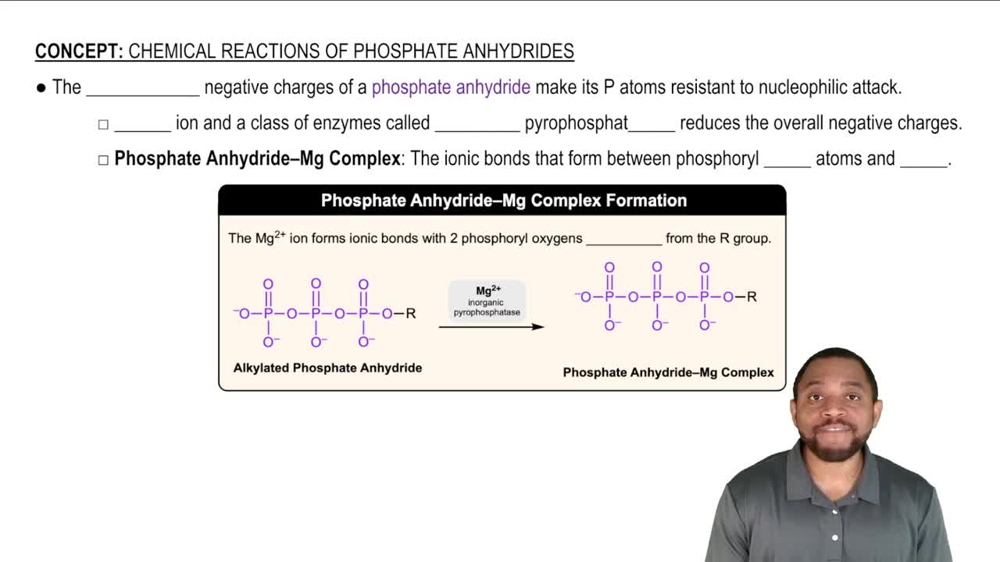
Chemical Reactions of Phosphate Anhydrides Concept 1
Functional Groups
Functional groups are specific groups of atoms within molecules that are responsible for the characteristic chemical reactions of those molecules. In organic chemistry, recognizing functional groups is crucial for predicting the behavior of compounds during reactions. Common functional groups include hydroxyl (-OH), carboxyl (-COOH), and amine (-NH2), each imparting distinct properties and reactivity to the organic molecules they are part of.
Reaction mechanisms describe the step-by-step process by which reactants are converted into products in a chemical reaction. Understanding these mechanisms is vital for predicting the outcome of reactions and for designing new synthetic pathways in organic chemistry. Key concepts include nucleophiles, electrophiles, and intermediates, which help explain how bonds are formed and broken during the reaction.