What would the yield be if two more steps (each with an 80% yield) were added to the synthesis?
Verified step by step guidance
1
Step 1: Understand the concept of yield in a multi-step synthesis. The yield of a synthesis is calculated by multiplying the yields of each individual step. For example, if a synthesis has three steps with yields of 80%, 90%, and 70%, the overall yield is calculated as (0.8 × 0.9 × 0.7).
Step 2: Analyze the given synthesis. The image shows a three-step reaction sequence starting with acetylene (HC≡CH) and ending with 1,2-ethanediol (HOCH2CH2OH). Each step has a specific yield, and the problem asks about adding two more steps, each with an 80% yield.
Step 3: Assume the yield of the existing synthesis is known or calculated. If the yield of the current three-step synthesis is Y_current, the addition of two more steps with 80% yield each will modify the overall yield. The new yield can be calculated as Y_new = Y_current × (0.8 × 0.8).
Step 4: Multiply the yield of the existing synthesis by the yields of the additional steps. For example, if the current yield is 50%, the new yield would be calculated as 0.5 × 0.8 × 0.8.
Step 5: Ensure that the final yield is expressed as a percentage. After performing the multiplication, convert the decimal result back into a percentage by multiplying by 100. This gives the overall yield of the synthesis after adding the two steps.
Verified video answer for a similar problem:
This video solution was recommended by our tutors as helpful for the problem above
Video duration:
3m
Play a video:
0 Comments
Key Concepts
Here are the essential concepts you must grasp in order to answer the question correctly.
Reaction Yield
Reaction yield refers to the amount of product obtained from a chemical reaction compared to the theoretical maximum amount possible. It is often expressed as a percentage, calculated by dividing the actual yield by the theoretical yield and multiplying by 100. Understanding yield is crucial for evaluating the efficiency of a synthesis process, especially when multiple steps are involved.
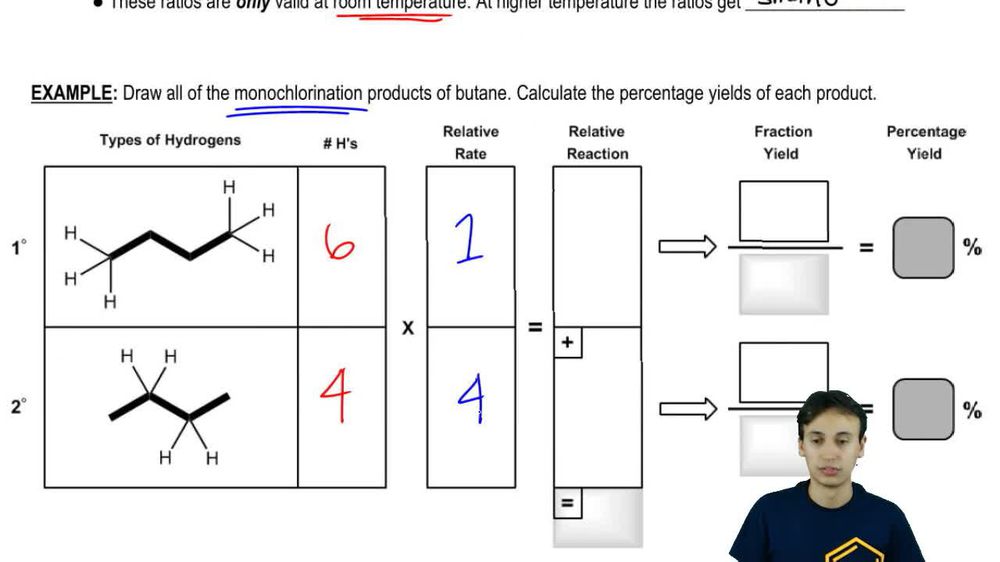
Draw all of the monochlorination products and calculate percentage yields.
Sequential Reactions
In organic chemistry, sequential reactions involve a series of chemical transformations where the product of one reaction serves as the reactant for the next. Each step can have its own yield, which affects the overall yield of the final product. When calculating the total yield of a multi-step synthesis, the yields of each step must be multiplied together to determine the cumulative effect on the final product.
Lindlar's catalyst is a specific type of palladium catalyst that is used to selectively hydrogenate alkynes to cis-alkenes without further reducing them to alkanes. It is crucial in organic synthesis for controlling the degree of hydrogenation. Understanding its role helps in predicting the products of reactions involving alkynes and the subsequent steps in a synthesis pathway.

 3:27 minutes
 Verified step by step guidance
 04:37
04:37