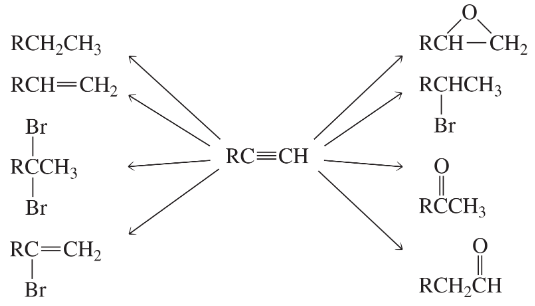
What reagents should be used to carry out the following syntheses?
Verified step by step guidance
1
Identify the starting material and the product. The starting material is an alkyne, and the product is an aldehyde.
Recognize that the transformation involves converting an alkyne to an aldehyde. This suggests a hydration reaction that stops at the aldehyde stage.
Consider the use of hydroboration-oxidation, which is a common method to convert terminal alkynes to aldehydes. This involves two main steps: hydroboration followed by oxidation.
For hydroboration, use a reagent like disiamylborane or 9-BBN (9-borabicyclo[3.3.1]nonane) to add across the triple bond in a syn addition manner.
For the oxidation step, use hydrogen peroxide (H₂O₂) in the presence of a base like sodium hydroxide (NaOH) to convert the boron intermediate into the aldehyde.
Verified video answer for a similar problem:
This video solution was recommended by our tutors as helpful for the problem above
Video duration:
4m
Play a video:
0 Comments
Key Concepts
Here are the essential concepts you must grasp in order to answer the question correctly.
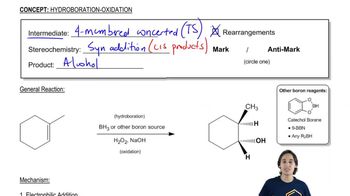
Hydroboration-Oxidation
Hydroboration-oxidation is a two-step reaction process used to convert alkenes or alkynes into alcohols. In the first step, an alkene or alkyne reacts with borane (BH3) to form an organoborane intermediate. The second step involves oxidation, typically using hydrogen peroxide (H2O2) in a basic solution, which converts the organoborane into an alcohol, resulting in anti-Markovnikov addition.
The primary reagents for hydroboration include borane (BH3) or its derivatives, such as diborane (B2H6), which can effectively add across the triple bond of an alkyne. These reagents are crucial for the initial step of the hydroboration process, allowing for the formation of the organoborane intermediate that will later be oxidized to yield the alcohol product.
Alkynes are reactive compounds due to the presence of a carbon-carbon triple bond, which is more reactive than double or single bonds. This reactivity allows alkynes to undergo various addition reactions, including hydroboration. Understanding the reactivity of alkynes is essential for predicting the products of reactions and selecting appropriate reagents for synthesis.