Explain why compound A has two stereoisomers but compounds B and C exist as single compounds.
Verified step by step guidance
1
Step 1: Analyze the structures of compounds A, B, and C. Compound A has a positively charged nitrogen atom bonded to four different groups: a methyl group, a hydrogen atom, an ethyl group, and a carbonyl group. This makes the nitrogen atom a stereogenic center, allowing for two stereoisomers (R and S configurations).
Step 2: Examine compound B. The nitrogen atom in compound B is also positively charged and bonded to four different groups: a methyl group, a hydrogen atom, another methyl group, and a carbonyl group. However, two of the groups are identical (methyl groups), which means the nitrogen atom is not a stereogenic center, and compound B exists as a single compound.
Step 3: Evaluate compound C. The nitrogen atom in compound C is neutral and has a lone pair of electrons. It is bonded to three groups: a methyl group, a hydrogen atom, and a carbonyl group. Since the nitrogen atom is sp2 hybridized and planar, it does not have a stereogenic center, and compound C exists as a single compound.
Step 4: Understand the concept of stereoisomers. Stereoisomers arise when a molecule has a stereogenic center (a carbon or nitrogen atom bonded to four different groups) and can exist in two non-superimposable mirror image forms. Compound A meets this criterion, while compounds B and C do not.
Step 5: Summarize the reasoning. Compound A has two stereoisomers due to the presence of a stereogenic nitrogen atom bonded to four different groups. Compound B lacks stereoisomers because it has two identical groups bonded to the nitrogen atom, and compound C lacks stereoisomers because its nitrogen atom is planar and not stereogenic.
Verified video answer for a similar problem:
This video solution was recommended by our tutors as helpful for the problem above
Video duration:
8m
Play a video:
0 Comments
Key Concepts
Here are the essential concepts you must grasp in order to answer the question correctly.
Stereoisomerism
Stereoisomerism occurs when compounds have the same molecular formula and connectivity of atoms but differ in the spatial arrangement of their atoms. This can lead to different physical and chemical properties. Compounds A has two stereoisomers due to the presence of a chiral center, which allows for non-superimposable mirror images.
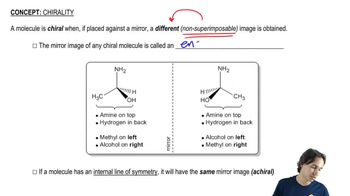
Chirality is a property of a molecule that makes it non-superimposable on its mirror image, often due to the presence of a carbon atom bonded to four different substituents. In compound A, the nitrogen atom creates a chiral center, leading to two distinct stereoisomers. In contrast, compounds B and C lack such chiral centers, resulting in only one form.
Geometric isomerism, a subtype of stereoisomerism, arises from the restricted rotation around a double bond or a ring structure, leading to different spatial arrangements of substituents. Compounds B and C may have double bonds or cyclic structures that do not allow for geometric isomerism, thus existing as single compounds without stereoisomers.