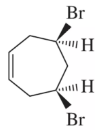
A molecule of the type shown here is discussed in greater detail in Section 6.5.1. Draw the mirror image. Is it superimposable? Switch the spatial orientation at both asymmetric centers. Have you generated a new molecule?
Verified step by step guidance
1
Step 1: Identify the asymmetric centers in the molecule. In the given structure, the two carbon atoms bonded to bromine (Br) and hydrogen (H) are asymmetric centers because they are bonded to four different groups.
Step 2: Draw the mirror image of the molecule. To do this, reflect the spatial orientation of the substituents (Br and H) at each asymmetric center across a vertical plane. For example, if Br is coming out of the plane (wedge), it will go into the plane (dash) in the mirror image, and vice versa for H.
Step 3: Determine if the mirror image is superimposable on the original molecule. Superimposability means that the mirror image can be aligned perfectly with the original molecule in three-dimensional space. If the molecule is chiral, the mirror image will not be superimposable.
Step 4: Switch the spatial orientation at both asymmetric centers. This involves interchanging the positions of the substituents (Br and H) at each asymmetric center. For example, if Br is on a wedge and H is on a dash, swap their positions.
Step 5: Analyze whether the new molecule generated by switching the spatial orientation at both asymmetric centers is identical to the original molecule or a different molecule. If the new molecule is not superimposable on the original, it is a stereoisomer (specifically, an enantiomer).
Verified video answer for a similar problem:
This video solution was recommended by our tutors as helpful for the problem above
Play a video:
0 Comments
Key Concepts
Here are the essential concepts you must grasp in order to answer the question correctly.
Chirality
Chirality refers to the geometric property of a molecule that makes it non-superimposable on its mirror image, much like how left and right hands are mirror images but cannot be perfectly aligned. Molecules with chirality typically contain one or more asymmetric centers, usually carbon atoms bonded to four different substituents, leading to two distinct enantiomers.
Asymmetric centers, or chiral centers, are atoms in a molecule that are bonded to four different groups or atoms. The presence of these centers is crucial for determining the chirality of a molecule, as they create the potential for two non-superimposable mirror images, known as enantiomers, which can exhibit different chemical properties and biological activities.
Stereoisomerism is a form of isomerism where molecules have the same molecular formula and connectivity of atoms but differ in the spatial arrangement of their atoms. This includes enantiomers, which are stereoisomers that are mirror images of each other, and diastereomers, which are not. Understanding stereoisomerism is essential for predicting the behavior and reactivity of chiral molecules in chemical reactions.

 Verified step by step guidance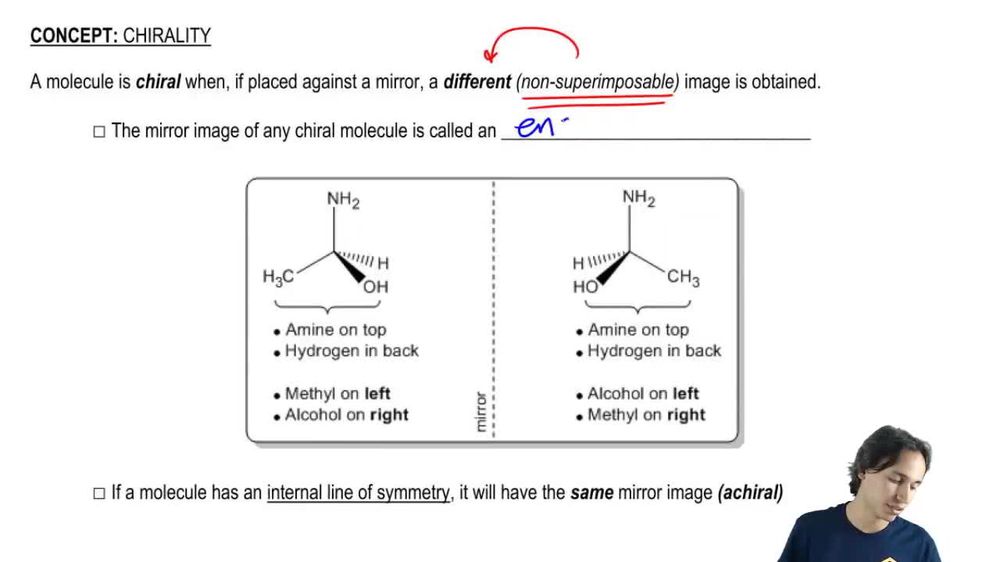
 05:10
05:10