Ch. 28 - Pericyclic Reactions
Bruice - Organic Chemistry 8th Edition
Bruice8th EditionOrganic ChemistryISBN: 9780135213711Not the one you use?Change textbook
Chapter 25, Problem 42

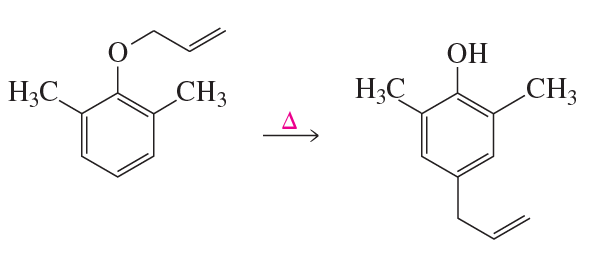
Propose a mechanism for the following reaction:
Chemical reaction diagram illustrating the Claisen rearrangement mechanism with reactants and products labeled.

Verified step by step guidance
1
Step 1: Identify the functional groups in the starting material. The molecule contains an ether group (-O-) attached to a benzene ring and an allylic group. The reaction conditions indicate heat (Δ), which suggests a rearrangement or elimination mechanism.
Step 2: Recognize the likely mechanism. Heating often promotes a Claisen rearrangement in allyl aryl ethers. This involves the migration of the allyl group to the ortho or para position of the benzene ring via a concerted pericyclic reaction.
Step 3: Draw the transition state for the Claisen rearrangement. The allyl group undergoes a [3,3]-sigmatropic rearrangement, where the bond between the oxygen and the allyl group breaks, and a new bond forms between the allyl group and the ortho position of the benzene ring.
Step 4: After the rearrangement, the intermediate formed is an ortho-allyl phenol. The hydroxyl group (-OH) is generated as the ether bond is cleaved during the rearrangement.
Step 5: Verify the final product. The structure of the product shows the allyl group attached to the ortho position of the benzene ring, and the hydroxyl group (-OH) is present on the benzene ring, confirming the Claisen rearrangement mechanism.

Verified video answer for a similar problem:

This video solution was recommended by our tutors as helpful for the problem above.
Video duration:
10m
Was this helpful?

Key Concepts

Here are the essential concepts you must grasp in order to answer the question correctly.

Claisen Rearrangement

The Claisen rearrangement is a thermal reaction involving the rearrangement of allyl aryl ethers to ortho- and para-substituted phenols. This reaction proceeds through a concerted mechanism, where the bond between the oxygen and the carbon atom is broken, and a new bond is formed, resulting in the migration of the allyl group. Understanding this rearrangement is crucial for predicting the products of the reaction shown in the image.
Recommended video:
Guided course
06:08
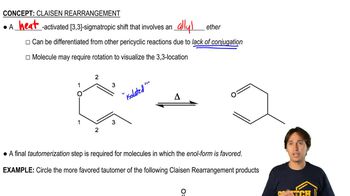
Definition of Claisen Rearrangement

Mechanistic Pathway

A mechanistic pathway outlines the step-by-step sequence of events that occur during a chemical reaction. In the case of the Claisen rearrangement, it involves the formation of a cyclic transition state, where the electrons are redistributed, leading to the formation of the final product. Analyzing the mechanistic pathway helps in understanding how the reactants transform into products and the role of intermediates in the reaction.
Recommended video:
2:13
Energy Production In Biochemical Pathways Concept 1

Thermal Activation

Thermal activation refers to the energy input required to initiate a chemical reaction, often provided by heat. In the Claisen rearrangement, heating the reaction mixture facilitates the necessary bond breaking and formation processes. Recognizing the importance of thermal activation is essential for predicting the conditions under which the reaction will proceed and for optimizing reaction yields.
Recommended video:
Guided course
06:36
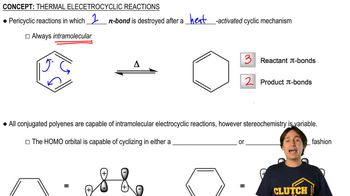
MO Theory of Thermal Electrocyclics