Ch. 20 - The Organic Chemistry of Carbohydrates
Bruice - Organic Chemistry 8th Edition
Bruice8th EditionOrganic ChemistryISBN: 9780135213711Not the one you use?Change textbook
Chapter 21, Problem 30b

b. Identify the glycosidic linkage that connects the sugars.

Verified step by step guidance
1
Examine the structure of the disaccharide or polysaccharide provided. Identify the two monosaccharide units that are connected to form the glycosidic bond.
Determine the anomeric carbon of the first sugar (the carbon that was part of the carbonyl group in the open-chain form). This is typically the carbon bonded to two oxygen atoms in the cyclic form.
Identify the hydroxyl group on the second sugar that is involved in the glycosidic bond. This is usually one of the hydroxyl groups attached to a non-anomeric carbon.
Analyze the stereochemistry of the glycosidic bond. Determine whether the bond is in the α (alpha) configuration (the anomeric oxygen is trans to the CH₂OH group) or the β (beta) configuration (the anomeric oxygen is cis to the CH₂OH group).
Specify the position of the glycosidic linkage by noting the carbon numbers of the two sugars involved in the bond (e.g., 1→4, 1→6). Combine this with the stereochemistry (α or β) to fully describe the glycosidic linkage.

Verified video answer for a similar problem:

This video solution was recommended by our tutors as helpful for the problem above.
Was this helpful?

Key Concepts

Here are the essential concepts you must grasp in order to answer the question correctly.

Glycosidic Linkage

A glycosidic linkage is a type of covalent bond that forms between two monosaccharides through a dehydration reaction, where a water molecule is released. This bond connects the anomeric carbon of one sugar to a hydroxyl group of another, resulting in the formation of disaccharides or polysaccharides. Understanding this linkage is crucial for analyzing carbohydrate structures and their functions.
Recommended video:
Guided course
12:17
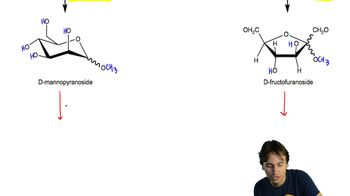
Predict the structure of the glycoside products

Monosaccharides

Monosaccharides are the simplest form of carbohydrates, consisting of single sugar units like glucose, fructose, and galactose. They serve as the building blocks for more complex carbohydrates. Recognizing the structure and properties of monosaccharides is essential for understanding how they combine to form glycosidic linkages and larger carbohydrate molecules.
Recommended video:
Guided course
12:01
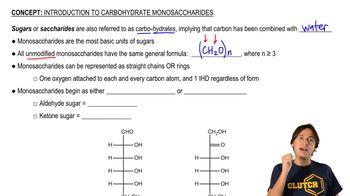
Monosaccharide

Dehydration Synthesis

Dehydration synthesis is a chemical reaction that involves the removal of a water molecule to form a new bond between two molecules. In the context of glycosidic linkages, this process allows monosaccharides to join together, creating larger carbohydrate structures. Grasping this concept is vital for comprehending how carbohydrates are formed and how their structures influence their biological roles.
Recommended video:
Guided course
01:23
General Reaction of Dehydration with POCl3