Identify the bonds that break and form in the following elimination reactions. (a)
Verified step by step guidance
1
Analyze the elimination reaction type: Determine whether the reaction is an E1 or E2 elimination. This depends on factors such as the substrate structure (primary, secondary, or tertiary), the strength of the base, and the reaction conditions (e.g., heat).
Identify the leaving group: Look for the atom or group that will leave the molecule during the elimination process. This is typically a halide (e.g., Cl⁻, Br⁻) or another good leaving group.
Determine the β-hydrogen: Locate the hydrogen atom on the β-carbon (the carbon adjacent to the carbon bearing the leaving group). This hydrogen will be removed during the elimination reaction.
Break the bonds: In the elimination reaction, the bond between the β-hydrogen and the β-carbon breaks, and the bond between the leaving group and the α-carbon (the carbon attached to the leaving group) also breaks.
Form the new bond: A π-bond (double bond) forms between the α-carbon and the β-carbon as a result of the elimination process, creating an alkene product.
Verified video answer for a similar problem:
This video solution was recommended by our tutors as helpful for the problem above
Video duration:
2m
Play a video:
0 Comments
Key Concepts
Here are the essential concepts you must grasp in order to answer the question correctly.
Elimination Reactions
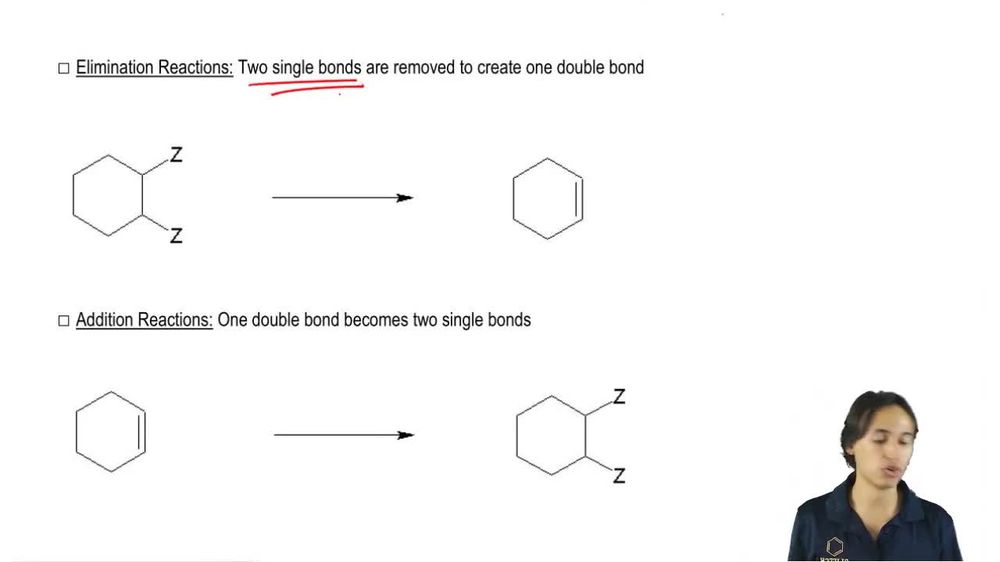
Elimination reactions are a type of organic reaction where two substituents are removed from a molecule, resulting in the formation of a double bond or a ring structure. These reactions typically involve the loss of a leaving group and a hydrogen atom, leading to the creation of alkenes or alkynes. Understanding the mechanism of elimination reactions, such as E1 and E2 pathways, is crucial for predicting the products formed.
In elimination reactions, specific bonds are broken and formed during the transition state. Typically, a carbon-hydrogen (C-H) bond is broken alongside a carbon-leaving group bond (C-X), where X is a leaving group. Simultaneously, a new pi bond (C=C) is formed between the two carbon atoms involved in the reaction. Recognizing which bonds are involved helps in understanding the reaction mechanism and predicting the outcome.
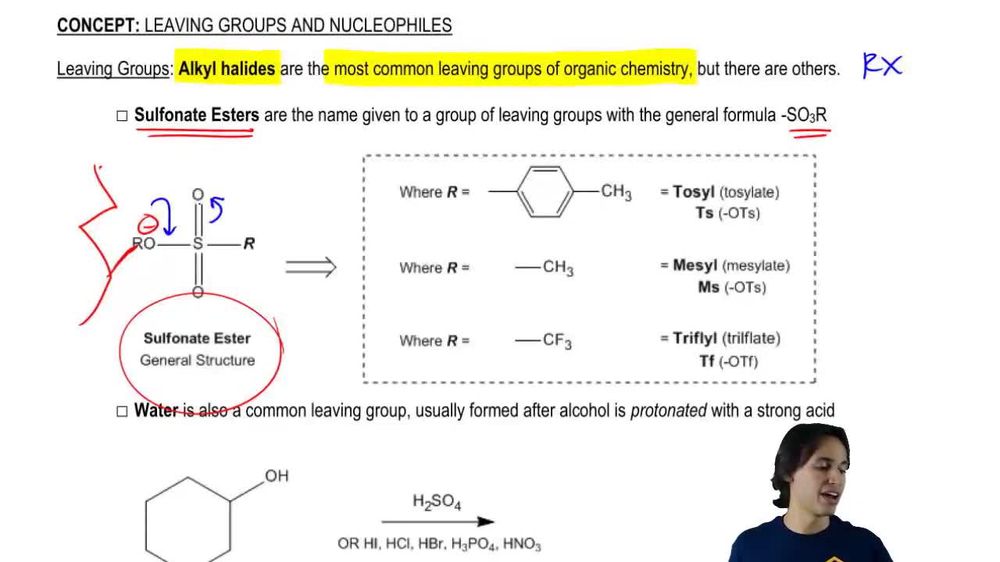
A leaving group is an atom or group of atoms that can depart from the parent molecule during a chemical reaction, facilitating the formation of new bonds. Good leaving groups are typically stable after departure, such as halides (Cl, Br, I) or sulfonate groups. The nature of the leaving group significantly influences the rate and mechanism of elimination reactions, making it essential to identify them when analyzing these processes.

 2:31 minutes
 Verified step by step guidance
 00:40
00:40