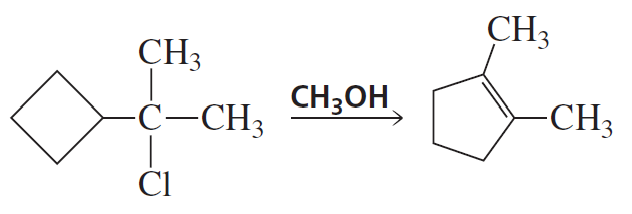
Step 1: Identify the type of reaction taking place. Determine if it is a substitution, elimination, addition, or rearrangement reaction based on the reactants and products provided.
Step 2: Analyze the structure of the reactants and products. Look for functional groups, electron-rich or electron-deficient areas, and any changes in bonding patterns.
Step 3: Determine the role of any reagents or catalysts involved in the reaction. For example, acids, bases, or specific solvents can influence the mechanism.
Step 4: Break down the reaction into individual steps. Start with the initiation step, where bonds are broken or formed, and proceed through intermediates until the final product is formed.
Step 5: Use curved arrows to illustrate the movement of electrons in each step of the mechanism. Ensure that all intermediates and transition states are accounted for, and verify that the mechanism follows the principles of organic chemistry, such as conservation of charge and proper orbital interactions.
Verified video answer for a similar problem:
This video solution was recommended by our tutors as helpful for the problem above
Video duration:
5m
Play a video:
0 Comments
Key Concepts
Here are the essential concepts you must grasp in order to answer the question correctly.
Reaction Mechanism
A reaction mechanism is a step-by-step description of how a chemical reaction occurs at the molecular level. It outlines the sequence of elementary steps, including bond breaking and formation, and the intermediates formed during the process. Understanding the mechanism helps predict the products and the conditions under which the reaction occurs.
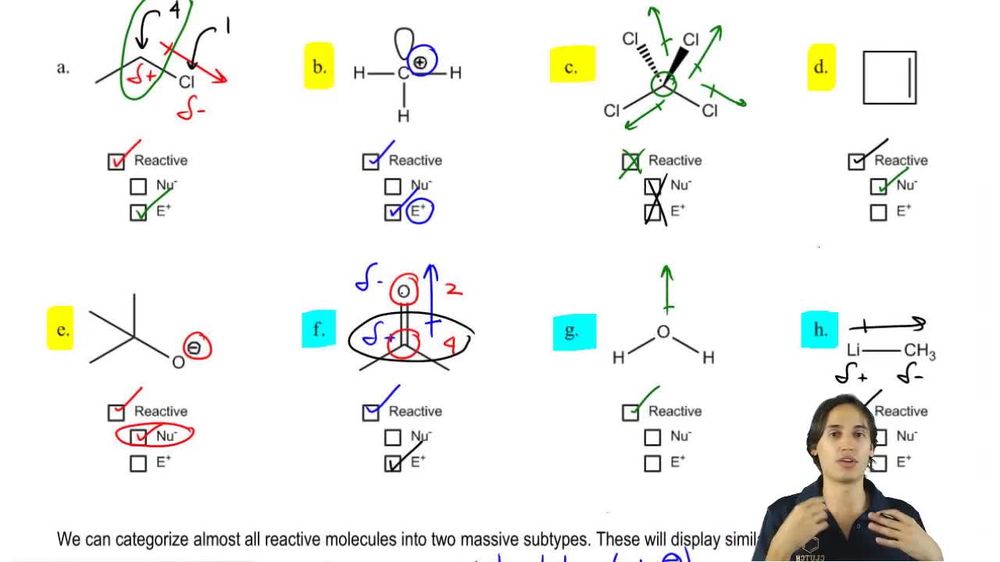
Nucleophiles are species that donate an electron pair to form a chemical bond, while electrophiles are electron-deficient species that accept an electron pair. Identifying these roles in a reaction is crucial for proposing a mechanism, as it determines how reactants interact and transform into products. Recognizing common nucleophiles and electrophiles is essential for understanding organic reactions.
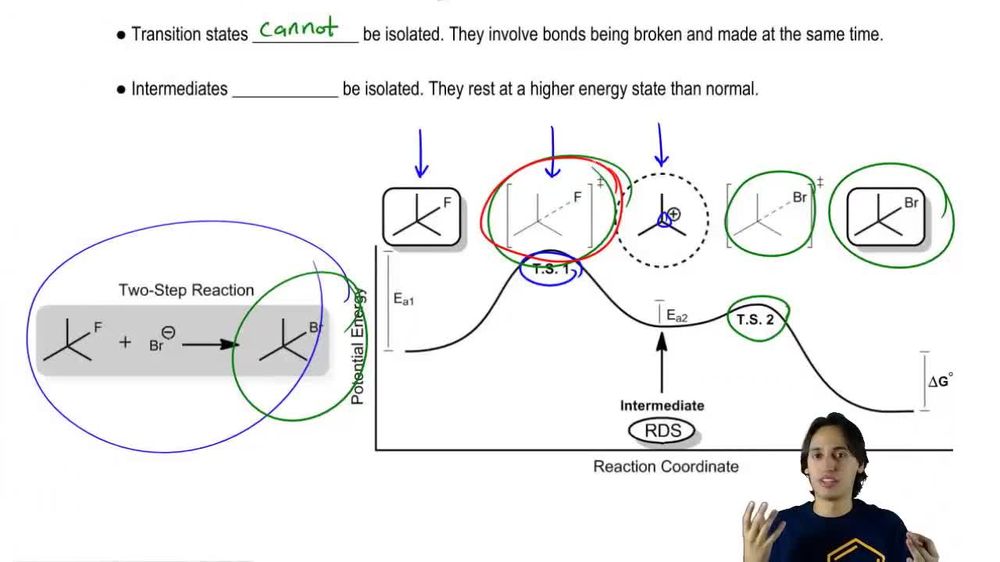
Transition states are high-energy states that occur during the transformation of reactants to products, representing the point of maximum energy along the reaction pathway. Intermediates are species that are formed and consumed during the reaction but are not present in the final products. Analyzing these elements is vital for understanding the energy profile and kinetics of the reaction.