Draw all of the possible spin states to explain why a hydrogen with four neighbors appears as a quintet (quint, five peaks).
Verified step by step guidance
1
Identify the hydrogen atom in question and its neighboring hydrogen atoms. In this case, the hydrogen has four neighboring hydrogens.
Understand the concept of spin-spin coupling in NMR spectroscopy. Each neighboring hydrogen can either align with or against the external magnetic field, creating different spin states.
Calculate the number of possible spin states using the formula 2nI + 1, where n is the number of neighboring hydrogens and I is the spin quantum number of hydrogen (I = 1/2). For four neighbors, this results in 2(4)(1/2) + 1 = 5 spin states.
Draw the possible spin states: Each neighboring hydrogen can be in either the +1/2 or -1/2 spin state. The combinations of these states result in the quintet pattern.
Explain how these spin states lead to the quintet: The different combinations of neighboring hydrogen spins result in five distinct energy levels, which correspond to the five peaks observed in the NMR spectrum.
Verified video answer for a similar problem:
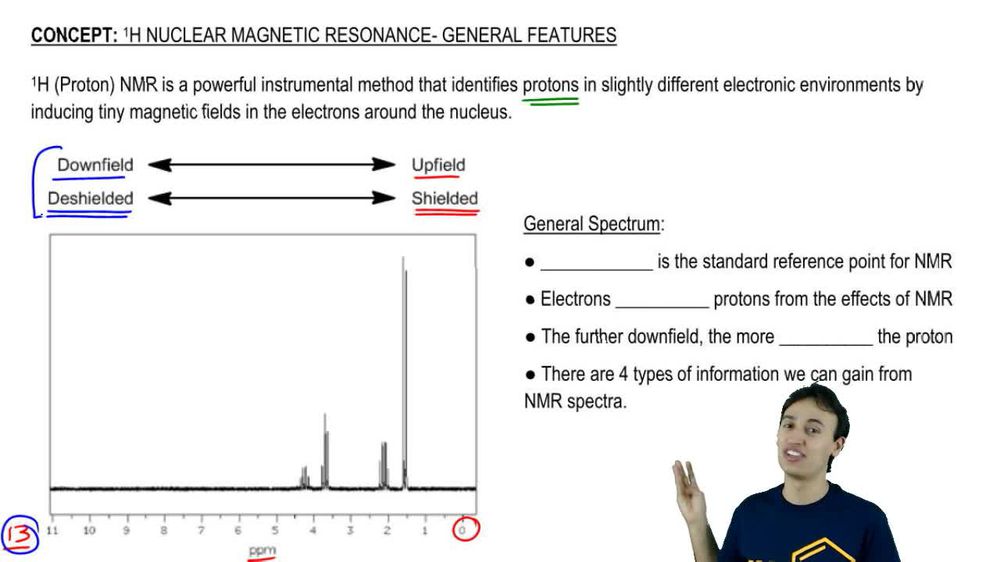
This video solution was recommended by our tutors as helpful for the problem above
Play a video:
0 Comments
Key Concepts
Here are the essential concepts you must grasp in order to answer the question correctly.
Spin States and NMR Spectroscopy
Nuclear Magnetic Resonance (NMR) spectroscopy is a technique used to determine the structure of organic compounds by observing the magnetic properties of atomic nuclei. Spin states refer to the different orientations of nuclear spins in a magnetic field, which result in distinct energy levels. In NMR, these spin states cause splitting patterns in the spectrum, providing insights into the molecular environment of the nuclei.
Coupling in NMR occurs when the magnetic field of one nucleus affects the magnetic field of neighboring nuclei, leading to splitting of NMR signals into multiple peaks, known as multiplets. The number of peaks in a multiplet is determined by the number of neighboring hydrogen atoms plus one (n+1 rule). A quintet, therefore, indicates the presence of four neighboring hydrogens affecting the observed hydrogen.
Pascal's Triangle is a mathematical tool used to predict the relative intensities of peaks in an NMR multiplet. Each row corresponds to the number of neighboring hydrogens, with the coefficients representing the relative intensities of the peaks. For a quintet, the fifth row of Pascal's Triangle (1, 4, 6, 4, 1) shows the pattern of peak intensities, helping to visualize the distribution of spin states.