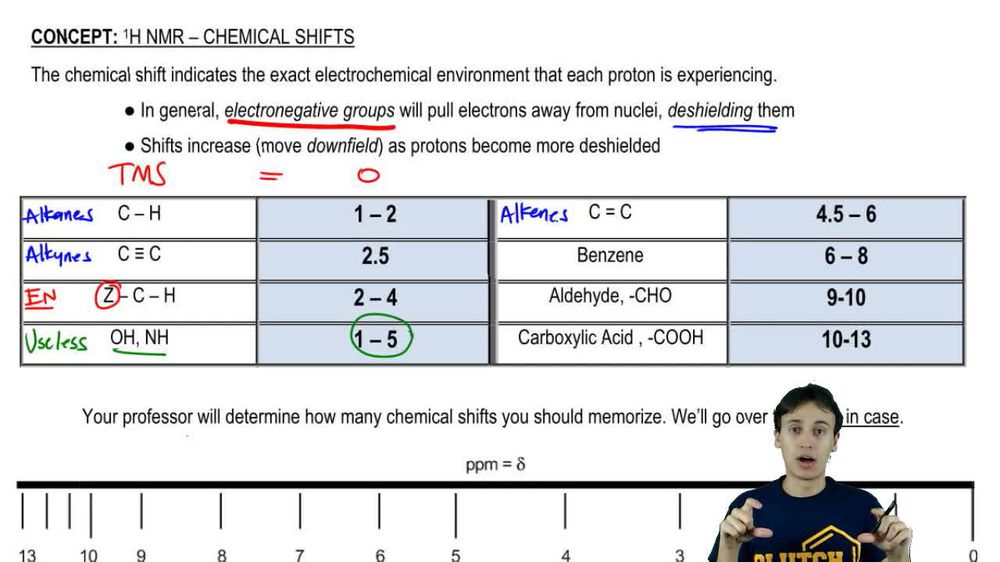
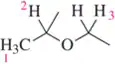
Predict the splitting pattern for each of the indicated hydrogens in Assessment 15.59. (b)
Verified step by step guidance
1
Identify the hydrogen atoms in the molecule that are indicated for analysis. These are the hydrogens whose splitting patterns you need to predict.
Determine the number of neighboring hydrogen atoms for each indicated hydrogen. Remember that neighboring hydrogens are those that are three bonds away, typically on adjacent carbon atoms.
Apply the n+1 rule to predict the splitting pattern for each indicated hydrogen. The n+1 rule states that the number of peaks in the splitting pattern is equal to the number of neighboring hydrogens (n) plus one.
Consider the chemical environment of each indicated hydrogen. Factors such as electronegative atoms or pi bonds nearby can affect the chemical shift and coupling constants, which may influence the splitting pattern.
Summarize the predicted splitting patterns for each indicated hydrogen, taking into account any additional factors that might cause deviations from the simple n+1 rule, such as long-range coupling or equivalent hydrogens.
Verified video answer for a similar problem:
This video solution was recommended by our tutors as helpful for the problem above
Play a video:
0 Comments
Key Concepts
Here are the essential concepts you must grasp in order to answer the question correctly.
NMR Spectroscopy
Nuclear Magnetic Resonance (NMR) Spectroscopy is a technique used to determine the structure of organic compounds by observing the magnetic properties of certain atomic nuclei. In NMR, the splitting pattern of hydrogen signals provides information about the number of neighboring hydrogen atoms, which helps in deducing the molecular structure.
Spin-spin coupling, also known as J-coupling, occurs when the magnetic field of one nucleus affects the magnetic field of a neighboring nucleus. This interaction causes the splitting of NMR signals into multiplets, with the number of peaks in a multiplet indicating the number of adjacent hydrogens plus one (n+1 rule).
Chemical shift in NMR refers to the resonant frequency of a nucleus relative to a standard in a magnetic field. It provides information about the electronic environment surrounding the nucleus. Different chemical environments cause shifts in the resonance frequency, allowing for the identification of different types of hydrogen atoms in a molecule.

 Verified step by step guidance
 10:06
10:06