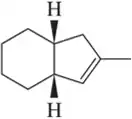
Predict the product(s) that would result when the alkenes are allowed to react under the following conditions: (i) Br2 (k)
Verified step by step guidance
1
Step 1: Recognize the type of reaction. The reaction involves an alkene reacting with bromine (Br₂). This is a halogenation reaction, specifically the addition of bromine across the double bond of the alkene.
Step 2: Understand the mechanism. Bromine reacts with the alkene via an electrophilic addition mechanism. The π-electrons of the alkene double bond attack the bromine molecule, forming a bromonium ion intermediate.
Step 3: Analyze the stereochemistry. The bromonium ion intermediate is cyclic and prevents free rotation. Bromine ions (Br⁻) will attack the more accessible side of the bromonium ion, leading to anti-addition (the two bromine atoms will add to opposite sides of the double bond).
Step 4: Predict the product. The final product will be a vicinal dibromide, where two bromine atoms are added to adjacent carbons of the original double bond. If the alkene is symmetrical, only one product will form. If the alkene is asymmetrical, consider regioselectivity and stereochemistry to determine the possible products.
Step 5: Verify the structure. Draw the structure of the product(s) based on the anti-addition mechanism and confirm that the bromine atoms are added to the correct carbons with the appropriate stereochemistry.
Verified video answer for a similar problem:
This video solution was recommended by our tutors as helpful for the problem above
Play a video:
0 Comments
Key Concepts
Here are the essential concepts you must grasp in order to answer the question correctly.
Electrophilic Addition
Electrophilic addition is a fundamental reaction mechanism in organic chemistry where an electrophile reacts with a nucleophile, typically involving alkenes. In the case of alkenes reacting with Br₂, the double bond acts as a nucleophile, attacking the electrophilic bromine molecule, leading to the formation of a cyclic bromonium ion intermediate.
Bromination is a specific type of electrophilic addition where bromine (Br₂) adds across the double bond of an alkene. This reaction results in the formation of vicinal dibromides, where bromine atoms are added to adjacent carbon atoms. The stereochemistry of the product can vary, leading to both anti and syn addition products.
Stereochemistry refers to the spatial arrangement of atoms in molecules and how this affects their chemical behavior. In the bromination of alkenes, the formation of a bromonium ion intermediate leads to the possibility of anti-addition, resulting in products that can exhibit different stereochemical configurations, such as enantiomers or diastereomers.

 Verified step by step guidance
 09:23
09:23