In which of the two steps in the alkene halogenation mechanism does a redox reaction occur?
Verified step by step guidance
1
Step 1: Begin by understanding the alkene halogenation mechanism. This reaction involves two main steps: (1) the formation of a halonium ion intermediate and (2) the nucleophilic attack by the halide ion.
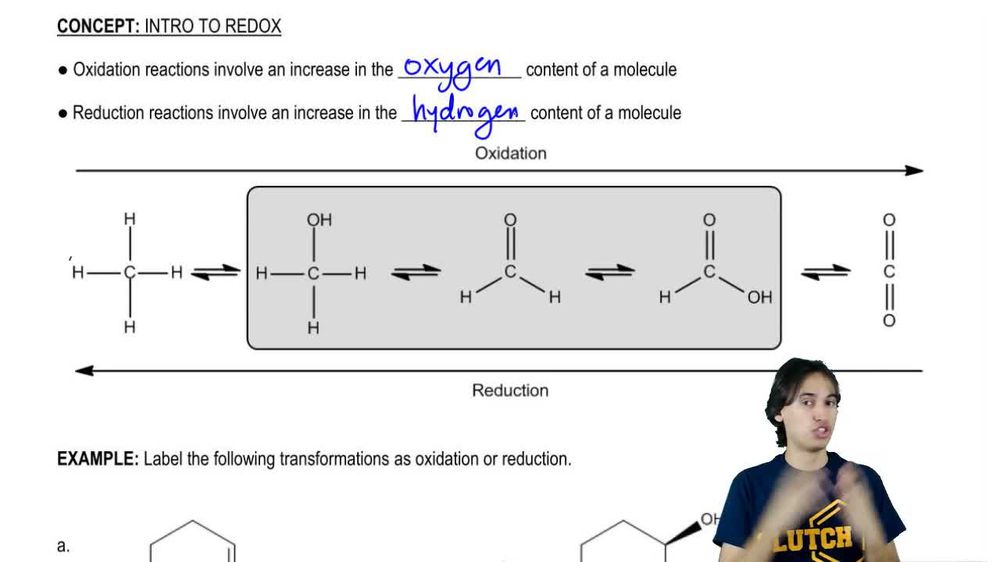
Step 2: Recall the definition of a redox reaction. A redox reaction involves the transfer of electrons, where one species is oxidized (loses electrons) and another is reduced (gains electrons).
Step 3: Analyze the first step of the mechanism. When the halogen molecule (e.g., Br₂ or Cl₂) approaches the alkene, the π-electrons of the alkene attack the halogen, forming a halonium ion. In this step, the halogen molecule is reduced as it gains electrons, and the alkene is oxidized as it loses electrons. This is a redox reaction.
Step 4: Examine the second step of the mechanism. The halide ion (e.g., Br⁻ or Cl⁻) attacks the halonium ion to open the ring and form the final dihalogenated product. This step does not involve a transfer of electrons in the sense of oxidation or reduction, so it is not a redox reaction.
Step 5: Conclude that the redox reaction occurs in the first step of the alkene halogenation mechanism, where the halogen molecule is reduced and the alkene is oxidized.
Verified video answer for a similar problem:
This video solution was recommended by our tutors as helpful for the problem above
Play a video:
0 Comments
Key Concepts
Here are the essential concepts you must grasp in order to answer the question correctly.
Alkene Halogenation Mechanism
The alkene halogenation mechanism involves the addition of halogens (like Cl2 or Br2) to an alkene, resulting in a vicinal dihalide. This process typically occurs in two main steps: the formation of a cyclic halonium ion and the subsequent nucleophilic attack by a halide ion. Understanding this mechanism is crucial for identifying where redox reactions may take place.
Redox reactions involve the transfer of electrons between species, resulting in changes in oxidation states. In the context of alkene halogenation, the halogen molecule is reduced as it forms a halonium ion, while the alkene is oxidized. Recognizing these electron transfer processes is essential for pinpointing the steps in which redox reactions occur.
Oxidation states are a way to keep track of electron transfer in chemical reactions. In the alkene halogenation mechanism, the oxidation state of the carbon atoms in the alkene changes as they bond with halogen atoms. Understanding how to assign and interpret oxidation states helps in identifying the specific steps where redox reactions happen.

 Verified step by step guidance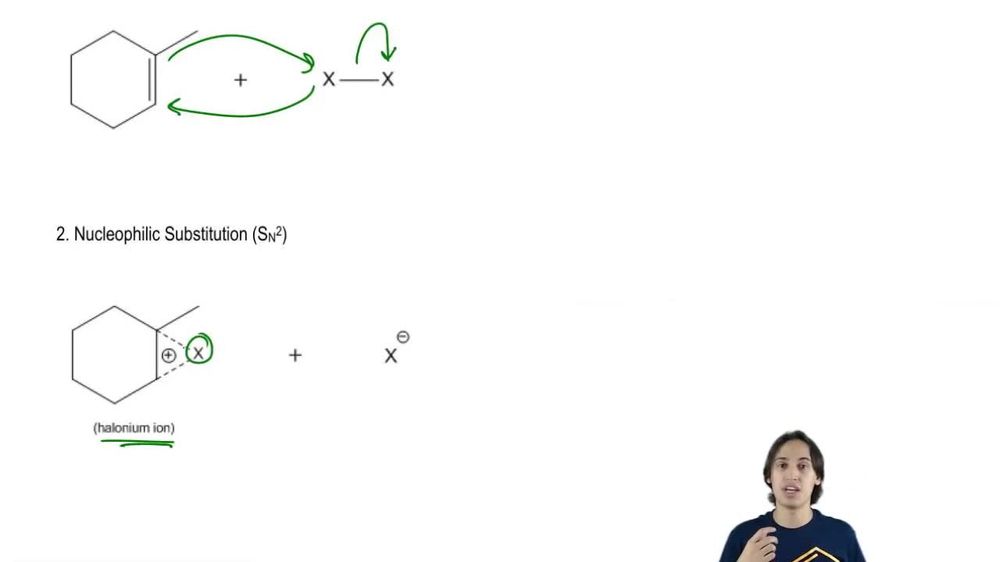
 03:45
03:45