Ch. 7 - The Reactions of Alkynes • An Introduction to Multistep Synthesis
Bruice - Organic Chemistry 8th Edition
Bruice8th EditionOrganic ChemistryISBN: 9780135213711Not the one you use?Change textbook
Chapter 8, Problem 39i

What is the major product of the reaction of 1 mol of propyne with each of the following reagents?
i. sodium amide

Verified step by step guidance
1
Step 1: Understand the structure of propyne. Propyne is an alkyne with the molecular formula C3H4. Its structure includes a triple bond between the first and second carbon atoms (CH≡C-CH3). The terminal hydrogen on the first carbon is acidic due to the sp hybridization of the carbon atom.
Step 2: Recognize the role of sodium amide (NaNH2) in the reaction. Sodium amide is a strong base that can deprotonate the acidic terminal hydrogen of propyne, forming a carbanion (acetylide ion). This reaction is a typical acid-base reaction.
Step 3: Write the chemical equation for the reaction. The reaction can be represented as: CH≡C-CH3 + NaNH2 → CH≡C⁻ + Na⁺ + NH3. Here, the acetylide ion (CH≡C⁻) is formed as the major product.
Step 4: Understand the significance of the acetylide ion. The acetylide ion is a nucleophile and can participate in further reactions, such as alkylation or addition reactions, depending on the reagents added subsequently.
Step 5: Note that no additional products are formed in this step unless further reagents are introduced. The major product of this reaction is the acetylide ion (CH≡C⁻), which is stabilized by the sodium cation (Na⁺).

Verified video answer for a similar problem:

This video solution was recommended by our tutors as helpful for the problem above.
Video duration:
3m
Was this helpful?

Key Concepts

Here are the essential concepts you must grasp in order to answer the question correctly.

Alkynes and Their Reactivity

Alkynes, such as propyne, are hydrocarbons containing at least one carbon-carbon triple bond. This triple bond makes alkynes more reactive than alkenes and alkanes, allowing them to undergo various reactions, including nucleophilic substitutions and eliminations. Understanding the reactivity of alkynes is crucial for predicting the products of their reactions with different reagents.
Recommended video:
Guided course
09:11
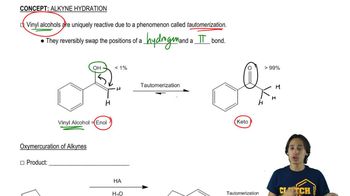
Alkyne Hydration

Nucleophilic Substitution Reactions

Nucleophilic substitution reactions involve the replacement of a leaving group by a nucleophile. In the case of propyne reacting with sodium amide (NaNH2), the amide ion acts as a strong nucleophile, attacking the terminal carbon of the alkyne. This reaction can lead to the formation of an alkyne anion, which can further react with electrophiles to form new products.
Recommended video:
Guided course
01:47
Nucleophiles and Electrophiles can react in Substitution Reactions.

Formation of Alkynide Ions

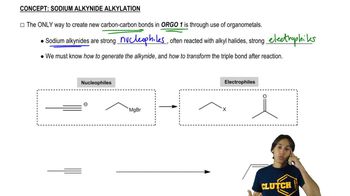
When propyne reacts with sodium amide, it can generate an alkynide ion, which is a negatively charged species formed by deprotonation of the terminal hydrogen of the alkyne. This ion is highly reactive and can participate in further reactions, such as nucleophilic attacks on alkyl halides, leading to the formation of larger carbon chains. Recognizing the formation of alkynide ions is essential for predicting the major product of the reaction.
Recommended video:
Guided course
03:19
Sodium Alkynide Alkylation