Using only your intuition, rank the following covalent bonds in terms of their polarity (1 = most polar; 6 = least polar). [You can use the periodic trend of electronegativity, but don't use actual numbers.] (a) C―C (b) C―O (c) C―H (d) C―F (e) C―Cl (f) C―S
Verified step by step guidance
1
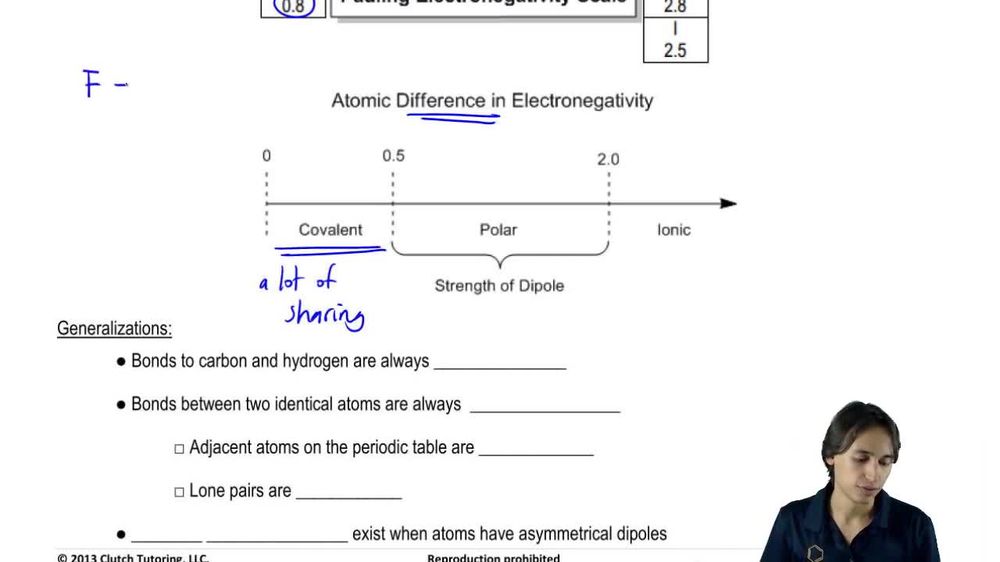
Step 1: Recall the concept of bond polarity. Bond polarity arises due to the difference in electronegativity between two atoms in a covalent bond. The greater the difference in electronegativity, the more polar the bond.
Step 2: Use the periodic trend of electronegativity. Electronegativity increases across a period (left to right) and decreases down a group (top to bottom) in the periodic table. For example, fluorine (F) is the most electronegative element, while sulfur (S) is less electronegative than oxygen (O) or chlorine (Cl).
Step 3: Compare the electronegativity of carbon (C) with each of the other atoms in the bonds provided: (a) C―C (same atoms, no electronegativity difference, nonpolar bond), (b) C―O (oxygen is more electronegative than carbon), (c) C―H (carbon and hydrogen have a small electronegativity difference), (d) C―F (fluorine is much more electronegative than carbon), (e) C―Cl (chlorine is more electronegative than carbon, but less so than fluorine), and (f) C―S (sulfur is slightly less electronegative than carbon).
Step 4: Rank the bonds in terms of polarity based on the electronegativity differences. The bond with the largest electronegativity difference will be the most polar, and the bond with the smallest or no electronegativity difference will be the least polar.
Step 5: Arrange the bonds in order of polarity: (1 = most polar, 6 = least polar). Based on the periodic trends, the ranking should be: (1) C―F, (2) C―O, (3) C―Cl, (4) C―H, (5) C―S, (6) C―C. Verify this ranking by consulting Figure 2.20 as instructed in the problem.
Verified video answer for a similar problem:
This video solution was recommended by our tutors as helpful for the problem above
Video duration:
4m
Play a video:
0 Comments
Key Concepts
Here are the essential concepts you must grasp in order to answer the question correctly.
Electronegativity
Electronegativity is a measure of an atom's ability to attract and hold onto electrons in a covalent bond. It varies across the periodic table, generally increasing from left to right and decreasing from top to bottom. This property is crucial for determining bond polarity, as a greater difference in electronegativity between two atoms leads to a more polar bond.
Covalent bonding occurs when two atoms share electrons to achieve a full outer shell, resulting in a stable molecule. The nature of the bond can vary in polarity depending on the electronegativity of the atoms involved. Understanding the types of covalent bonds—nonpolar, polar, and ionic—is essential for ranking their polarity.
Differences between ionic, polar and covalent bonds
Polarity of Bonds
The polarity of a bond refers to the distribution of electrical charge across the bond. A polar bond has a significant difference in electronegativity between the two atoms, leading to partial positive and negative charges. In contrast, nonpolar bonds have equal sharing of electrons. Recognizing the polarity helps in predicting molecular behavior and interactions.

 4:55 minutes
 Verified step by step guidance

 1:47
1:47