Rank the following elements from least electronegative to most electronegative. Na, Si, F, Mg, C, O, N
Verified step by step guidance
1
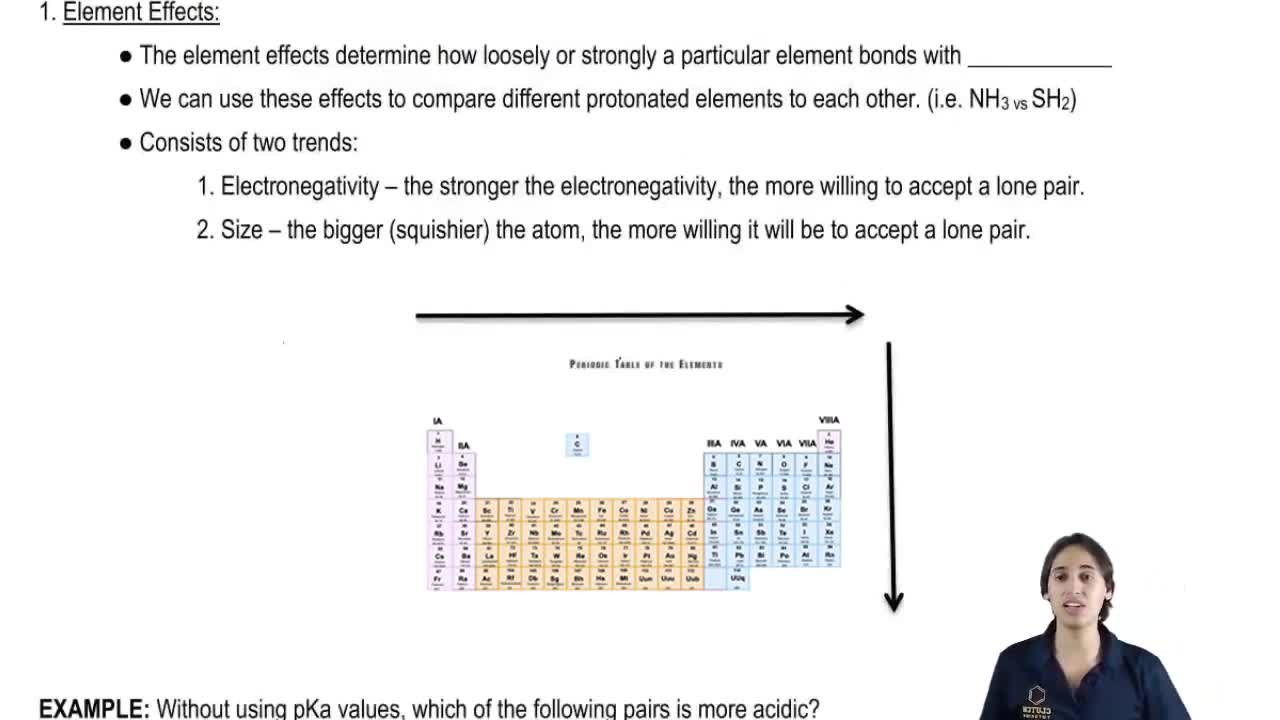
Understand the concept of electronegativity: Electronegativity is the ability of an atom to attract electrons in a chemical bond. It generally increases across a period (left to right) in the periodic table and decreases down a group (top to bottom).
Locate the elements on the periodic table: Identify the positions of Na, Si, F, Mg, C, O, and N in the periodic table. Note their group and period numbers.
Compare trends across periods: Within the same period, electronegativity increases as you move from left to right. For example, Na (Group 1) will have lower electronegativity than Si (Group 14), and Si will have lower electronegativity than F (Group 17).
Compare trends within groups: Electronegativity decreases as you move down a group. For example, Mg (Group 2, Period 3) will have lower electronegativity than elements like C, N, O, and F, which are in higher periods.
Rank the elements: Based on their positions in the periodic table and the trends in electronegativity, arrange the elements from least electronegative to most electronegative. Use the general rule that metals (e.g., Na, Mg) are less electronegative than nonmetals (e.g., C, N, O, F).
Verified video answer for a similar problem:
This video solution was recommended by our tutors as helpful for the problem above
Video duration:
3m
Play a video:
0 Comments
Key Concepts
Here are the essential concepts you must grasp in order to answer the question correctly.
Electronegativity
Electronegativity is a measure of an atom's ability to attract and hold onto electrons in a chemical bond. It is a key factor in determining the nature of bonds between atoms, influencing whether they will form ionic or covalent bonds. The Pauling scale is commonly used to quantify electronegativity, with higher values indicating greater ability to attract electrons.
Periodic trends refer to the predictable patterns observed in the properties of elements across the periodic table. Electronegativity generally increases from left to right across a period and decreases from top to bottom within a group. Understanding these trends helps in predicting the behavior of elements in chemical reactions and their bonding characteristics.
When ranking elements by electronegativity, it is essential to compare their positions in the periodic table. For example, fluorine (F) is the most electronegative element, while sodium (Na) and magnesium (Mg) are less electronegative due to their positions in groups 1 and 2. This comparison allows for a systematic ranking of the elements based on their electronegativity values.

 3:20 minutes
 Verified step by step guidance

 1:47
1:47