For which of the following reactions would you expect elimination to be more favored than substitution? (f)
Verified step by step guidance
1
Step 1: Understand the key factors that influence whether elimination or substitution is favored. These include the nature of the substrate, the type of base/nucleophile, the solvent, and the reaction conditions (temperature). Elimination reactions are generally favored by strong bases, higher temperatures, and sterically hindered substrates.
Step 2: Analyze the substrate. If the substrate is tertiary (3°), elimination is often favored over substitution due to steric hindrance, which makes it difficult for the nucleophile to attack the carbon directly for substitution.
Step 3: Consider the base/nucleophile. Strong, bulky bases (e.g., tert-butoxide) tend to favor elimination because they are sterically hindered and less likely to act as nucleophiles for substitution.
Step 4: Evaluate the solvent. Polar protic solvents (e.g., water, alcohols) tend to favor elimination reactions, especially E1 mechanisms, because they stabilize the carbocation intermediate formed during elimination.
Step 5: Assess the reaction conditions. Higher temperatures generally favor elimination reactions over substitution because elimination has a higher activation energy, and increased thermal energy helps overcome this barrier.
Verified video answer for a similar problem:
This video solution was recommended by our tutors as helpful for the problem above
Video duration:
6m
Play a video:
0 Comments
Key Concepts
Here are the essential concepts you must grasp in order to answer the question correctly.
Elimination vs. Substitution Reactions
Elimination reactions involve the removal of atoms or groups from a molecule, resulting in the formation of a double bond, while substitution reactions involve replacing one atom or group with another. The preference for one type over the other can depend on factors such as the structure of the substrate, the nature of the leaving group, and the reaction conditions.
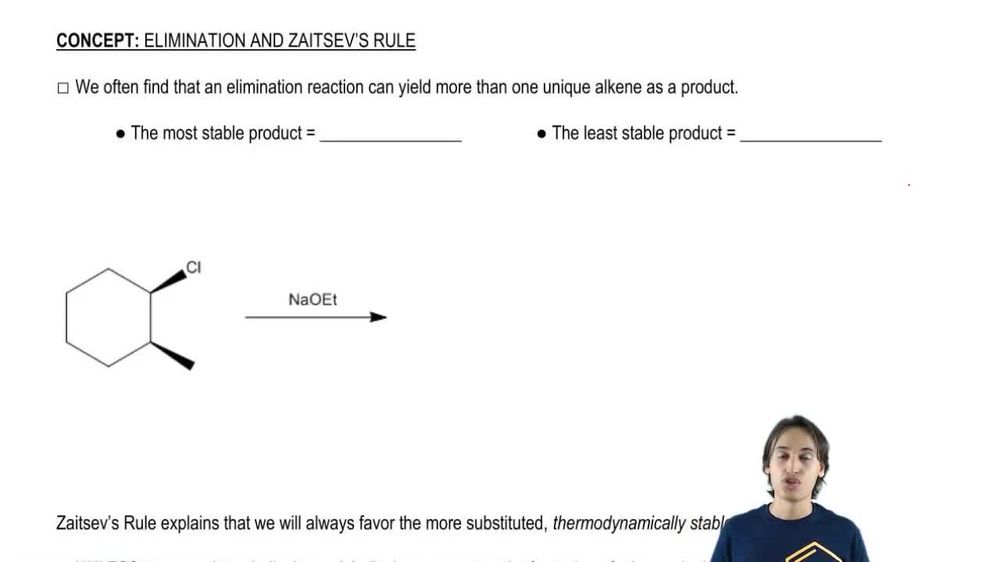
Zaitsev's Rule states that in elimination reactions, the more substituted alkene (the one with more alkyl groups attached to the double bond) is typically the major product. This principle helps predict the outcome of elimination reactions and is crucial for understanding when elimination is favored over substitution.
The conditions under which a reaction occurs, such as temperature, solvent, and concentration, can significantly influence whether elimination or substitution is favored. For example, higher temperatures often favor elimination reactions, while lower temperatures may favor substitution, making it essential to consider these factors when analyzing reaction pathways.

 6:31 minutes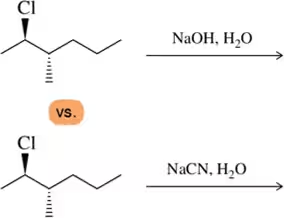
 Verified step by step guidance

 00:38
00:38