Predict the products of the following reactions. (c) benzyl bromide + sodium cyanide
Verified step by step guidance
1
Step 1: Identify the type of reaction. Benzyl bromide reacts with sodium cyanide (NaCN) in a nucleophilic substitution reaction. The bromine atom is a good leaving group, and the cyanide ion (CN⁻) acts as a nucleophile.
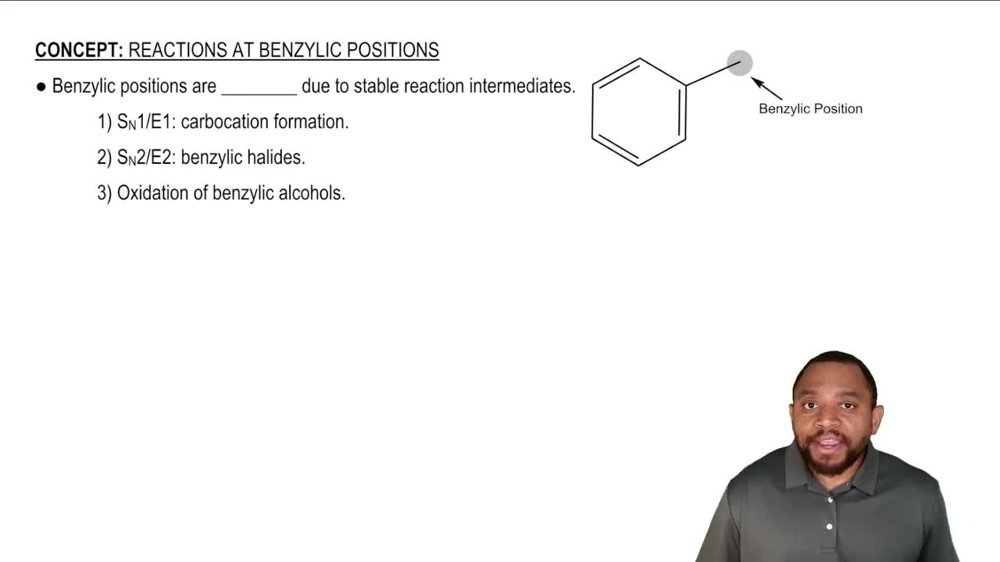
Step 2: Analyze the structure of benzyl bromide. Benzyl bromide consists of a benzene ring attached to a CH₂ group, which is further bonded to a bromine atom. The CH₂-Br bond is susceptible to nucleophilic attack.
Step 3: Determine the mechanism. This reaction typically proceeds via an SN2 mechanism because the benzyl position is sterically unhindered, allowing the cyanide ion to directly attack the carbon bonded to bromine.
Step 4: Predict the product. The cyanide ion replaces the bromine atom, forming benzyl cyanide (C₆H₅CH₂CN). The benzene ring remains intact, and the CH₂ group is now bonded to the cyanide group.
Step 5: Write the chemical equation. The reaction can be represented as: .
Verified video answer for a similar problem:
This video solution was recommended by our tutors as helpful for the problem above
Video duration:
1m
Play a video:
0 Comments
Key Concepts
Here are the essential concepts you must grasp in order to answer the question correctly.
Nucleophilic Substitution
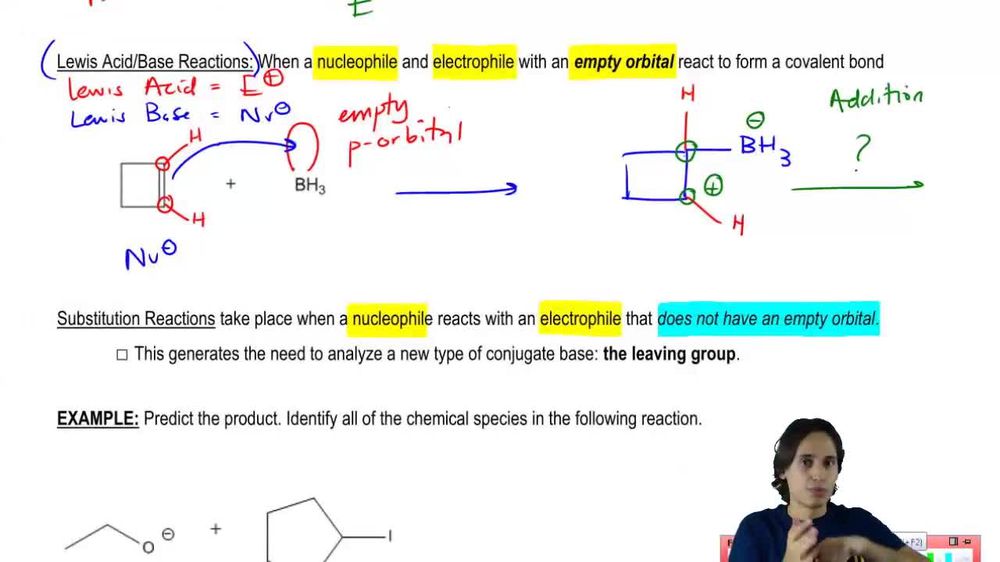
Nucleophilic substitution is a fundamental reaction in organic chemistry where a nucleophile attacks an electrophile, resulting in the replacement of a leaving group. In this case, sodium cyanide (NaCN) acts as the nucleophile, attacking the carbon atom bonded to the bromine in benzyl bromide, leading to the formation of a new bond and the release of bromide ion.
Nucleophiles and Electrophiles can react in Substitution Reactions.
Benzyl Bromide Reactivity
Benzyl bromide is a primary alkyl halide, which makes it highly reactive towards nucleophiles due to the accessibility of the carbon atom bonded to the bromine. The presence of the benzyl group stabilizes the transition state during the nucleophilic substitution, facilitating the reaction with sodium cyanide to form benzyl cyanide.
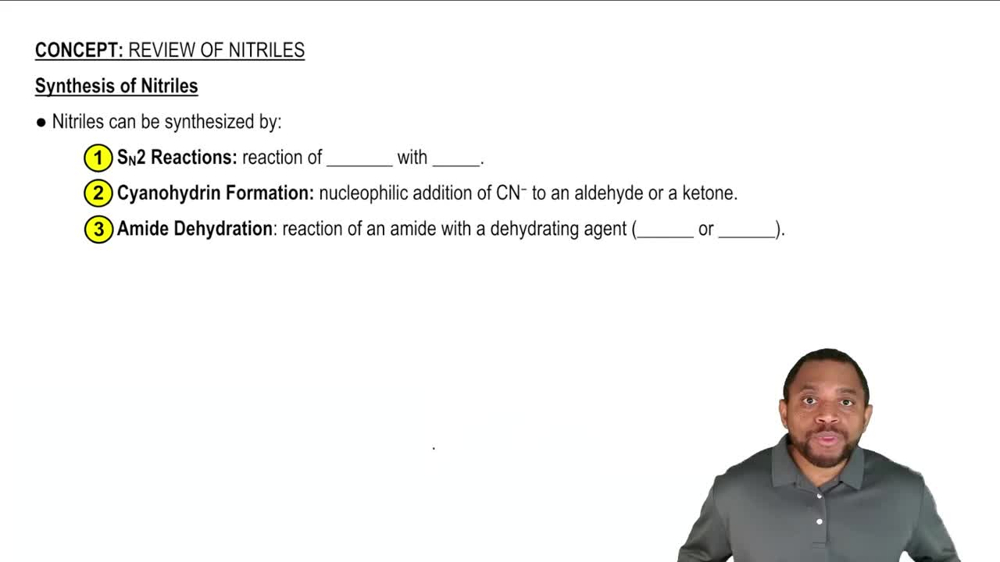
The reaction of benzyl bromide with sodium cyanide results in the formation of a nitrile, specifically benzyl cyanide. Nitriles are characterized by the presence of a cyano group (-C≡N), which is formed when the nucleophile (cyanide ion) replaces the leaving group (bromide ion). This transformation is significant in organic synthesis, as nitriles can be further converted into various functional groups.

 1:47 minutes
 Verified step by step guidance
 01:47
01:47