Propose an SN1 mechanism for the solvolysis of 3-bromo-2,3-dimethylpentane in ethanol.
Verified step by step guidance
1
Identify the substrate: The compound 3-bromo-2,3-dimethylpentane is a tertiary alkyl halide. Tertiary alkyl halides are highly favorable for SN1 reactions due to the stability of the carbocation intermediate formed during the reaction.
Step 1: Initiation of the reaction begins with the departure of the leaving group (bromide ion, Br⁻) from the substrate. This step is the rate-determining step and results in the formation of a tertiary carbocation at the 3rd carbon of the pentane chain.
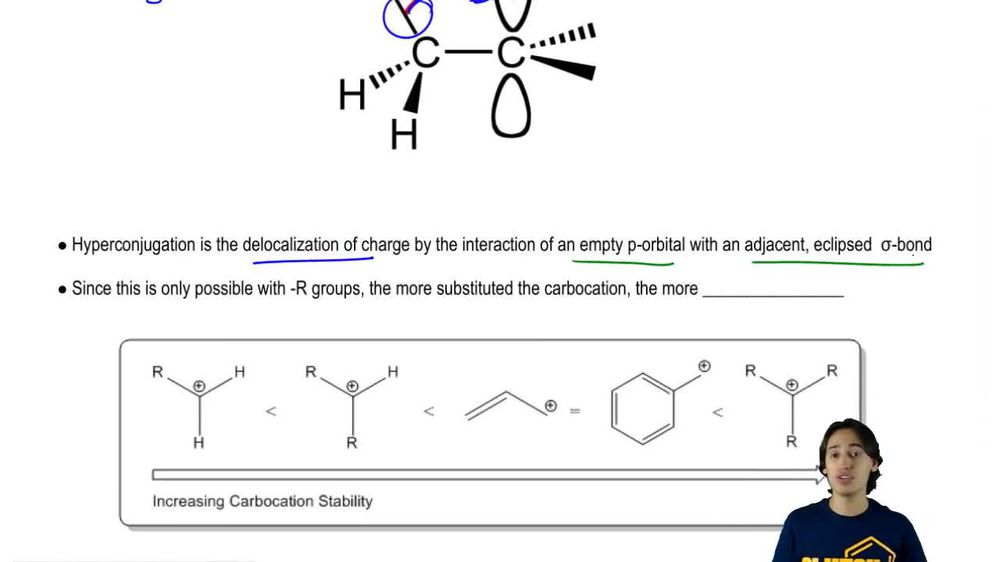
Step 2: Analyze the stability of the carbocation. The tertiary carbocation formed is stabilized by hyperconjugation and inductive effects from the surrounding alkyl groups. No rearrangement is necessary as the carbocation is already in its most stable form.
Step 3: Nucleophilic attack by ethanol (CH₃CH₂OH). The lone pair of electrons on the oxygen atom of ethanol attacks the positively charged carbocation, forming an oxonium ion intermediate.
Step 4: Deprotonation of the oxonium ion. A molecule of ethanol or another base in the solution removes a proton (H⁺) from the oxonium ion, resulting in the formation of the final product, an ether (3-ethoxy-2,3-dimethylpentane).
Verified video answer for a similar problem:
This video solution was recommended by our tutors as helpful for the problem above
Video duration:
7m
Play a video:
0 Comments
Key Concepts
Here are the essential concepts you must grasp in order to answer the question correctly.
SN1 Mechanism
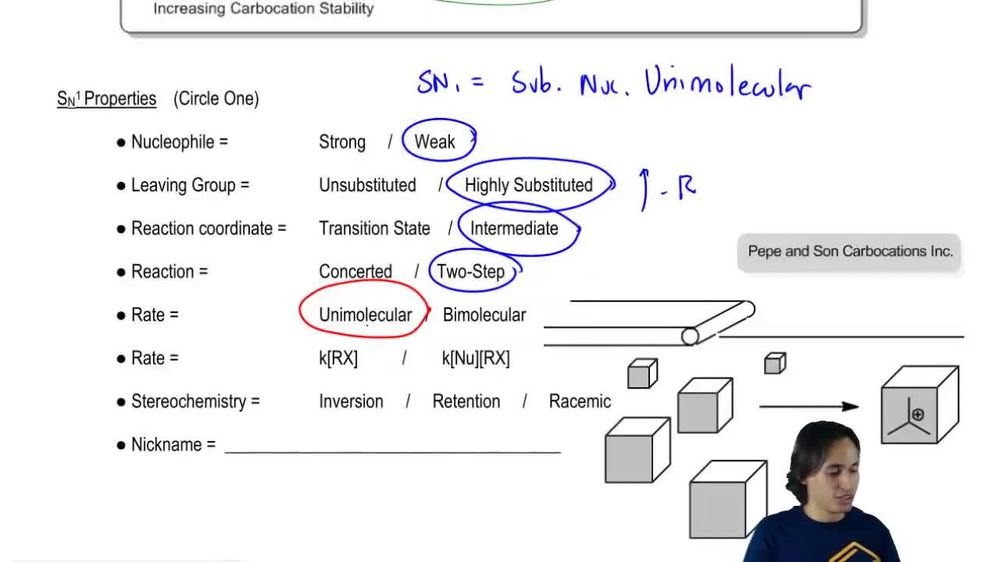
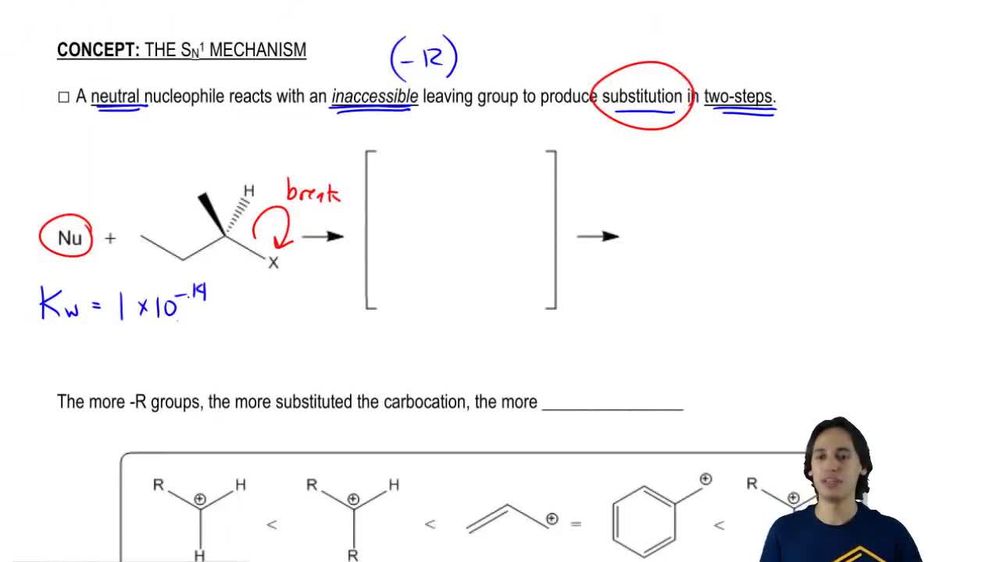
The SN1 mechanism, or unimolecular nucleophilic substitution, involves two main steps: the formation of a carbocation intermediate and the subsequent nucleophilic attack. The rate-determining step is the first step, where the leaving group departs, leading to a positively charged carbocation. This mechanism is favored in tertiary substrates due to their ability to stabilize the carbocation through hyperconjugation and inductive effects.
Carbocation stability is crucial in determining the feasibility of an SN1 reaction. Tertiary carbocations are more stable than secondary or primary ones due to the greater number of alkyl groups that can donate electron density through hyperconjugation and inductive effects. In the case of 3-bromo-2,3-dimethylpentane, the formation of a tertiary carbocation is favored, making the SN1 pathway more likely.
Solvolysis refers to a chemical reaction in which the solvent acts as a nucleophile, leading to the substitution of a leaving group. In this context, ethanol serves as the solvent and nucleophile, attacking the carbocation formed during the SN1 mechanism. The nature of the solvent can significantly influence the reaction rate and mechanism, with polar protic solvents like ethanol stabilizing the carbocation and facilitating the reaction.

 7:09 minutes
 Verified step by step guidance
 10:49
10:49