Give the SN1 mechanism for the formation of 2-ethoxy-3-methylbutane, the unrearranged product in this reaction.
Verified step by step guidance
1
Step 1: Identify the substrate and the conditions for the reaction. The substrate is 3-methyl-2-butanol, and the reaction occurs under acidic conditions, which favor the SN1 mechanism. SN1 reactions proceed via a two-step process involving the formation of a carbocation intermediate.
Step 2: Protonation of the alcohol group (-OH) occurs under acidic conditions. The hydroxyl group is converted into a better leaving group, such as water (H₂O), by reacting with H⁺ from the acid.
Step 3: The leaving group (H₂O) departs, forming a carbocation intermediate. The carbocation is formed at the 2-position of the 3-methylbutane structure, resulting in a secondary carbocation. This step is the rate-determining step of the SN1 mechanism.
Step 4: Nucleophilic attack occurs. The ethoxide ion (CH₃CH₂O⁻) acts as the nucleophile and attacks the carbocation at the 2-position, forming a new bond between the ethoxy group and the carbocation.
Step 5: The final product, 2-ethoxy-3-methylbutane, is formed. This is the unrearranged product because no carbocation rearrangement occurs during the reaction.
Verified video answer for a similar problem:
This video solution was recommended by our tutors as helpful for the problem above
Video duration:
9m
Play a video:
0 Comments
Key Concepts
Here are the essential concepts you must grasp in order to answer the question correctly.
SN1 Mechanism
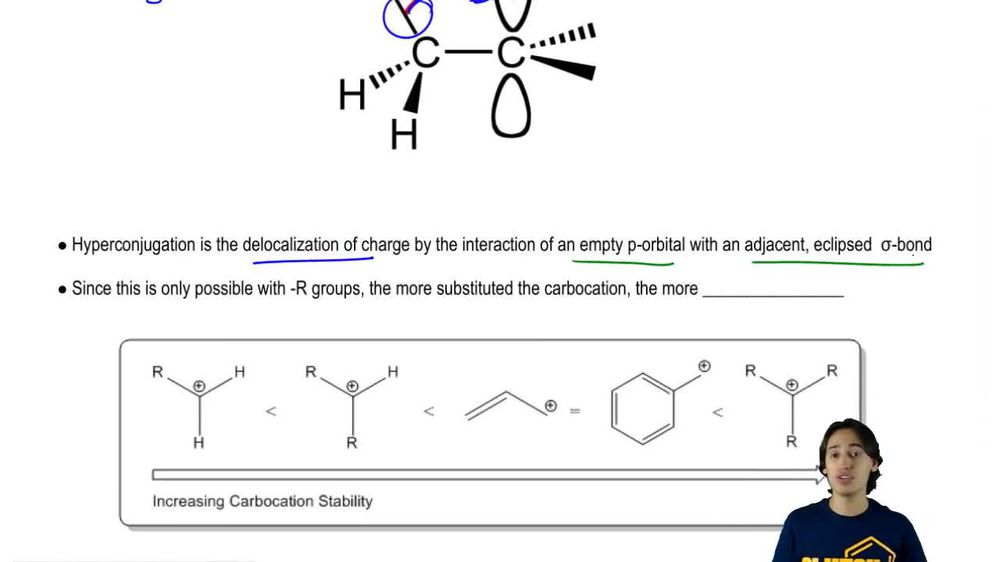
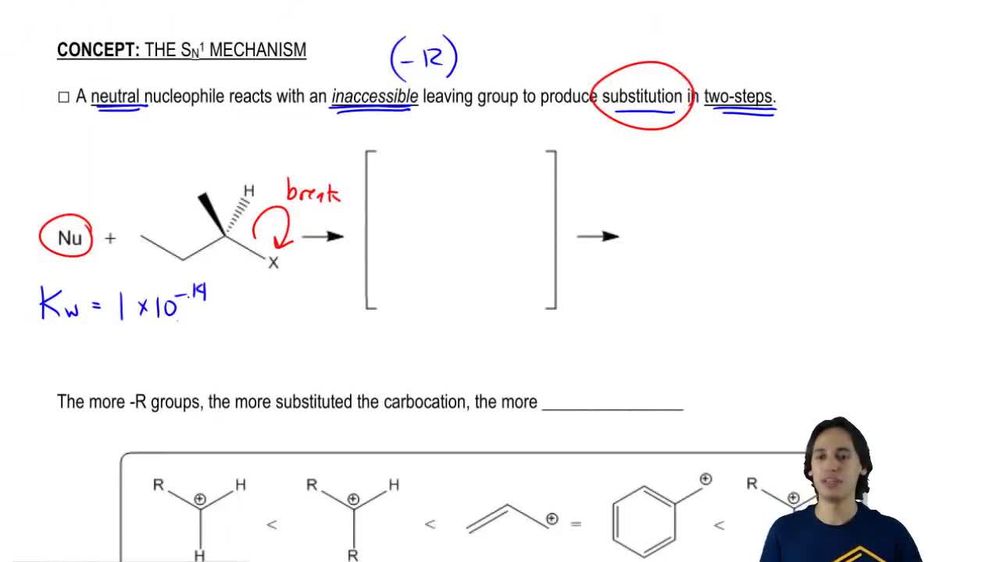
The SN1 mechanism, or unimolecular nucleophilic substitution, involves two main steps: the formation of a carbocation intermediate and the nucleophilic attack. The rate-determining step is the first step, where the leaving group departs, creating a positively charged carbocation. This mechanism is favored in tertiary substrates due to their ability to stabilize the carbocation through hyperconjugation and inductive effects.
Carbocation stability is crucial in SN1 reactions, as more stable carbocations form more readily. Stability increases with the degree of substitution: tertiary > secondary > primary. Factors contributing to stability include hyperconjugation and resonance, which help to delocalize the positive charge. Understanding carbocation stability is essential for predicting the outcome of SN1 reactions.
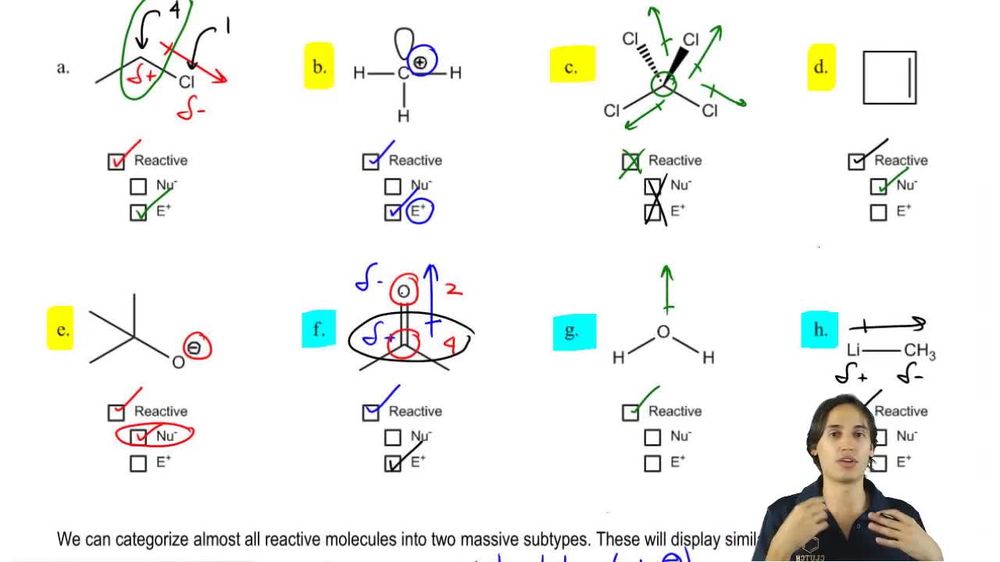
In organic chemistry, nucleophiles are species that donate an electron pair to form a chemical bond, while electrophiles are electron-deficient species that accept electron pairs. In the context of the SN1 mechanism, the nucleophile attacks the carbocation formed after the leaving group departs. The choice of nucleophile can significantly influence the reaction pathway and the final product.