Would you expect acetate ion (CH3CO2−) to be a better nucleophile in an SN2 reaction with an alkyl halide carried out in methanol or in dimethyl sulfoxide?
Verified step by step guidance
1
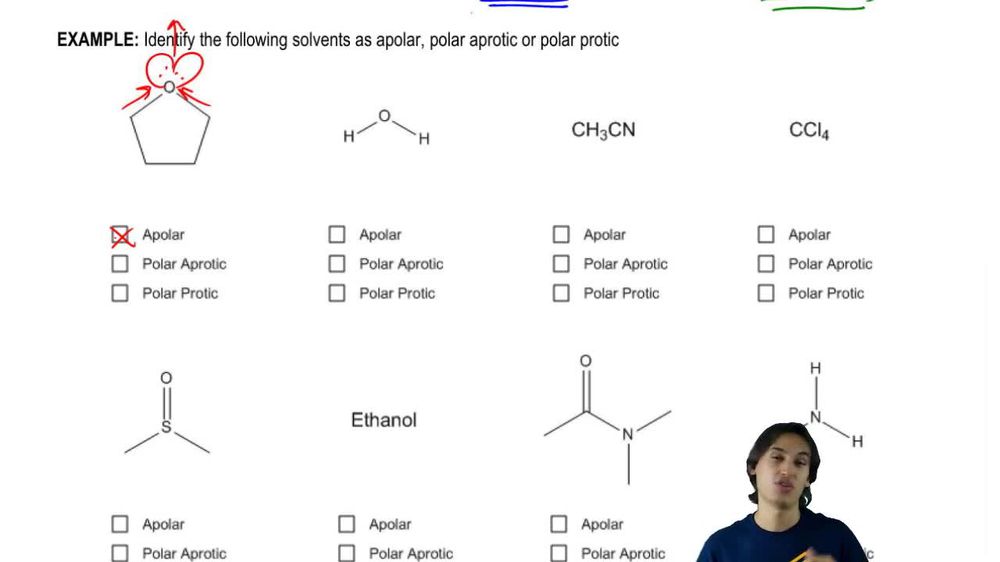
Understand the role of the solvent in an SN2 reaction: In an SN2 reaction, the nucleophile attacks the electrophilic carbon of the alkyl halide in a single concerted step. The solvent can significantly influence the nucleophilicity of the nucleophile. Polar aprotic solvents enhance nucleophilicity, while polar protic solvents can hinder it by stabilizing the nucleophile through hydrogen bonding.
Analyze the solvents given: Methanol (CH3OH) is a polar protic solvent, meaning it has hydrogen atoms capable of forming hydrogen bonds with the nucleophile. Dimethyl sulfoxide (DMSO, (CH3)2SO) is a polar aprotic solvent, meaning it does not have hydrogen atoms that can form hydrogen bonds, but it can stabilize cations without significantly stabilizing the nucleophile.
Consider the acetate ion (CH3CO2−): The acetate ion is a negatively charged nucleophile. In a polar protic solvent like methanol, the acetate ion will be stabilized by hydrogen bonding, reducing its nucleophilicity. In contrast, in a polar aprotic solvent like DMSO, the acetate ion will not be stabilized by hydrogen bonding, allowing it to remain more reactive as a nucleophile.
Relate solvent effects to the SN2 reaction: Since SN2 reactions are favored by strong nucleophiles, the acetate ion will be a better nucleophile in DMSO (polar aprotic solvent) compared to methanol (polar protic solvent). This is because DMSO does not hinder the nucleophile's reactivity, whereas methanol does.
Conclude the comparison: Based on the solvent effects, the acetate ion (CH3CO2−) would be a better nucleophile in an SN2 reaction with an alkyl halide when the reaction is carried out in dimethyl sulfoxide (DMSO) rather than in methanol.
Verified video answer for a similar problem:
This video solution was recommended by our tutors as helpful for the problem above
Video duration:
2m
Play a video:
0 Comments
Key Concepts
Here are the essential concepts you must grasp in order to answer the question correctly.
Nucleophilicity
Nucleophilicity refers to the ability of a species to donate an electron pair to an electrophile, forming a chemical bond. It is influenced by factors such as charge, electronegativity, and solvent effects. In general, negatively charged species like acetate ion are stronger nucleophiles than their neutral counterparts. Understanding nucleophilicity is crucial for predicting the outcome of nucleophilic substitution reactions.
The choice of solvent can significantly impact the rate and mechanism of nucleophilic substitution reactions. Polar protic solvents, like methanol, can stabilize ions through hydrogen bonding, potentially reducing nucleophilicity. In contrast, polar aprotic solvents, such as dimethyl sulfoxide (DMSO), do not stabilize anions as effectively, often leading to increased nucleophilicity. Recognizing how solvents influence reaction dynamics is essential for evaluating reaction conditions.
The S<sub>N</sub>2 mechanism is a type of nucleophilic substitution reaction characterized by a single concerted step where the nucleophile attacks the electrophile, leading to the displacement of a leaving group. This mechanism is bimolecular, meaning the rate depends on the concentration of both the nucleophile and the substrate. Understanding the S<sub>N</sub>2 mechanism is vital for predicting reaction pathways and outcomes in organic chemistry.