How will the rate of each of the following SN2 reactions change if it is carried out in a more polar solvent? c.
Verified step by step guidance
1
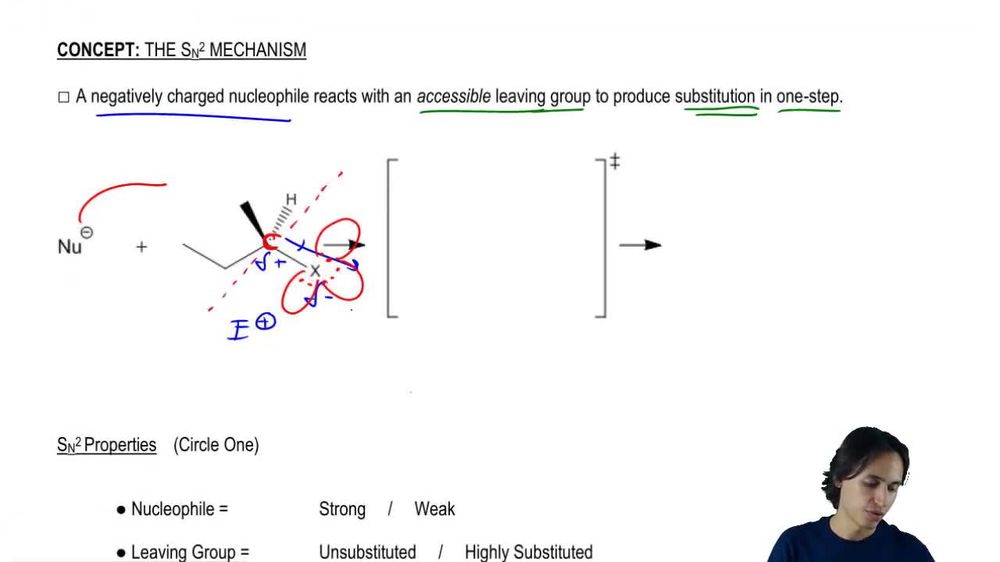
Understand the SN2 reaction mechanism: SN2 reactions are bimolecular nucleophilic substitution reactions where the rate depends on both the concentration of the nucleophile and the substrate. The reaction occurs in a single step with a backside attack by the nucleophile, leading to the inversion of configuration at the carbon center.
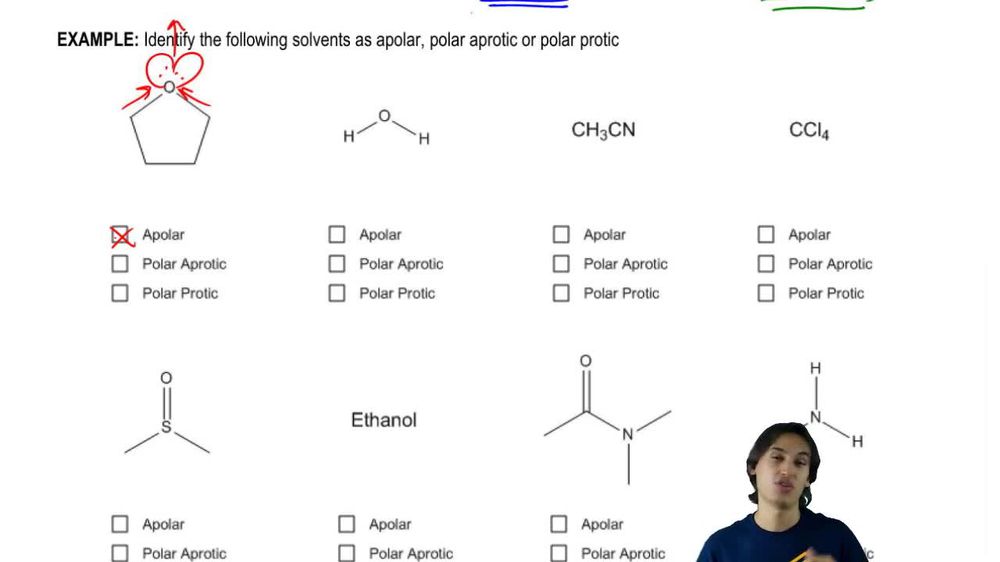
Analyze the role of the solvent: Polar solvents can be classified as protic or aprotic. Protic solvents (e.g., water, alcohols) can form hydrogen bonds and stabilize the nucleophile, reducing its nucleophilicity. Aprotic solvents (e.g., acetone, DMSO) do not stabilize the nucleophile as much, allowing it to remain more reactive.
Consider the nucleophile (NH3): Ammonia (NH3) is a neutral nucleophile. In a more polar protic solvent, the nucleophile may be stabilized through hydrogen bonding, which can decrease its reactivity and slow down the SN2 reaction rate. In a polar aprotic solvent, the nucleophile remains more reactive, potentially increasing the reaction rate.
Evaluate the substrate (CH3CH2I): Ethyl iodide (CH3CH2I) is a good substrate for SN2 reactions due to the weak C-I bond and the relatively unhindered primary carbon. The substrate's reactivity is not significantly affected by the polarity of the solvent, but the solvent's effect on the nucleophile is crucial.
Conclude the impact of a more polar solvent: If the solvent is polar protic, the rate of the SN2 reaction may decrease due to stabilization of the nucleophile. If the solvent is polar aprotic, the rate may increase as the nucleophile remains more reactive. The specific change in rate depends on the type of polar solvent used.
Verified video answer for a similar problem:
This video solution was recommended by our tutors as helpful for the problem above
Video duration:
4m
Play a video:
0 Comments
Key Concepts
Here are the essential concepts you must grasp in order to answer the question correctly.
SN2 Reaction Mechanism
The SN2 (substitution nucleophilic bimolecular) reaction is a type of nucleophilic substitution where the nucleophile attacks the electrophile simultaneously as the leaving group departs. This concerted mechanism results in a single transition state and is characterized by a second-order rate law, meaning the reaction rate depends on the concentration of both the nucleophile and the substrate.
Polar solvents have a significant dipole moment, which allows them to stabilize charged species and transition states through solvation. In SN2 reactions, a more polar solvent can stabilize the nucleophile and the leaving group, potentially increasing the reaction rate by lowering the activation energy required for the reaction to proceed.
Nucleophilicity refers to the ability of a nucleophile to donate an electron pair to an electrophile. In polar solvents, nucleophilicity can be affected due to solvation effects; strong solvation can hinder the nucleophile's reactivity. Therefore, understanding how solvent polarity influences nucleophilicity is crucial for predicting the rate of SN2 reactions.