The mechanism of the acid-catalyzed hydration of an alkene to make an alcohol is shown. If this reaction is reversible, draw a mechanism that justifies formation of the alkene from the alcohol under similar conditions. How do you know this mechanism is correct?
Verified step by step guidance
1
Step 1: Recognize that the reverse reaction involves the conversion of the alcohol back into the alkene. This is achieved through an acid-catalyzed dehydration mechanism, which is the reverse of the hydration mechanism shown in the image.
Step 2: Protonate the alcohol group using an acid (H₃O⁺). The lone pair of electrons on the oxygen atom of the alcohol will attack the hydrogen of H₃O⁺, forming a positively charged oxonium ion (R-OH₂⁺). This step increases the leaving group ability of the hydroxyl group.
Step 3: Eliminate water (H₂O) from the oxonium ion to form a carbocation intermediate. The bond between the oxygen and the carbon breaks, releasing a neutral water molecule and leaving behind a positively charged carbocation.
Step 4: Rearrange the carbocation if necessary to form the most stable carbocation (e.g., tertiary carbocation is more stable than secondary or primary). This step is crucial for regioselectivity in the reaction.
Step 5: Deprotonate the carbocation to form the alkene. A base (such as water or another molecule) will abstract a proton from a β-hydrogen adjacent to the carbocation, resulting in the formation of a double bond and regenerating the acid catalyst (H₃O⁺).
Verified video answer for a similar problem:
This video solution was recommended by our tutors as helpful for the problem above
Play a video:
0 Comments
Key Concepts
Here are the essential concepts you must grasp in order to answer the question correctly.
Acid-Catalyzed Hydration
Acid-catalyzed hydration is a reaction where an alkene reacts with water in the presence of an acid to form an alcohol. The acid donates a proton to the alkene, creating a carbocation intermediate, which is then attacked by water. This mechanism is crucial for understanding how alkenes can be converted to alcohols and vice versa.
Many organic reactions, including acid-catalyzed hydration, are reversible. This means that the products can revert to the original reactants under certain conditions. Understanding the equilibrium between the alcohol and alkene is essential for drawing the reverse mechanism, which involves the removal of water and the reformation of the alkene.
Mechanistic justification involves providing a detailed step-by-step explanation of how reactants are converted into products. In the context of the reverse reaction, this includes showing how the alcohol loses a water molecule to regenerate the alkene. This justification is supported by the stability of intermediates and the energy changes throughout the reaction pathway.


 Verified step by step guidance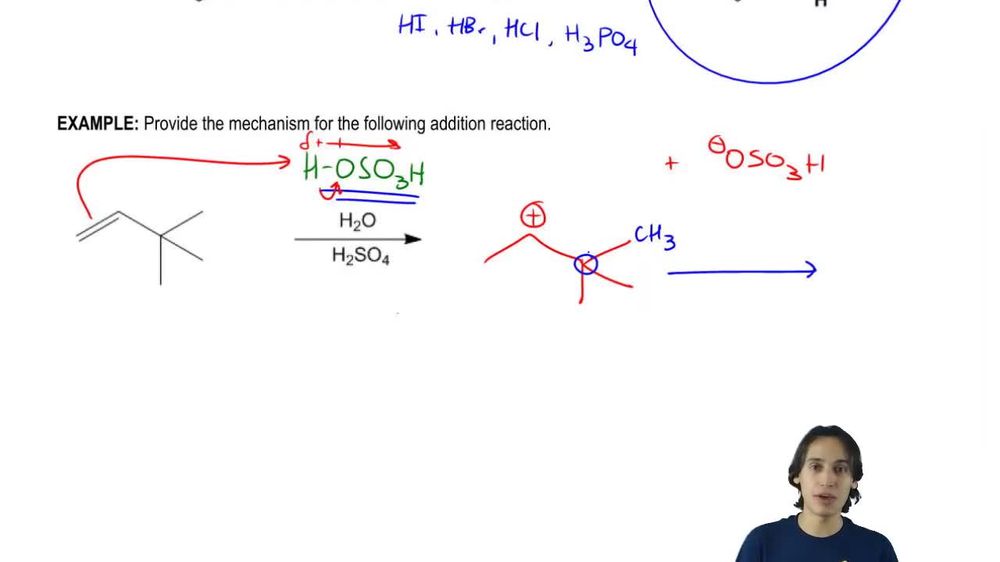
 06:34
06:34