A small amount of another organic product is formed in a Williamson ether synthesis. What is this product when the alkyl halide used in the synthesis of butyl propyl ether is a. propyl bromide?
Verified step by step guidance
1
Step 1: Understand the Williamson ether synthesis mechanism. This reaction involves the nucleophilic substitution of an alkoxide ion (RO⁻) with an alkyl halide (R'X) to form an ether (ROR'). However, side reactions can occur depending on the reactivity of the alkyl halide and the alkoxide ion.
Step 2: Identify the alkyl halide used in the synthesis. In this case, the alkyl halide is propyl bromide (C₃H₇Br). The alkoxide ion used is butoxide (C₄H₉O⁻), as the target ether is butyl propyl ether (C₄H₉OC₃H₇).
Step 3: Consider the possibility of elimination reactions. Alkyl halides, especially primary ones like propyl bromide, can undergo elimination (E2 mechanism) in the presence of a strong base such as butoxide. This leads to the formation of an alkene as a side product.
Step 4: Predict the elimination product. In the case of propyl bromide, elimination would result in the formation of propene (C₃H₆), as the β-hydrogen is abstracted by the base, and the bromide ion leaves.
Step 5: Summarize the side product formation. While the main product of the Williamson ether synthesis is butyl propyl ether, the side product formed due to elimination is propene (C₃H₆). This occurs because the strong base (butoxide) can promote elimination alongside the substitution reaction.
Verified video answer for a similar problem:
This video solution was recommended by our tutors as helpful for the problem above
Video duration:
3m
Play a video:
0 Comments
Key Concepts
Here are the essential concepts you must grasp in order to answer the question correctly.
Williamson Ether Synthesis
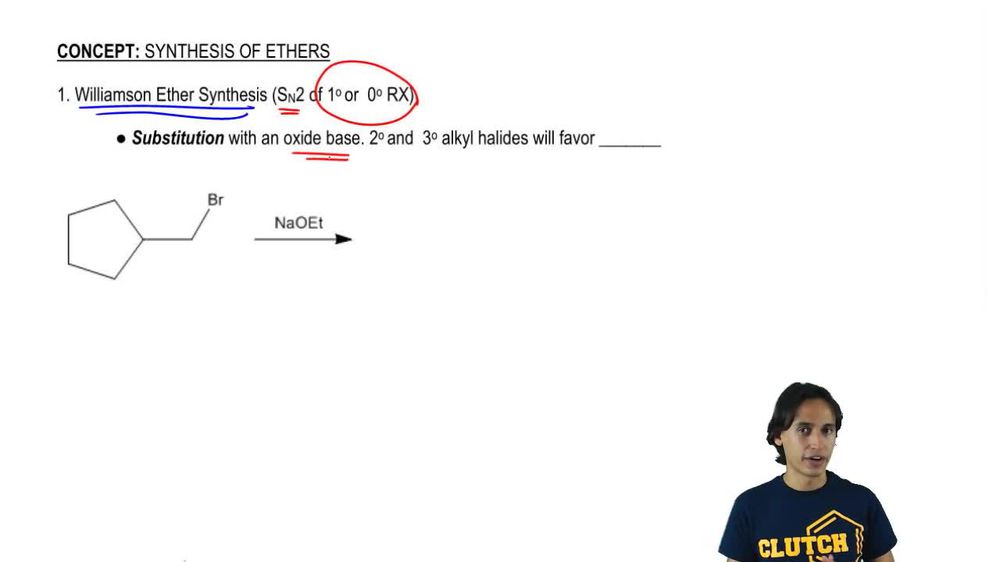
The Williamson ether synthesis is a method for producing ethers through the reaction of an alkoxide ion with a primary alkyl halide. This reaction typically involves nucleophilic substitution, where the alkoxide acts as a nucleophile, attacking the electrophilic carbon of the alkyl halide, leading to the formation of an ether and the release of a halide ion.
Alkyl halides are organic compounds containing a carbon atom bonded to a halogen atom (such as chlorine, bromine, or iodine). In the context of the Williamson ether synthesis, the choice of alkyl halide is crucial, as primary alkyl halides favor the desired nucleophilic substitution reaction, while secondary or tertiary halides may lead to elimination reactions instead.
In organic reactions, side products are unintended products formed alongside the desired product. In the case of Williamson ether synthesis, when using propyl bromide, a common side product is the formation of propyl alcohol, which can occur due to competing reactions such as hydrolysis of the alkyl halide or rearrangement, highlighting the importance of reaction conditions in determining product distribution.

 3:35 minutes
 Verified step by step guidance
 03:50
03:50