Draw the elimination products that are formed when 3-bromo-3-methyl-1-butene reacts with b. CH3OH
Verified step by step guidance
1
Step 1: Identify the type of reaction. The given reaction involves 3-bromo-3-methyl-1-butene reacting with CH3OH, which suggests a nucleophilic substitution or elimination reaction. Since CH3OH is a weak nucleophile and base, the reaction is likely to proceed via an elimination mechanism (E1).
Step 2: Analyze the structure of the substrate. The substrate, 3-bromo-3-methyl-1-butene, contains a bromine atom attached to a tertiary carbon. Tertiary carbons are highly favorable for E1 reactions due to the stability of the carbocation intermediate formed after the loss of the leaving group (Br⁻).
Step 3: Determine the first step of the E1 mechanism. The bromine atom leaves, forming a tertiary carbocation at the 3rd carbon. This step is the rate-determining step and results in a positively charged intermediate.
Step 4: Consider the elimination step. A proton (H⁺) is removed from a β-carbon (adjacent to the carbocation) by the weak base (CH3OH). The elimination of H⁺ leads to the formation of a double bond. Since the substrate already contains a double bond, the elimination will extend conjugation or form a new double bond in the molecule.
Step 5: Predict the product. The elimination will result in the formation of an alkene product. The most stable alkene product will be formed, considering factors such as conjugation and hyperconjugation. The product will likely be a conjugated diene due to the stability provided by conjugation.
Verified video answer for a similar problem:
This video solution was recommended by our tutors as helpful for the problem above
Video duration:
3m
Play a video:
0 Comments
Key Concepts
Here are the essential concepts you must grasp in order to answer the question correctly.
Elimination Reactions
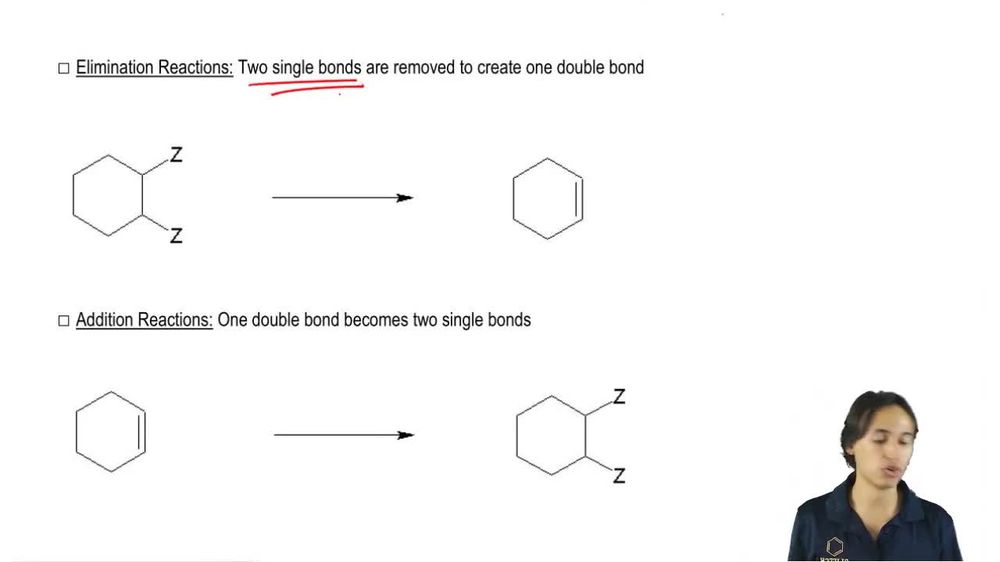
Elimination reactions involve the removal of atoms or groups from a molecule, resulting in the formation of a double bond or a ring structure. In this context, the reaction of 3-bromo-3-methyl-1-butene with CH3OH can lead to the elimination of HBr, forming an alkene. Understanding the mechanism of elimination, such as E2 or E1 pathways, is crucial for predicting the products.
Nucleophilic substitution is a fundamental reaction in organic chemistry where a nucleophile replaces a leaving group in a molecule. In this case, CH3OH acts as a nucleophile that can attack the carbon atom bonded to the bromine in 3-bromo-3-methyl-1-butene. Recognizing the conditions under which substitution occurs versus elimination is essential for determining the major products of the reaction.
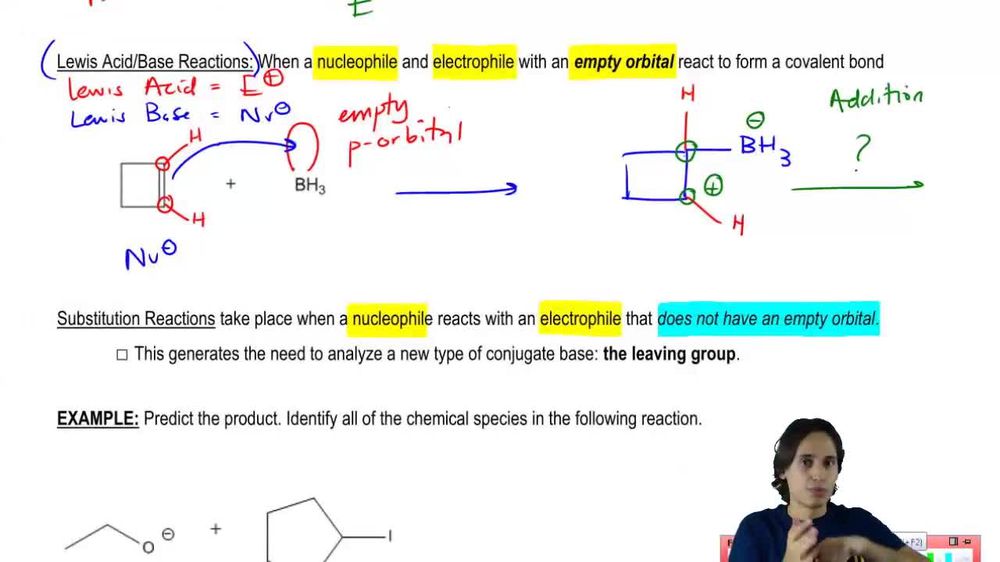
Nucleophiles and Electrophiles can react in Substitution Reactions.
Regioselectivity and Stereochemistry
Regioselectivity refers to the preference of a chemical reaction to yield one structural isomer over others, while stereochemistry involves the spatial arrangement of atoms in molecules. In the reaction of 3-bromo-3-methyl-1-butene with CH3OH, understanding which carbon atoms are involved in the elimination and substitution processes helps predict the regio- and stereochemical outcomes of the products formed.

 3:56 minutes
 Verified step by step guidance
 00:40
00:40