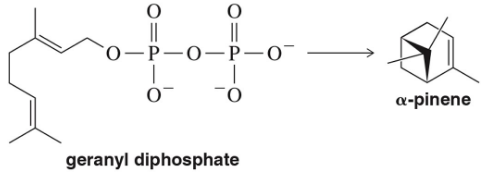
α-Pinene is a terpene found in pine trees. Starting from geranyl diphosphate (a terpene), draw the arrow-pushing mechanism to produce α-pinene. Assume that an enzyme active site will provide whatever acids and bases you might need.
Verified step by step guidance
1
Identify the starting material, geranyl diphosphate, which contains a diphosphate group attached to a 10-carbon terpene backbone. The diphosphate group is a good leaving group, making this molecule primed for a reaction.
Recognize that the reaction involves the formation of α-pinene, a bicyclic terpene. This suggests that the mechanism will involve cyclization and rearrangement steps.
The first step is the ionization of the diphosphate group. The enzyme active site provides an acidic environment to protonate the diphosphate group, facilitating its departure and generating a carbocation at the allylic position.
The carbocation undergoes a cyclization reaction. The double bond in the terpene backbone attacks the carbocation, forming a six-membered ring intermediate. This step involves arrow-pushing to show the movement of electrons from the double bond to the carbocation.
A second cyclization occurs to form the bicyclic structure of α-pinene. The remaining double bond attacks the newly formed carbocation, creating the bicyclic framework. Finally, deprotonation by a base in the enzyme active site stabilizes the structure, yielding α-pinene.
Verified video answer for a similar problem:
This video solution was recommended by our tutors as helpful for the problem above
Video duration:
7m
Play a video:
0 Comments
Key Concepts
Here are the essential concepts you must grasp in order to answer the question correctly.
Terpenes and Their Biosynthesis
Terpenes are a large and diverse class of organic compounds produced by various plants, particularly conifers. They are synthesized from isoprene units, and their biosynthesis often involves the conversion of geranyl diphosphate (GPP) into more complex structures. Understanding the basic structure and function of terpenes is essential for grasping how α-pinene is formed from GPP.
The arrow-pushing mechanism is a method used in organic chemistry to illustrate the movement of electrons during chemical reactions. It involves using arrows to show the flow of electron pairs, indicating bond formation and breaking. This technique is crucial for visualizing the steps involved in the conversion of geranyl diphosphate to α-pinene, including any intermediates and transition states.
Enzymes are biological catalysts that speed up chemical reactions by lowering the activation energy required for the reaction to proceed. In the context of terpene biosynthesis, enzymes facilitate the conversion of substrates like geranyl diphosphate into products such as α-pinene. Understanding enzyme mechanisms, including the role of acids and bases in the active site, is vital for accurately depicting the reaction pathway.