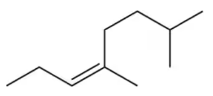
Predict the products you would get when the following alkenes react under the following conditions: (i) H2SO4, H2O and (ii) 1. Hg(OAc)2, H2O , 2. NaBH4 (c)
Verified step by step guidance
1
Step 1: Analyze the structure of the given alkene. The molecule contains a double bond in the middle of the chain, which is the reactive site for the addition reactions.
Step 2: For condition (i) H2SO4 and H2O, this is an acid-catalyzed hydration reaction. The double bond will react with H2SO4 to form a carbocation intermediate. The more stable carbocation will form due to Markovnikov's rule, where the hydrogen adds to the less substituted carbon of the double bond.
Step 3: After the carbocation forms, water will attack the carbocation, leading to the formation of an alcohol. The hydroxyl group (-OH) will attach to the more substituted carbon of the original double bond.
Step 4: For condition (ii) 1. Hg(OAc)2, H2O and 2. NaBH4, this is an oxymercuration-demercuration reaction. The double bond reacts with Hg(OAc)2 and H2O to form a mercurinium ion intermediate. Water then attacks the more substituted carbon, following Markovnikov's rule, leading to the addition of a hydroxyl group (-OH) to the more substituted carbon.
Step 5: In the second step of condition (ii), NaBH4 reduces the mercury-containing intermediate, replacing the mercury group with a hydrogen atom. This results in the formation of an alcohol at the more substituted carbon of the original double bond.
Verified video answer for a similar problem:
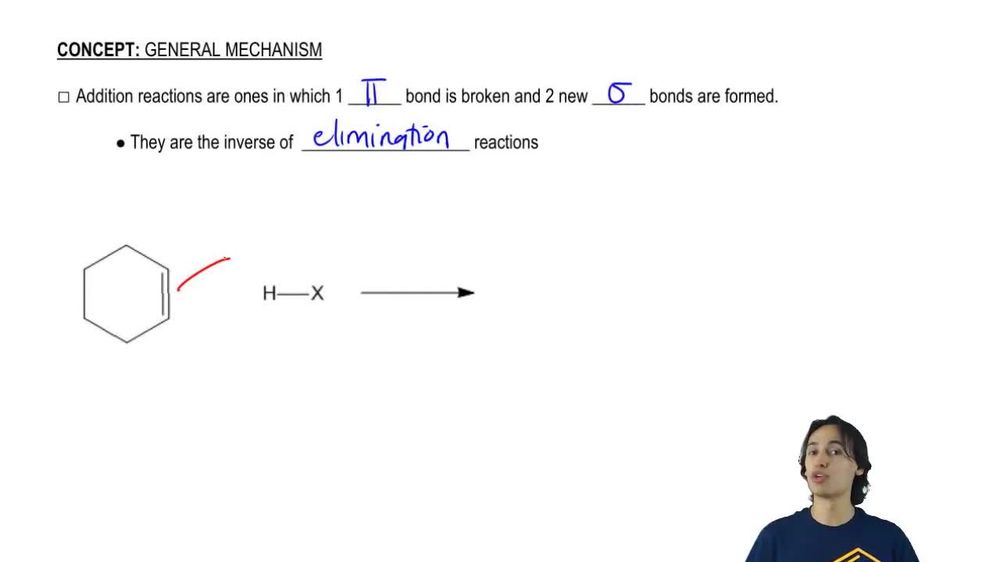
This video solution was recommended by our tutors as helpful for the problem above
Video duration:
1m
Play a video:
0 Comments
Key Concepts
Here are the essential concepts you must grasp in order to answer the question correctly.
Electrophilic Addition Reactions
Electrophilic addition reactions are a fundamental type of reaction for alkenes, where an electrophile reacts with the double bond, leading to the formation of a more stable carbocation intermediate. This process is crucial for understanding how alkenes can be transformed into alcohols or other functional groups through the addition of reagents like sulfuric acid or mercuric acetate.
Markovnikov's Rule states that in the addition of HX to an alkene, the hydrogen atom will attach to the carbon with the greater number of hydrogen atoms already attached, while the halide (or other group) will attach to the carbon with fewer hydrogen atoms. This principle helps predict the regioselectivity of the products formed during the reactions of alkenes with acids and other electrophiles.
Hydration of alkenes involves the addition of water across the double bond, typically facilitated by an acid catalyst like H₂SO₄. This reaction can lead to the formation of alcohols, and understanding the mechanism, including carbocation rearrangements and the role of the acid, is essential for predicting the final products of the reaction.