Ch. 11 - Organometallic Compounds
Bruice - Organic Chemistry 8th Edition
Bruice8th EditionOrganic ChemistryISBN: 9780135213711Not the one you use?Change textbook
Chapter 12, Problem 31d

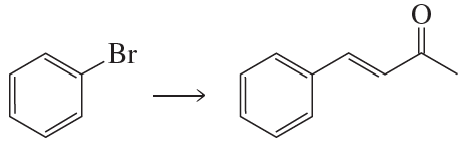
Using the given starting material, any necessary inorganic reagents and catalysts, and any carbon-containing compounds with no more than three carbons, indicate how each of the following compounds can be prepared:
d. Chemical reaction diagram showing the conversion of a bromobenzene compound to a carbonyl-containing product.

Verified step by step guidance
1
Step 1: Analyze the target molecule and starting material. The starting material is benzene with a methyl group (toluene), and the target molecule is a styrene derivative with a cyclohexyl group attached to the double bond. This suggests a sequence involving alkylation and elimination reactions.
Step 2: Perform a Friedel-Crafts alkylation on toluene using cyclohexyl chloride (C6H11Cl) and a Lewis acid catalyst such as AlCl3. This will introduce the cyclohexyl group onto the benzene ring, forming cyclohexylmethylbenzene.
Step 3: Oxidize the methyl group on the benzene ring to a benzylic alcohol using an oxidizing agent like KMnO4 or CrO3 under controlled conditions.
Step 4: Dehydrate the benzylic alcohol to form the styrene derivative. This can be achieved using an acid catalyst such as H2SO4 or H3PO4 to promote the elimination reaction, forming the double bond.
Step 5: Verify the structure of the final product to ensure it matches the target molecule, ensuring the double bond is in the correct position and the cyclohexyl group is attached appropriately.

Verified video answer for a similar problem:

This video solution was recommended by our tutors as helpful for the problem above.
Video duration:
4m
Was this helpful?

Key Concepts

Here are the essential concepts you must grasp in order to answer the question correctly.

Heck Reaction

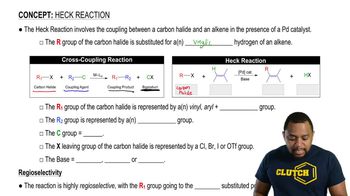
The Heck reaction is a palladium-catalyzed coupling reaction between an aryl or vinyl halide and an alkene, resulting in the formation of substituted alkenes. This reaction is significant in organic synthesis for constructing complex molecules and is widely used in the pharmaceutical and materials industries. The reaction typically requires a base and can be performed under mild conditions, making it a versatile tool for chemists.
Recommended video:
Guided course
05:09
Heck Reaction

Catalysts in Organic Reactions

Catalysts are substances that increase the rate of a chemical reaction without being consumed in the process. In organic chemistry, catalysts such as transition metals (e.g., palladium in the Heck reaction) facilitate the formation and breaking of chemical bonds, allowing reactions to proceed more efficiently. Understanding the role of catalysts is crucial for optimizing reaction conditions and yields in synthetic pathways.
Recommended video:
1:22
Introduction to Catalysis Example 1

Reagents and Reaction Conditions

Reagents are the starting materials used in a chemical reaction, while reaction conditions refer to the specific environment in which the reaction occurs, including temperature, pressure, and solvent. In the context of the Heck reaction, selecting appropriate reagents (like alkene and halide) and optimizing reaction conditions (such as base and temperature) are essential for achieving the desired product efficiently and selectively.
Recommended video: