Propose a mechanism for each reaction, showing explicitly how the observed mixtures of products are formed. c. cyclopenta-1,3-diene + Br2 → 3,4-dibromocyclopent-1-ene + 3,5-dibromocyclopent-1-ene
Verified step by step guidance
1
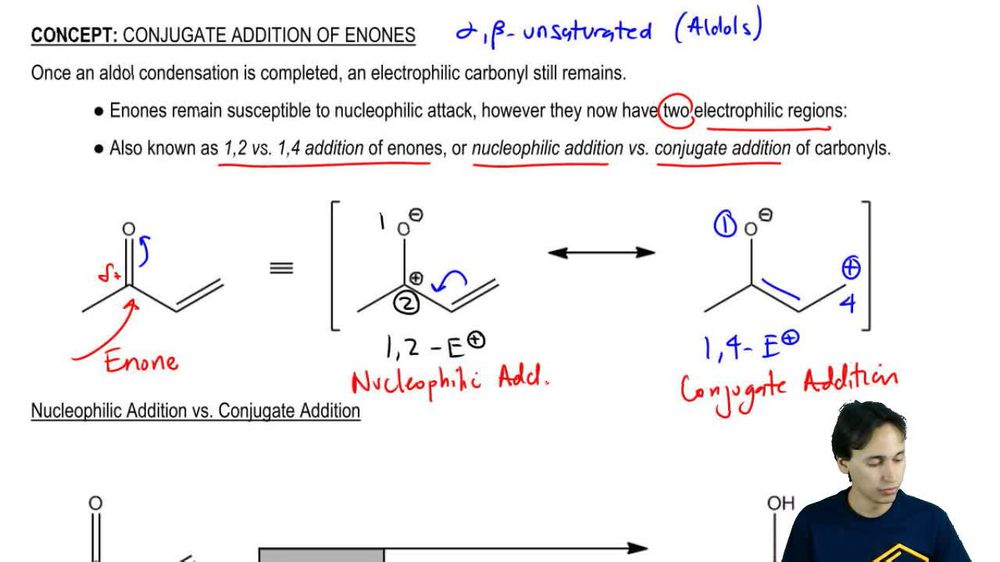
Identify the type of reaction: This reaction involves the addition of bromine (Br₂) to cyclopenta-1,3-diene, which is a conjugated diene. The reaction proceeds via an electrophilic addition mechanism, and the observed products suggest that both 1,2- and 1,4-addition occur.
Step 1: Activation of bromine molecule: The bromine molecule (Br₂) becomes polarized as it approaches the electron-rich π-system of cyclopenta-1,3-diene. This polarization creates a partial positive charge on one bromine atom, making it electrophilic.
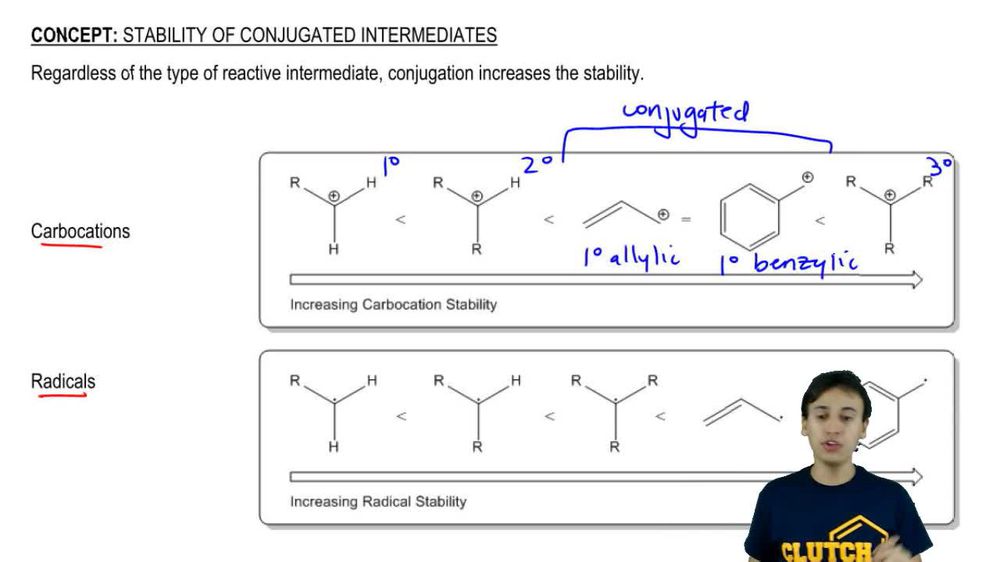
Step 2: Formation of the bromonium ion intermediate: The π-electrons of one of the double bonds in cyclopenta-1,3-diene attack the electrophilic bromine atom, leading to the formation of a cyclic bromonium ion intermediate. This intermediate is stabilized by the conjugated system of the diene.
Step 3: Nucleophilic attack by bromide ion: The bromide ion (Br⁻), generated in the previous step, acts as a nucleophile and attacks the bromonium ion. Depending on the site of attack, two possible products can form: (a) 1,2-addition product (3,4-dibromocyclopent-1-ene) or (b) 1,4-addition product (3,5-dibromocyclopent-1-ene).
Step 4: Analyze the product distribution: The observed mixture of products arises because the bromide ion can attack at different positions of the bromonium ion intermediate. The relative stability of the products and the reaction conditions (e.g., temperature) influence the ratio of 1,2- and 1,4-addition products.
Verified video answer for a similar problem:
This video solution was recommended by our tutors as helpful for the problem above
Video duration:
2m
Play a video:
0 Comments
Key Concepts
Here are the essential concepts you must grasp in order to answer the question correctly.
Electrophilic Addition Reactions
Electrophilic addition reactions involve the addition of an electrophile to a nucleophile, typically across a double bond. In the case of cyclopenta-1,3-diene reacting with Br2, the diene acts as a nucleophile, attacking the bromine molecule, which is an electrophile. This process leads to the formation of a cyclic bromonium ion intermediate, which is crucial for understanding the subsequent product formation.
The stability of reaction intermediates, such as carbocations or bromonium ions, significantly influences the outcome of organic reactions. In this reaction, the formation of a bromonium ion allows for the rearrangement and stabilization of the intermediate, leading to different product distributions. The stability of these intermediates can dictate the regioselectivity of the final products, such as 3,4-dibromocyclopent-1-ene and 3,5-dibromocyclopent-1-ene.
Regioselectivity refers to the preference of a chemical reaction to yield one structural isomer over others. In the reaction of cyclopenta-1,3-diene with Br2, the formation of two different dibrominated products arises from the regioselective attack of the bromide ion on the bromonium ion intermediate. Understanding the factors that influence regioselectivity, such as sterics and electronic effects, is essential for predicting the product distribution in this reaction.

 2:28 minutes
 Verified step by step guidance
 05:39
05:39