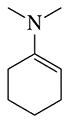
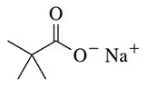
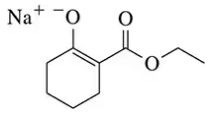
Would you expect the following nucleophiles to do 1,2- or 1,4-addition? (d) (e) (f)
Verified step by step guidance
1
Identify the type of nucleophile in each image. The first image shows a nitrogen-based nucleophile, the second image shows an oxygen-based nucleophile with a sodium counterion, and the third image shows a sodium enolate nucleophile.
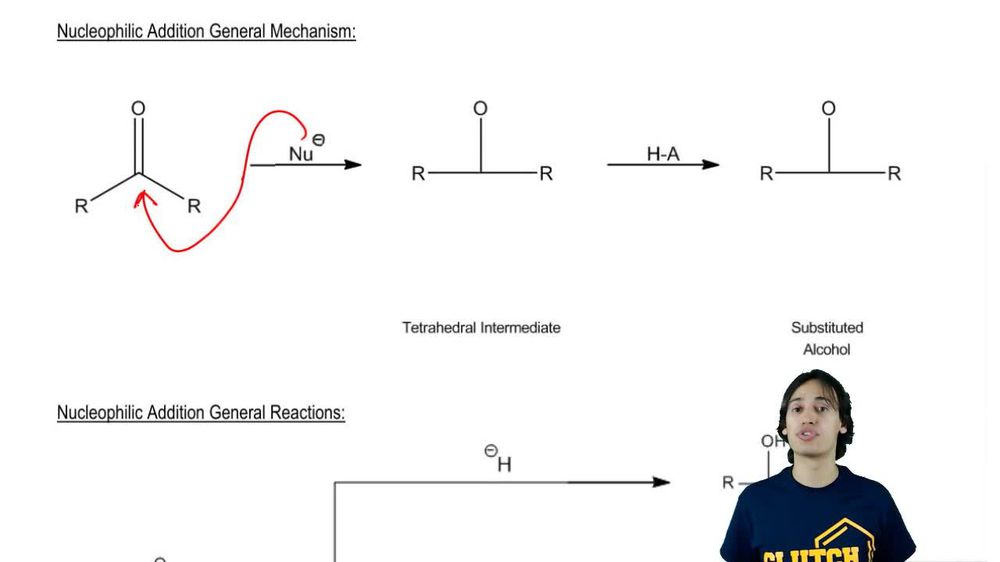
Understand the concept of 1,2- and 1,4-addition. 1,2-addition involves the nucleophile attacking the carbonyl carbon directly, while 1,4-addition involves the nucleophile attacking the beta carbon in conjugated systems.
Consider the electronic and steric factors. Nitrogen-based nucleophiles are typically more reactive and may favor 1,2-addition due to their ability to attack the carbonyl carbon directly. Oxygen-based nucleophiles, especially enolates, can stabilize through resonance and may favor 1,4-addition.
Analyze the structure of the nucleophiles. The first nucleophile is a tertiary amine, which is less likely to stabilize through resonance and may favor direct attack (1,2-addition). The second nucleophile is a carboxylate ion, which can stabilize through resonance and may favor 1,4-addition. The third nucleophile is an enolate, which is known for 1,4-addition due to resonance stabilization.
Consider the reaction conditions. If the reaction conditions favor kinetic control, 1,2-addition is more likely. If the conditions favor thermodynamic control, 1,4-addition is more likely. This can be influenced by temperature, solvent, and the presence of catalysts.
Verified video answer for a similar problem:
This video solution was recommended by our tutors as helpful for the problem above
Video duration:
8m
Play a video:
0 Comments
Key Concepts
Here are the essential concepts you must grasp in order to answer the question correctly.
Nucleophilicity
Nucleophilicity refers to the ability of a species to donate an electron pair to an electrophile, forming a chemical bond. Strong nucleophiles are typically negatively charged or have lone pairs of electrons, making them more reactive. Understanding the strength and nature of nucleophiles is crucial for predicting the type of addition reaction they will undergo, such as 1,2- or 1,4-addition.
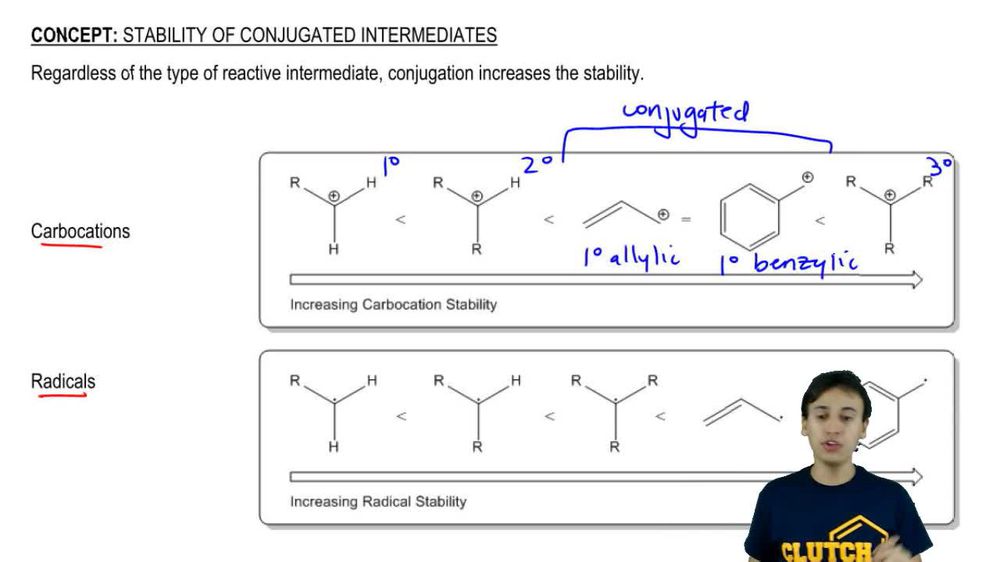
1,2- and 1,4-addition reactions describe how nucleophiles add to conjugated systems, such as α,β-unsaturated carbonyl compounds. In 1,2-addition, the nucleophile attacks the carbonyl carbon, while in 1,4-addition, it attacks the β-carbon. The preference for one pathway over the other often depends on the stability of the intermediates and the nature of the nucleophile involved.
The stability of reaction intermediates plays a significant role in determining the pathway of nucleophilic addition. More stable intermediates, such as resonance-stabilized carbocations, favor certain addition modes. For example, if a nucleophile can stabilize a positive charge through resonance, it may lead to a preference for 1,4-addition, while less stable intermediates may favor 1,2-addition.