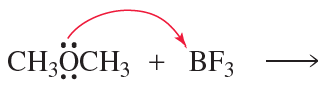
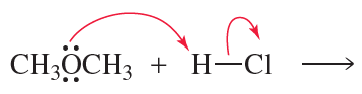
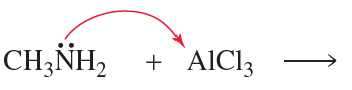
Draw the products of the following reactions: a. b. c.
Verified step by step guidance
1
Step 1: Analyze the reaction in part (a). The reactants are CH₃CH₂OCH₃ (an ether) and BH₃ (borane). Borane is an electron-deficient species due to the incomplete octet of boron, making it a Lewis acid. The lone pair of electrons on the oxygen atom in the ether can act as a Lewis base and donate electrons to boron.
Step 2: Predict the product for part (a). The oxygen atom in CH₃CH₂OCH₃ will form a coordinate covalent bond with boron in BH₃. This results in the formation of a Lewis acid-base adduct. The structure of the product will show the oxygen atom bonded to boron, with boron completing its octet.
Step 3: Analyze the reaction in part (b). The reactants are CH₃CH₂NH₂ (an amine) and AlF₃ (aluminum trifluoride). Aluminum in AlF₃ is electron-deficient due to its incomplete octet, making it a Lewis acid. The lone pair of electrons on the nitrogen atom in the amine can act as a Lewis base and donate electrons to aluminum.
Step 4: Predict the product for part (b). The nitrogen atom in CH₃CH₂NH₂ will form a coordinate covalent bond with aluminum in AlF₃. This results in the formation of a Lewis acid-base adduct. The structure of the product will show the nitrogen atom bonded to aluminum, with aluminum completing its octet.
Step 5: For both reactions, ensure that the products are drawn with proper chemical structures, showing the new bonds formed between the Lewis base (oxygen or nitrogen) and the Lewis acid (boron or aluminum). Include any lone pairs and formal charges if applicable.
Verified video answer for a similar problem:
This video solution was recommended by our tutors as helpful for the problem above
Video duration:
4m
Play a video:
0 Comments
Key Concepts
Here are the essential concepts you must grasp in order to answer the question correctly.
Lewis Acids and Bases
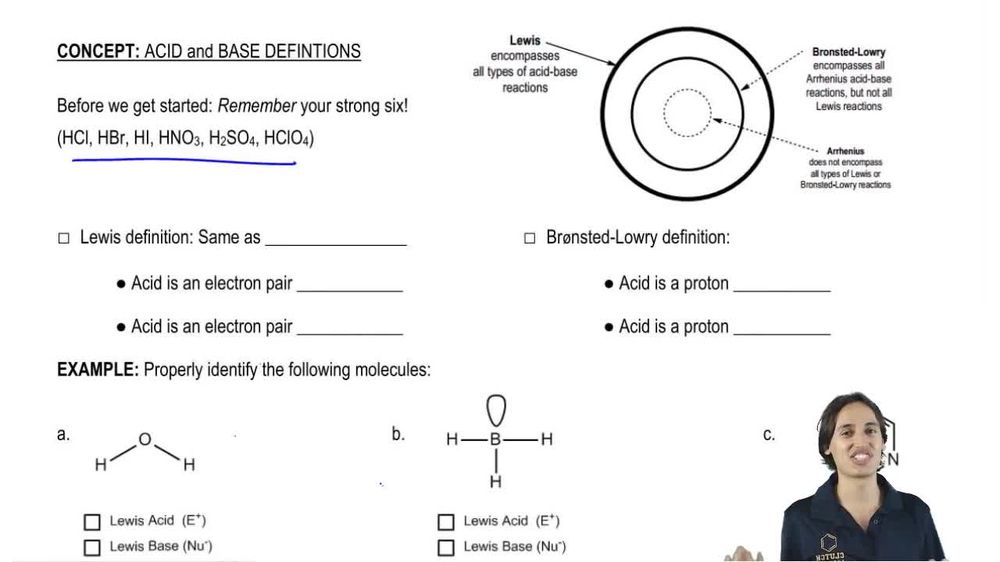
Lewis acids are electron pair acceptors, while Lewis bases are electron pair donors. In the reactions shown, BH3 acts as a Lewis acid, accepting electron pairs from the ether (CH3CH2OCH3), and AlF3 acts as a Lewis acid, interacting with the amine (CH3CH2NH2). Understanding these definitions is crucial for predicting the products of these reactions.
Nucleophilic attack occurs when a nucleophile (an electron-rich species) donates an electron pair to an electrophile (an electron-deficient species). In the first reaction, the ether oxygen donates a pair of electrons to BH3, forming a new bond. Recognizing the nucleophile and electrophile in a reaction helps in determining the products formed.
Understanding reaction mechanisms involves knowing the step-by-step process by which reactants transform into products. This includes identifying intermediates and transition states. In the provided reactions, recognizing how the Lewis acids interact with the bases and the resulting bond formations is essential for accurately drawing the products.